
Was I marriage material, I wondered as I dipped into the thousands of matrimonial ads in the complimentary Times of India provided on my red-eye flight into Delhi. The parents of one sterling-sounding chap extolled his virtues thus in the "wanted brides" column: "handsome and tall, 29, an MBA from a top US college, working with a fortune 500 company, coming from a top-drawer westernised family". This young man knew - or, rather, his parents knew - exactly what he wanted: "A confident girl of some beauty with an infectious laugh and happy demeanour capable of holding her own both abroad and in the prestigious clubs in Delhi." It was with relief that I discovered the ads tucked-away in the "handicapped" column, with their straightforward pathos. One girl was a "convent-educated B.Com Hons", which would stand her in good stead, just as her "slight facial deformity" would not.
Sadly, it was a high concentration of exhaust fumes rather than human loveliness that struck me when we arrived in the capital. The pollution, caused mainly by the rickety old two-stroke motor-rickshaws that crowd every Indian city, is apparently not as bad as it was. That is frightening because it is still very palpable as greasy brown smog that soon stings the eyes and rasps at the throat.
Actually getting around by rickshaw also seems, at first, potentially bad for the health. I spent much of my first ride in Delhi squawking with fear and then clenching my eyes shut as the little vehicle seemingly just avoided one terrible collision after another. I came to realise that my attitude was wrong and that the only way to treat a rickshaw journey was like a funfair ride and revel in the risk.
Delhi's immensity, its density, its somehow ordered chaos make it compelling but, like a party that is beginning to get manic, also nice to leave. The first stops on our tour were, as if we were pilgrims, two of the holiest towns in India: Haridwar and then Rishikesh. I almost decided to stay put at the Gayatri Pariwar ashram, on the outskirts of Haridwar. With a capacity of 7,000 guests this religious retreat could qualify as a town in its own right. Its theme is ecumenical, the unity of all religions, and people from throughout the world, including westerners, come to stay here. The ashram's emphasis on nondenominational contemplation of the meaning of it all felt powerfully attractive, even with the shockingly early rises. Perhaps the religiosity that is as thick in India's air as the smell of spice had begun to penetrate my skin.
We reached Rishikesh by boat along the Ganges, with some white-water rafting along the way. This had struck me as one of those activities, along with mountain climbing and skydiving, that could usefully be gathered under the "why bother" category. But I undeniably found it exhilarating and immediately wanted to graduate to something more hardcore.
Rishikesh is where the Beatles got turned on to eastern wisdom and where young Israelis now sojourn to grow their hair and smoke dope after three years' obligatory scrapping in the occupied territories. The Hebrew on all the restaurant menus is incongruous enough but nowhere nearly as weird as my glimpse through the thick Indian jungle of a Hassidic rabbi in full regalia conducting a service before a ritually nodding congregation. Nestled in a discrete turn of the Ganges and backed by steep green hills, Rishikesh's setting is idyllic and only slightly marred by the white-elephant hotel constructions illegally built too close to the river and now slowly sliding into it.
It is all very well going to India and enjoying its diversions or getting all spiritual but sooner or later any sentient being will realise that most Indians are incredibly poor. Scenes of dystopian deprivation and blight are everywhere. I remember beggars twisted into inhuman shapes lying in the baking sun outside the enormous Jama Masjid mosque in Delhi, one hand out and emitting an endless, sedative ululation of "Allah, Allah". In Agra, the city containing the Taj Mahal, a pack of feral hogs fed off a great smoking pile of garbage just off the main street as if in some Dantean vision of hell.
It is with India's poverty in mind that Make a Difference (MAD) Adventures, the company whose Northern Extreme journey I was on, donates 10% of each client's payment to a local development project; hence its name. The donation might also serve as an acknowledgement that MAD Adventures and like outfits conducting tours in poor countries owe their existence to the huge price differential between the latter and the west. (How's 20p for roadside shoe repair compared to £20 in the UK? Or £1 for the average meal?)
On this north Indian trip MAD puts the 10% cut into a fund for the embattled Gujjar tribal people. The Gujjar live in and around the Corbett national park and tiger reserve in the state of Uttar Pradesh. In a conservation irony, their traditional, roaming buffalo grazing is deemed by Corbett's management to threaten the park's precious flora and fauna. MAD's clients' money will help to buy land for the Gujjar with the aim of weaning them from their peripatetic existence. Whether they are entirely happy with such an arrangement is a moot point.
You could always ask them. A highlight of the trip, for me, was the visit to one of the tribal villages. The life of the Gujjar, who are Muslim, has in many ways not changed for centuries. They build their beautifully simple houses, painted with sparse floral designs, from the mud and thatch of the surrounding forest. They are vegetarian, their staples being potato and various products - cheese, butter and ghee - derived from buffalo milk. These they cook in stone and iron hearths set in the earthen floor of their dwellings; we sat down to one such simple meal in the evening, the interior of the hut illuminated only by the fire and a single oil lamp. Westerners romanticise subsistence living at the drop of a hat, but the Gujjar seemed to me unencumbered by things rather than deprived of them.
A grinning gaggle of children had surrounded us as soon as we walked into the village; they were so photogenic, with their pond-like brown eyes and chocolaty skin, I thought of calling Benetton's ad men there and then and surely securing myself a fat spotter's fee. The adults beckoned us into their houses to observe their families going about their evening routines. In one, a grandmother read from an ancient-looking Koran to several generations of her relatives. They rested on scattered beds in a big common room in which they would also all sleep.
To the consternation of the park authorities, some Gujjar men had recently killed a leopard that they said had menaced children in the village. Apparently leopards love dogs - no, not the way the English do - and will attack crawling toddlers by mistake. Along with elephants and tigers, leopards were some of the animals we hoped to see when we mounted the accommodating cow elephant Lakshmi for a safari through the jungle.
As we swayed through the vegetation at about mid-tree height, we saw a lot of Langur monkeys, several barking deer (an animal with an apparent evolutionary identity crisis) and even the odd greater Indian hornbill, but nothing feline and growling. I thought my bare, white leg, dangling down the elephant's flank, might have looked a tempting morsel and tried to display it to its best advantage, but all it succeeded in attracting was a swarm of mosquitoes.
Later, fearing malaria, I sipped a prophylactic G&T on the balcony of my room in Corbett lodge (named, like the park, after Jim Corbett, a famous tiger-hunter turned conservationist). This was pleasant accommodation; it lacked the veneer of grime, protruding wires and recalcitrant plumbing that were beginning to appear like Indian hotel standards. There was no fruit bowl in the room but nor was there a complimentary greasy black hair draped over the phone handset. Each balcony had a staggered view across the large swimming pool, the Ramnager river, on whose shores the park's denizens can sometimes be spotted, the forest and, beyond that, the foothills of the Himalayas.
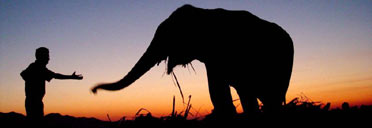
The day after the safari we followed Lakshmi the elephant to the river for her daily ablution. Descending the steep banks, her front legs shackled, she gingerly tested her weight against the ground as the keeper goaded her on. But once in the water, she lost all this tentativeness. She slowly immersed herself deeper and deeper, snorting plumes of water over her back. Finally she rolled on to her side and floated, letting the river take her full weight. Doing the same a few metres downstream from her, I felt as if we were sharing exactly the same pleasure. She released a few impressive dung balls into the current in my direction.
Defiantly off-script, Lakshmi refused to leave the water when her bathing hour was up. She ignored her keeper's cajoling chant and groaned and hooted in protest when he raised a fist-sized stone as if to throw it at her. With a shrug he retreated, and the elephant returned to contented lolling for an hour. Only when he dove into the river, crossed to the opposite bank and began to pelt Lakshmi with stones from there, did she finally emerge. The memory of her little show of rebellion, in such an ordered existence, will stay with me for a long time.
Way to go
Make a Difference Adventures (0845 1221304) runs the nine-day Northern Extreme tour approximately once a month from January to April and September to December. The standard cost is £803, which does not include flights, although MAD are currently offering 20% off the first trip of 2004, leaving January 24, at £643.
