
Saba was playing hard to get. I scoured the bush with my binoculars.Our radio equipment told us we were within 20 metres of the 21-month-old leopard but against this dappled grassland she was virtually invisible. Our Land Rover cruised slowly past umbrella acacias, a small water hole and, to the left, a vast plain the colour of lions. Then I spotted it - a giant paw dangling from the branch of a tree.
I had joined a three-day specialist leopard safari in the private game reserve of Phinda in South Africa's KwaZulu-Natal province. Owned by Conservation Corporation Africa, the 15,000 hectare reserve is involved in the area's first major leopard research study, which has been running since April 2002.
By contrast with your average safari (if there is such a thing), a specialist leopard safari allows you to single-mindedly, obsessively, follow these elusive big cats.
The reserve has an estimated leopard population of about 15 (eight tagged with radio collars), but many are under threat of being shot by farmers neighbouring Phinda, as they often stray from the safe boundaries of the reserve.
The researchers are trying to discover just how leopards operate: their territories; the kinds of vegetation and landscape they feel at home in; their hunting styles; and the population an area can comfortably support.
Leopards are among the most persecuted animals on the planet. The project aims to offer an educated and scientific basis from which to suggest changes to the current laws governing their hunting in South Africa. And it provides a brilliant opportunity to see this creature.
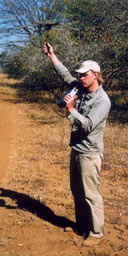
As part of the research, the eight tagged leopards must be tracked and located daily by project researcher Guy Balme and, for a couple of days, by us - Richard Anderson, a CC Africa ranger trained in the art of telemetry, and myself.
You get up fearlessly early and track the signal from an animal's radio collar. Once an animal is located, a satellite position reading is taken, along with any observations made by the guests or Richard about the type of terrain, vegetation, the kind of tree the leopard is in and what it is doing. The data is then fed directly into Balme's research, making his life a little easier.
Seeing your first leopard is a magical experience. Earlier that morning, Richard and I had gone bundu bashing - driving the Land Rover through virtually impenetrable vegetation, stopping every now and then to hack back thorny branches with a machete. Finally we'd pulled forward into a clearing and there was Chinga, a beautiful three-and-a-half-year-old female, dozing under a tree.
A 35lb female such as Chinga can bring down an antelope and drag its carcass into a tree using only its jaws. But from 15m, we saw nothing of that latent power, only the silky dappled fur, the small furry chin, the large spotted paws that occasionally twitched as she slept and the tongue that appeared now and again. She looked like a beautiful oversized domestic cat and the urge to get out and stroke her was suicidally strong. We sat for perhaps an hour, watching as she lay sleeping in the shade of a bush.
With Saba (Zulu for 'scared'), that feeling came back to me. She was 5m up in a tree, her legs dangling, belly laid along the bough. She watched us blankly for a few minutes, yawned and went back to sleep.
From this distance, if we'd been so inclined, we could have killed her with one shot from the comfort of the Land Rover. It's a sickening, but sadly not far-fetched, thought: people can still pay good money to do just that.
After perhaps half-an-hour Saba began to wake. The sun was sinking, turning the dry grass a dusky pink. She yawned several times, showing off impressive teeth, then demonstrated the explosive force that makes leopards so feared. She leapt through the tree to another branch and landed without a sound, then sauntered down the trunk and off through the long grass.
'As the sun sets she becomes more powerful,' Richard explained, 'and everything else becomes weaker. And she knows it.'
It was true. As dusk fell, Saba grew in confidence. She moved with more ease, brazenly sauntering, following scents, choosing her direction on a whim. We followed for a while before letting her slip into a thicket in search of food, then we returned to the water hole to have a beer and a snack and plan our next move.
As the sky darkened and the moon appeared with Jupiter bright and clear below it, three of its moons visible through binoculars, we decided to track Sinkwe, a male leopard named after the Zulu word for Bush Baby. He would be far more elusive than Chinga or Saba, but if we were lucky we might just catch him hunting. We entered the frequency of his collar transmitter into the telemetry equipment and headed south.
After several hours of bundu bashing in the south of the reserve we had all but given up on Sinkwe. We stood by the Land Rover eating our bush supper, sipping whisky and looking at the stars. We could hear lions nearby making their distinctive coughing noise, and the low rasp of a leopard that sounded like a blunt saw through a piece of board. The hunt was over. We started back to the lodge.
Suddenly, as we drove off, with me riding shotgun swinging the Land Rover's large spotlight from left to right, we saw him, up ahead, padding nimbly along the road. He paused, glancing back at us with a look that seemed to say, 'OK, the game's up. Here I am.' Then he turned and dissolved into the thick bush to hunt.
Factfile
A two-night leopard research safari at Phinda costs £645 per person low season (December and January, except Christmas and New Year, and April-June), £895 per person high season sharing, inclusive of accommodation at Forest Lodge and all meals. Departures by arrangement.
Rainbow Tours (020 7226 1004) offers a five-night package from London including international and domestic flights to Durban, road transfers to Phinda, five nights at Forest Lodge, including all meals, most drinks, accommodation on a shared basis, game drives, nature walks and the two-day leopard safari, from £2,075 in low season and from £2,625 in high season. Regional departures also available.
For further information contact the South Africa Tourism information and brochure request line (0870 155 0044).
