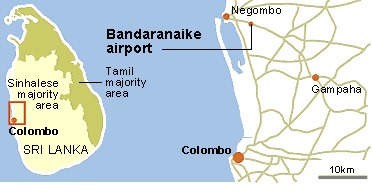
Sri Lanka's air force today bombed Tamil rebel camps, hours after a daring suicide attack on the country's international airport and a nearby air base, the defence ministry said.
Forty-seven Britons were forced to flee the airport after the rebels attacked the buildings with mortars and gunfire.
Brigadier Sanath Karunaratne, a defence ministry spokesman, said two Israel-built Kfir jets and two MiG-27s took part in the retaliatory bombing in the east.
"I am confirming that our pilots took the targets successfully," he said.
Earlier, rebel suicide bombers, armed with mortars, guns and explosives, damaged eight military and five passenger aircraft. Police said all nine guerrillas were killed. Five military personnel also died.
Huge clouds of smoke billowed over the airport after the audacious pre-dawn attack, which began at a nearby military base.
A British tourist caught up in the onslaught described the scene as "like something out of Sarajevo".
Jimmy Belleini - who was on his honeymoon with his wife and two young daughters - said that his family dodged gunfire as they tried to escape, before scrambling into a ditch with other British tourists, to shelter from the Tamil separatists.
Terrified tourists were later evacuated to hotels in Colombo, the capital.
Mr Belleini said he realised that something was happening as soon as he stepped off his coach.
"Everyone seemed a bit over-cautious - the way they were checking our bags," he told the BBC's Radio 5 Live, adding that no one told the tourists that it was a Tamil Tiger anniversary.
"We knew something was wrong when we checked in and went upstairs and looked outside and there was a plane on fire after I heard a bang.
"After that it was all bedlam. It was like I was watching a film."
Mr Belleini said the attackers were firing shots from inside the airport.
"They were up in the watchtower shooting down. It was a mortar attack. They were hiding in the bushes. There was no security at all. I couldn't see any of the airport staff," he said.
Another British tourist, Pippa Hutchings, told CNN: "I didn't know whether I was going to come out alive. You could see gunfire. It was very close by."
A Foreign Office spokeswoman said that the Britons were in two groups - one of 32 people, the other of 15 - and that the British high commission in Colombo had been in touch with both groups.
"We are advising British nationals flying in and out of Colombo to check with their tour operator or airline," she said.
Current Foreign Office advice, last updated on June 25, lists previous terrorist incidents in Sri Lanka, adding that, although Colombo has been quiet in recent months, the risk of further attacks remains.
"We believe there were two teams of terrorists," said Brig Karunaratne, adding they had used rocket-propelled grenades and small arms.
Airport officials said five civilian Airbus planes - all empty at the time - were destroyed or damaged and eight military planes could also be seen burning at the nearby airbase.
The attack on Colombo airport comes on the anniversary of riots in July 23-24 1983, in which mobs of Sri Lanka's Sinhalese majority killed between 2,000 and 3,000 of the minority Tamils. The rebels are fighting for a homeland for Sri Lanka's 3.2m Tamils, saying they face discrimination by the 14m-strong Sinhalese.
The issue explained
Civil war in Sri Lanka
Talk about it
What do you think?
Travel guidelines
Sri Lanka
Useful links
Sri Lankan government
TamilNet
Tamil Eelam
Eelam Web
More Tamil links
Daily News, Colombo
Editorials from Tamil and Sinhalese press
Sri Lanka profile
Tourist information
Sri Lanka high commission, London
