
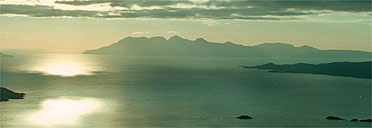
Ever seen a sheep looking noble? In the right conditions the Knoydart ewes look positively heroic. I'm sitting outside the Stone Lodge at Doune and the sun is dipping behind a stupendous, spiky frieze across the water: the Cuillin mountains of Skye. It is a sublime spring evening, the sea is hushed and even the oyster catchers sound relaxed.
My eye wanders to a headland of Doune Bay and the four-legged silhouette on its edge. It is a lone sheep, head raised, questing westwards like the figurehead on a ship. It seems transfixed; almost as if the splendour of the Hebridean seaboard has entered its woolly consciousness and held it spellbound.
I know how it feels. Early that morning I have taken myself to the same spot on the seaward extremity of the Knoydart peninsula, where the view expands to include the islands of Eigg and Rhum. Other visitors have reported a sighting of three dog otters on the shore, although the locals are less excited. 'They're round here all the time,' says Jamie Robinson, the main man at Doune Marine.
'I've seen them swim right up to the pier when I've been working on the boat.'
Typical. Otters, like fairies, tend not to appear when you're looking for them.
But start to turn away and you may find a sleek head in the corner of your eye, or catch the perfect roll of an acrobatic back as it sinks in the shallows; which is all I see after 30 minutes of scrutiny.
Still, it's enough. Knoydart is a place where the visitor measures time in small pleasures and big achievements. Getting there is a feat in itself. There are no roads into the glorious fastness called Scotland's 'last wilderness'. Unless you are fit enough to tackle 15 miles of high mountain country on foot you must take a boat from the port of Mallaig.
Committing your holiday to its desolate splendour is an act of faith. The lochside village of Inverie and the tiny community of Doune, seven miles away, are the only sources of bed and board. When Atlantic fronts close down the great outdoors you are left to your own resources.
Knoydart is not for wimps. I get three days of blameless sunshine at the end of a winter which brought 40 consecutive days of rain. 'What do your guests do when the weather is bad?' I ask Liz Tibbetts, our hostess, whose magnificent meals are part of the answer. (Guests at the communal dining table actually fails to move a mountain of langoustines, plucked out of the sea that morning). 'They read, they fish, they walk in the rain and they seem to go away happy.'
What do I do, with a ridge of high pressure at my disposal? If I were a diver I might explore the pellucid waters of the Sound of Sleat from one of Doune Marine's three charter boats; or visit the seabird colonies of the Small Isles on the 18 knot Mary Doune. Instead, I join a crabbing expedition. Jamie has pots to lift, and we all take turns to haul them from the seabed.
That night our catch of four hefty crustaceans are on the table. It's a tasty irony that this near-mythic wilderness, famous for its 'rough bounds' and bleak history of depopulation, now supports three of the best eating places on the West Highland seaboard: Doune Dining Room, where even the oatcakes and lemon curd are home-made; Inverie's Pier House, a licensed restaurant with six guest rooms; and the Old Forge at Inverie, which the Guinness archivists have recorded as 'the most remote pub on the British mainland'. Two out of the three operate seasonally. The village pub is a social service and can't be closed. There are only 70 permanent residents on the peninsula, although the number swells between April and October with second home-owners, hillwalkers and yachties.
Geographically the population lives between bliss and torment: Knoydart's saltwater frontiers are the long fissures of Loch Nevis and Loch Hourn, whose Gaelic names mean Heaven and Hell.
Sunday morning. I've walked over the hill from Doune and it's paradise indeed beside Loch Nevis, where the white cottages of Inverie admire their reflections in its heavenly mirror. I sit outside the Old Forge with a very superior sandwich (smoked venison and rocket salad) and polish up my birding. Herons patrol the foreshore and a golden eagle rides the thermals off one of Knoydart's mighty Munros.
Much of the peninsula is mountain, with four peaks over 3,000ft. Its 85 square miles represent the past, the present and the potential future of land ownership in Scotland - a mixture of private sporting estate, conservation trust and community partnership. Three years ago one peninsula chunk, the 17,000-acre Knoydart Estate, was rescued from a succession of indifferent landlords by a community buy-out, funded by an alliance of public money and individual donations.
The Knoydart Foundation's trustees include the conservationist Chris Brasher and the impressario Sir Cameron Mackintosh. If you sit outside the Old Forge long enough, one of them might pass by. Sooner or later all Knoydart and its visitors find their way to mainland Britain's most remote pub.
Before I've eaten my sandwich I've had three conversations: one with Ian Robertson, the landlord, about the pub's ceilidhs (he keeps fiddles, penny whistles and other instruments available for transient troubadours); one with Chris Brasher about the Knoydart Foundation's development plans; and one with Neil Birnie, a walking operator, about routes up Ladhar Beinn, the senior Munro.
The Old Forge makes a virtue of its negatives, 'no juke boxes, video games, coach parties or briefcases', and advises a dress code of 'wellies, waterproofs and midge cream'. But the coach party reference is a joke. The peninsula's day trippers take 40-minute sails from Mallaig on the passenger ferry. They, too, need personal resources. There may be plenty to eat and drink, but there are no shopping opportunities on Knoydart.
Find Your Way around Scotland's 'last wilderness'
Visitors to Doune are collected from Mallaig (where you can leave your car or make rail connections with Fort William and points south) on Saturdays and Tuesdays, price £10 return. Visitors to Inverie use the local ferry, the Western Isles (01687 462233), which runs twice a day from Monday to Friday from June to mid-September and three times a week the rest of the year, £12 return. Walking operators include Wilderness Scotland (01309 673691; www.wildernessscotland.com)
The Stone Lodge (01687 462667; www.doune-marine.co.uk) at Doune has one twin and two doubles, all with ensuite shower and toilet. Each room also has bunk accommodation for two children, and all catering is done at the adjacent Doune Dining Room. Price, £48 per night per adult (minimum three nights) including breakfast, packed lunch and dinner.
Nearby Doune Bay Lodge (same contact as above), with shared facilities, has accommodation for parties of up to 14. Holidays may be self-catered, fully catered or a combination of both.Price, fully catered, is £40 per person per day.
Pier House (01687 462347; thepierhouseknoydart.co.uk) at Inverie sleeps eight. Four rooms, two en-suite, two with extra bed/bunks for children. Dinner, bed and breakfast £40 per night.
Knoydart's self-catering accommodation includes a range of cottages and Torrie Sheiling (01687 462669), a superior 'bunkhouse' which sleeps 12. Price, £15 per person per night, including pick-ups from Inverie Pier.
