
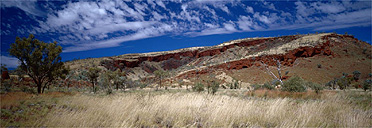
It's an odd place for a holiday - red scrubland stretching away to a horizon barely visible in the shimmering heat of the day. It is an arid place where if you are unprepared, you would die of heat and exhaustion, where orientation is difficult because everywhere looks the same.
But this unforgettable and unforgiving desert, supporting little but a hardy grass called spinifex and sporadic dense thickets of the mulga tree, has its attractions. Sitting on a horse after a dusty day in the saddle -shared with kangaroos and scavenging dingos - atop a hill which could double as a rocky outcrop in a cowboy movie, you feel a satisfaction and an aching for a world you never knew and will never know for real apart from moments like these. It feels a long way from home.
For a hardy few, though, this is home - those families who carve out a living on huge farms the size of Hertfordshire. They are the archetypal Aussies with faces wizened by the burning sun and a remote farmstead miles from the nearest shop, neighbour or doctor. Their only contact with the outside world is by radio, their doctor is the flying kind who comes bouncing down the strip in a plane. You've seen it all in movies and early black-and-white TV shows. Now you can live the Australian Outback life yourself - without having to emigrate.
The Outback is home for Bill Hayes. A few miles outside Alice Springs, Bill turns off the Tarmac on to a long, straight, red dirt road, heading for Ooramina Bush Camp 50km to the south where his family have been cattle farming for six generations. We are going to participate in the day-to-day running of one of Australia's oldest working cattle stations. At 700,000 acres, Ooramina is the fifth smallest cattle station in the Alice Springs area. The average size is well over a million acres - that is Hertfordshire - and some of them are a lot more remote than Bill's.
Ooramina maintains 5,000 head of cattle which they can sustain whatever the climate brings. But we have been driving for nearly an hour before we have our first sighting. It was if we were on safari in Africa. In the Outback they roam free. Bill does not feed them, and they are given no supplements or hormones. The last time a vet was called out was in 1980 when they were testing for TB, and cows are left to calve on their own.
Suddenly, up ahead, we see four healthy cows with their calves in tow. But then Bill's two-way radio crackles into action. It is his son William reporting a problem with one of the water bore holes. The one in question is a mere 100km away. We turn off the main track to Ooramina and head east. It is quite clear that life around here revolves around water - the finding of, the conserving of and the distribution of. There is no naturally occurring water - no rivers or lakes - on the land so, every third day, William makes the 700km round trip to check each of the 20 water holes. Whether it be windmill, or bore pump, each produces about 30,000 gallons from a water table 100m underground. This ensures a seven-day supply for 200 cattle within a 5km radius.
By the time we arrive, a team of men, covered in grease, are already attempting to mend the pump. Lunchtime is like a scene from a Castlemaine XXXX advert, with burly men throwing down cold beers and chomping on huge beef sandwiches. Not the place to be on a diet.
The "in" and "out" gates in the fencing surrounding the water hole can both be closed to trap the cattle just before a muster. Then they are driven by horse, quad bike, or helicopter up to 40km to one of the drafting yards. Here they are counted, checked and sorted. Calves are branded, bullocks castrated and the animals shipped off to market. But there are only two or three cattle here. So much rain over the last few months has meant that the grass itself has enough moisture and the cattle have no need to come to the water hole.
There is to be a mart for bullocks in 10 days time. Bill wants to start mustering in a week, and he is praying for the dry weather to continue. That way his cattle will be driven to seek water at the bore holes and he can trap them easily. What he is worried about is that if there is any rain over the next few days he may need to hire a helicopter to help him locate a dispersed herd.
The bore pump now fixed, we make our way to Ooramina. The first sign of the homestead is a corral full of horses. Bill has bred all 20 of them. In the old days when horses were used for finding and mustering the cattle, he needed 10 stockmen. Each man had five horses which they broke and shod themselves and would ride up to 100km a day. Now Bill needs half the number of men on quads to muster the same amount of cattle.
But, all the rain has made it an unusual year. The quads will struggle in certain areas, so Bill has decided to use at least three horseback riders for this muster. And, despite two knee-replacement operations earlier this year, the 65-year-old is determined to be one of them. To this end he needs to get his horse fit.
We saddle up. Bill has a full range of steeds, and horses can be matched to riders according to experience. All are Arab crossed with brimmy, Australia's wild horse. We are going to check the fencing surrounding one of the water holes and we canter along a flat dirt road which seems to stretch out for miles. We reach one of the oldest bore holes surrounded by barbed-wire fencing. After giving the horses a drink, we tour the perimeter and Bill spots a cow without a calf - a certainty for the mart.
We set off at a canter again, heading up low, steep-sided hills with shale surfaces. From the top of these red rocky outcrops, as the sun moves slowly down in the sky, Bill shares with us the panoramic views over his farm - a tiny part of this vast land.
We head back to the homestead and our new wood-beamed chalet, a few minutes away from the main house with its huge veranda. That night, we eat in the main house, Mrs Hayes cooking up steaks so big they fall over the edges of the plates. The Hayes family first came to Alice Springs in 1884 as contractors for the Overland Telegraph Line, selling steel poles to replace the wooden ones which had been destroyed by ants. Life may be a little easier now but it is still harder than anything most of us have to put up with.
Way to go
Bridge The World (0870 4447474, bridgetheworld.com) offers return flights from Heathrow to Perth, via Brunei, and on to to Alice Springs for £715. A three- night trip to the Ooraminna bush camp, from Alice Springs, costs £395. These prices are valid from January 16 - March 22.
Country code: 00 61.
Flight time to Perth: 19 hours.
Time difference from Alice:
10hrs.
A$1= 2.64 dollars.
