
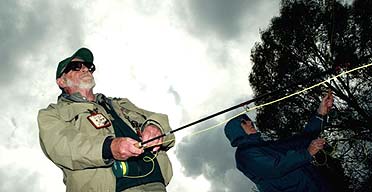
Fly fishing had always intrigued me, but that was about as far as I had got. I couldn't understand what drove men (and they were invariably men) to stand around all day waving a rod in the air, obvious connotations notwithstanding.
My father, a keen fisherman and sailor, had tried to get me involved as a child, but it was half-hearted on both sides; he'd already seen me keener to tan than tack on a boat. Plus, the first sign of rain - this being a Devon childhood, a common sight - saw me staying by the fire. But increasingly, I wanted an excuse to get out of town at weekends, to de-stress and see something green.
A friend recommended learning to fly fish because "you can do it anywhere and it's more stress-relieving than yoga". When she bought me a beginners' course for my birthday, it was a case of get hooked or else. I was enrolled on a two-day foundation course at Nether Wallop Mill in Hampshire.
Equipment and tuition were provided, so all I had to do was get up unusually early one Saturday and power down the A3 for a 9.30am start. I'd checked out the website beforehand so I knew that Hampshire's famous chalkstreams were "the cradle of fly fishing". The website was also full of men grinning from ear to ear while holding aloft their catch. "Some of our fish run to 5lb plus!" the site enthused. How big this was in the fish world I had no idea, but one thing I did know: I wasn't getting into one of those sludge-coloured jackets of many pockets without a struggle.
It took a few wrong turns for me to reach Nether Wallop Mill (I got distracted by Britain's "prettiest village", ugly houses being as welcome in Nether Wallop as home buyers with less than £500,000 to spend). But it seemed unintimidating enough. My three course-mates, Peter, Ian and Tim, all looked harmless, too.
Women make up less than 10% of the fishing fraternity (there are still men-only fly fishing clubs), even though a woman holds the record for landing the largest salmon in UK waters. But the instructor, Duncan Weston, quickly put me at ease and assured me that strength didn't come into it: fly fishing was about speed and effective use of the rod. A Scot with the weather-beaten looks of someone who's spent many decades in waders, Duncan has been a game-angling instructor for around 12 years, and has fished since he was a small boy. I felt a bit sorry for him with four novices to coach, but he assured me he preferred it that way ("No bad habits to get you out of"). He quickly barked us into shape: "I'm strict. So. Do. What. I. Say."
We started the day getting to grips with the equipment. A few things had changed since my childhood - the weight of the rods, for a start. As light as a coat hanger, the modern versions are marvels of engineering in carbon fibre. Thankfully, I hadn't brought my grandfather's rod to show off with. We were taken through the kit, from rod to reel and line. The good news is that while you can go up to £600 or more for the rod alone, there's no need to; you can be kitted out with a decent rod, reel and line for less than £100, plus a bit more for the flies and a net with which to pull in your catch.
Most rods come in two parts, which are gently twisted together so that the eyes match up. You pass a line through these eyes. "Don't do this in view of the river," Duncan cautioned. "You'll see a fish and miss the last eye." But at this stage, fish seemed a long way off. Like most things in life that look easy, fly fishing is not.
The morning was spent flicking a piece of wool around the garden and into the river. "If you start with a real fly, you'll soon lose your eye," Duncan glowered. Getting the rod to flick the line into a "power arc", so that it curved lasso-like in the air is incredibly difficult. In Duncan's hands, the line became a thing of beauty, arching through the air like a gymnast's ribbon. With the rest of us, it piddled down in front or behind, or wrapped itself around the rod like a maypole. Apparently, I was limp-wristed, so was kitted up with a black leather strap to tie the rod to my wrist. A bit alarming, especially as Duncan insisted on calling me "madam" (he's not good at remembering names), but it worked and I slowly started to get it. Once you've got the line moving roughly in the right direction, you start to feel the addiction. You also feel stupidly chuffed (especially considering that you're fishing with a bit of Day-Glo green wool).
Best of all, unlike the line at times, I was starting to unwind. Fly fishing is like skiing: you can't think about anything else or you'll fall over. By lunchtime, we were exhausted, and headed to the Five Bells, Hampshire's prettiest pub (you'd expect nothing less in Nether Wallop). To be honest, all we really wanted was a ploughman's lunch, but this was pub food at its smartest. Foie gras, smoked salmon and delicious-looking penne all featured - even the cream of cauliflower soup came drizzled with pumpkin oil.
Back at Nether Wallop Mill, suitably refreshed (I particularly recommend the chocolate parfait with honeycomb pieces), Duncan demonstrated the two knots needed to fasten the fly to the line. Then, finally, we were let loose at the fish in a small lake. It was comedy caper time as we walked rod-first into trees and caught the fly on anything but water. For every cast we made in roughly in the right direction, there were 10 that we didn't, until we were all but sobbing into the lake and threatening to snap the rod in two. But you don't do that, because you're scared of Duncan, even though his coaching was gentle ("Bend your elbow, madam!"). Whenever he started to cast, fish rose up as though he were the Pied Piper of Hamelin.
The first time this happened, I was left with the rod and forgot everything I'd been told. The fish escaped with the fly, and the next cast ended in my hair. But towards the end of the day there was a Hollywood moment. My last cast struck the water roughly where I'd hoped it would and I had a bite. It took over 10 minutes, but I pulled the fish in and Duncan helped it into the net.
Even then, it was hardly love at first bite. My "priest", a truncheon-like piece of metal with which the "last rites" are administered, went all limp in my hands. But I got a grip (in both senses) and a quick bash later it was all over. If this sounds cruel, I apologise.
At 5.30pm, we called it a day, and the fish weighed in at nearly 5lb. My bed for the night was the cosy White Hart Inn, in nearby Stockbridge, one of the middle-priced offerings on Fishing Breaks' website accommodation list. It was here, when I collared the landlord to talk about my catch, that I realised I'd become a fly fisher. The bed was comfortable and the food was hearty pub fare; to be recommended, but more fun with a friend. The next morning, after a sturdy breakfast, it was back to the lake and a "I do believe she's got it!" from Duncan. Well, I didn't catch the fly in my hair again and was less limp-wristed when it came to my fourth (yes, fourth!) catch.
It turns out that once you've mastered the basics, there's little more you can learn. And although I haven't bought a sludge-coloured jacket yet, I have booked a day with a ghillie, or guide, for the next time I'm in Devon. A licence to fish a bit of river or reservoir costs from around £35 a day - a lot less than the average shopping trip. I guess you could say I am hooked.
Way to go
Getting there: Nether Wallop is off the A343 south-west of Andover. For details of rail services between London Waterloo and Andover, contact National Rail Enquiries (08457 484950, nationalrail.co.uk).
Courses: Fishing Breaks (020-7359 8818, fishingbreaks.co.uk) offers one-day foundation courses at Nether Wallop Mill from £125; two days from £225 including tea or coffee. Accommodation and meals paid for separately.
Where to stay: White Hart Inn, Stockbridge (01264 810663, accommodating-inns.co.uk/whitehart) £60 per night B&B.
