
In the extreme, enchanted half-world of Lapland, where planes are doused in shrimp sauce to repel the frost, life can take you unawares. The bulky quadrupeds drifting through the woodland gloom are pensioners on runner-mounted walking frames. Lemmings attack cyclists and eat twice their own body weight every 24 hours.
Scouting for troll or wolverine tracks as our sledge bucketted back over the frozen lake, we suddenly spied traffic cones. "Testing for Continental Tyres," cried Matti, the fur-hatted lugemeister, as his huskies skidded south in a vapour trail of snow crystals and excrement. Matti has a steady stream of female visitors from Stockholm, keen for the backwoods experience, but they don't last long. "They get tired of the dogs," Matti sighed.
Two miles down the road, the interaction between the old ways and the new was at a more long-standing level. King Karl IX of Sweden chartered Jokkmokk's winter market in 1602 and, for three days every February, the small town's glacial pavements seethe with traders selling everything from snowmobiles to polar bear heads.
"Blackcarrot juice?" a fox-faced troll croaked, thrusting out an inky flask. Either side of him, tight-eyed figures in fur smocks and sealskin bootees rummaged among trestle tables stacked with dried mushroooms. snowshoes, and knivblads. Headless ptarmigans swung like feathered snowballs beside stiff Manchester United tea-towels. The kerbsides crackled with reindeer hides, taut as glass. At -20C, it was too cold to do much touting so most stallholders stood motionless, wreathed in animal hair and tobacco fumes, clutching plastic cups of cloudberry schnapps.
Jokkmokk lies in Sweden's Norbotten county, a primordial tracery of lakes and rivers splintering round virgin forests and knuckleduster mountains. The original inhabitants are the Sami whose trans-national diaspora spreads east from Norway into Russia and south to Poland. Thousands converge each year on the Jokkmokk market to meet old friends and fondle spring-loaded fishing hooks. Once persecuted by the Swedish authorities, the Sami are gradually reasserting their identity. They have a parliament and, in Jokkmokk, a dedicated museum. The market contributes to this growing self-awareness with a fringe programme of cultural events. Last year's highlight was a concert by Roger Pontare, a Sami who had just represented Sweden in the Eurovision Song Contest.
A plump lady with a brown cape and a tall pointed cap came sauntering past the snowmobile stand. She said she was a witch from Denmark. Some Sami teenagers jeered at her but when she threatened to make them impotent, they backed off nervously. Swedish Lutheran missionaries tried to root out the Sami shamen, the noaidi, but they are allegedly still out there, making furtive sacrifices to the wind god Bieg gaalmaj. In a sauna the night before, three sweating Sami had run through a list of shamanistic rules that still apply: never stare at the full moon; brandishing a flaming log will ensure an epidemic of blind reindeer calves; spitting on the camp fire will guarantee a wolf attack. The peaceful, reindeer-herding, Sami may have no word for "war", but they view the wolf with disconcerting fury.
"If the government says it wants another 500 wolves, [there are currently 20], let them be down in Stockholm and Gothenburg and eat their sheeps," Nils had roared, cocking an imaginary rifle through a cloud of steam.
Not all the Jokkmokk traders were Nordic. At a corner near the tourist office, pigtailed Clare Henshaw from Shropshire was dispensing homemade hats and scarves from wicker baskets at her shivering feet. Formerly a glass engraver with work displayed at the V&A, Clare moved into a Swedish collective two years ago. "It's more like a bourgeois village now," she confessed, hugging her designer poncho.
As the thermometer slid towards -30C, I stepped inside a dark Sami wigwam, and, curled up on a reindeer hide, sipped reindeer soup by a roaring brazier. The smoke hung on the sharp air like a silk scarf. Four Irish students crept in and, thawing, told of their misfortune. Enrolled as business students in Lulea, 120 miles to the east, they had discovered too late that their lectures were to be in Swedish.
The sledge-making demonstration was cancelled, so I went to the Sami fashion show. In a packed museum beside a diorama of weatherbeaten pre-historic Sami, the models flounced past in sealskin jeans and chunky knitwear embroidered with noaid (Lappish) motifs. I asked Ann-Sofi Fjallström, one of the designers, if she recycled wolfskin.
"Wolves? Never!" she snorted. "They are not a kind animal." That night, the disco in the basement of the Sami College became a Goblins' Ball as mobs of Sami teenagers frolicked in spangled belts and shoes like tasselled gondolas.
The Roger Pontare concert was very entertaining. He is a large man and, draped in furs, beads and weasel skin, resembled Genghis Khan impersonating Meatloaf. The support acts included an Inuit singer/drummer from Greenland, and a medicine man from Winnipeg called General Ed, whose heavily feathered costume looked like a collision between a helicopter and a giant pine cone. Jokkmokk's packed 500-seat Folkets Hus gave them three encores.
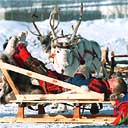
For obvious reasons, the Sami do not have a great sporting profile. Their best-known performer is Borje Salming, a former star of the Toronto Maple Leafs hockey team. But they like a contest as much as anyone.The most dramatic element of the winter market is a sort of Ben Hur on ice, with reindeer dragging manned sledges in a high-velocity blur around an oval on Jokkmokk's frozen Talvatis lake. By the time I crunched down to the shore there were already 300 spectators, eager for blood and guts.
The Sami should be good at this. They did invent the ski, they have been sledgers for millennia and have, in total, over a million reindeer. But Lapland, or the noiadi , had one last trick to play. To the faint disappointment of the stiffening crowd, the figure crawling off the winning sledge turned out to be the numbed and slightly terrified author of this article.
Way to go
Getting there: SAS (0845 6072772, scandinavian.net) flies Heathrow or Stansted to Lulea, via Stockholm, from £273 return inc taxes. The two-hour bus journey to Jokkmokk costs £18 return.
Where to stay: For the 2002 winter market (February 7-9), it is essential to book well in advance with the town's two hotels (Hotel Jokkmokk +971 777 00; Hotel Gastis +971 100 12). Otherwise, you can stay in private rooms (from £35 pp) or sleep on school floors (+971 104 37). Jokkmokk's sole travel agency, SN Resor, can be contacted via snr.se.
Further information: Swedish Travel and Tourism Council (00800 30803080 visit-sweden.com) Jokkmokk tourist office (+ 971 121 40, turism.jokkmokk.se). Flight time: L'don to Stockholm 2 hrs, S'holm to Lulea 75m.
Country code: 00 46.
Time difference: GMT +1 hr.
£1 = 14.59 Swedish krone.
