
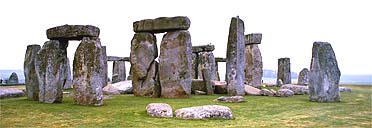
If you walk on a midwinter evening up the ancient grass avenue leading to Stonehenge, you sometimes see a blood-red sun sinking to the horizon between two of the tallest stones. "It's very spooky," says Julian Richards. "It looks like a beating heart slowly dropping out of sight.
He thinks the midwinter solstice probably saw the most important ceremonies. "It marks the turning of the year, the shortest day: from now on, the days will get longer and spring will follow. You talk to the gods, and light can return."
The walk up the Avenue is the finale of his favourite four-mile circuit of the area, best done in winter when low light and a touch of frost or snow emphasise the lumps and bumps that an archaeologist looks for.
Most visitors allow an hour and just see the stones, he says. But it's much more rewarding to give it four - then you can tour the rim of the natural amphitheatre, exploring the burial mounds and looking back at the sarsens, or large sandstones, and their place in the landscape.
"If you look around from the henge, on every skyline there is a group of barrows," says Richards. "You appreciate the stones more when you see them from a distance. It brings you closer to the lives of the people who built this place over 1,500 years."
His Stonehenge winter walk takes him from the car park to the dramatic cluster of barrows at the western end of the Cursus, a ditched enclosure 3km long and 100m wide. The pioneering 18th-century archaeologist William Stukelely wrongly believed it to be a Roman racecourse. You can speculate on its real use, which remains obscure, as you stroll eastwards along it, passing the sewage works gifted by modern planners. Richards thinks that 3,000 years ago the Cursus would have been stripped of grass, a glittering chalk expanse for processions and ceremonies.
The eastern end of it brings him to King Barrow ridge, his favourite part of the walk. "You start to see more burial mounds, and lovely vistas through the trees back towards Stonehenge - it's a great viewpoint, and sometimes the stones are sitting there surrounded by mist.
From here, via the New King barrows, Richards reaches the start of the Avenue for the processional approach to Stonehenge, which he thinks would have been reserved for priests and other dignitaries. If the sun is now sinking behind the stones, so much the better.
"You really need to get away from the car park and the souvenir shop and the 21st century to get a feel for the mystical landscape around Stonehenge," says Richards.
"If you go in the summer it's nice to take a picnic. But I once spent six months here living in a tent, and I can recall many picnics huddled in ditches trying to stop the coleslaw blowing off my plate."
The practicals
Salisbury rail station is 10 miles south of Stonehenge: national rail inquiries 0345 484950. Regular buses from Salisbury station to Stonehenge (01722 336855). An accommodation information and booking service is available on 0870 2405599, or call Amesbury Tourist Information Office on 01980 622833 (www.visitsalisbury.com or www.wiltshiretourism.co.uk). Salisbury and Wiltshire Cycling and Walking Hotline 01980 623255. A National Trust booklet, Exploring the Stonehenge Landscape, is available for £1 in Stonehenge car park or from NT Wessex Office, Eastleigh Court, Bishopstrow, Warminster, Wiltshire, BA12 9HW (01985 843600). Maps: OS Explorer (2 inches to 1 mile), no 130 (Salisbury and Stonehenge), £5.50 or Landranger (1 to 1 mile) no 184 (Salisbury and the Plain), £5.25.
• The last of the current series of Meet The Ancestors is on Tuesday February 14, on BBC2 at 9pm.
