
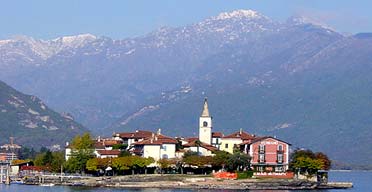
With casual precision the pilot throws the engines into reverse and we glide to a perfect halt alongside Stresa's palm-studded quayside. It's been a long day, touring the Borromean islands and soaking up the sunshine, so we head straight for a bar and order draught prosecco by the glass.
It's part of a long tradition for the British. Once the Simplon Pass was opened in 1806, the shores of Lake Maggiore made an essential Grand Tour rest stop on the way to Florence, Rome and Venice. It's hardly surprising that the rich and famous would come here on their holidays - with a pleasant climate all year round, limpid blue waters, abundant, opulent palazzi with lush gardens, and snowy-peaked Alps in the distance.
Happily, these days you don't need to be on a Grand Tour - or even be a Grand Tourist - to take advantage of the Italian lakes. Jump on a flight out of London after work on a Friday night, and with a fair wind (and a bit of luck with air traffic control) you can be dining on a trattoria terrace overlooking Isola Bella the same evening. It's a perfect short getaway.
The heart of the tourist activity takes place in Stresa, a small town on the western shore with more hotel rooms than residents, facing straight across to the islands. Dominating the front are rows of palm trees and majestic hotels - and notably the palatial Grand Hotel des Iles Borromees.
Hemingway convalesced here for a week in September 1918 (and used the lake for a key escape scene to Switzerland in A Farewell to Arms), but even he would probably baulk at taking the Hemingway Suite these days, which goes for an eye-popping €2,600 a night. That said, a lakeside double room can be had here for a more reasonable €250, and the views are unparalleled.
Behind the front you'll find cobbled streets, a range of cheaper accommodation, enticing food emporia and small cafes and restaurants. Tuck into freshly-made tagliatelle with white-truffle sauce or asparagus risotto, washed down with a hearty house red and top it off with a dish of pungent local gorgonzola and sweet honey - all for under a tenner a head.
Somewhat quieter (and considerably less ostentatious) than Stresa is Baveno, four kilometres up the shore. I found Queen Victoria standing in the Belvedere at the Lido Palace Hotel, just out of town, commemorating her visit in 1879, and saw the room Winston Churchill used while honeymooning here with Clemmie in 1908 - yours for €225 a night, and still smelling faintly of cigar smoke.
Even if you're not slumming it at the Lido Palace, Baveno makes an excellent base, with several small pensione and a whole range of wood-fired pizzas and home-made gelati within a seagull's cry of the imbarcadero. Two minutes up the hill, away from the front, there's an appealing little historical centre dating back to the middle ages. Check out the 11th century campanile and the Roman tombstones built into the church's facade.
Whether you're in Stresa or Baveno, it won't be long before you're tempted out to the islands. There are three you can visit on the regular boats which run from Stresa to Intra and back, stopping at Isola Bella (formerly the lower island), Isola dei Pescatori (fishermen's island, but still known on the ferry timetables as Superiore, the upper island), Baveno, Isola Madre and Pallanza.
The islands are still owned by the Borromeos, as you can see by the preponderance of Borromean Rings - three interlinked circles signifying strength in unity, representing the bond between the Borromeo, Sforza and Visconti families. On Isola Bella you'll find the rings inlaid in a floor, decorating walls, made into floral forms, garnishing flower pots and even stamped on the entry tickets.
Almost the whole island is given over to the Borromeo Palazzo and its gardens, which were conceived in the early 17th century by Carlo III, for his wife Isabella (Shut your eyes, dear, I've got a little surprise for you! Oh darling, you really shouldn't have!).
Before you get as far as the palace, however, you'll have to fight your way through a mob of enthusiastic touts peddling gewgaws, knickknacks and trifles, along with brightly-painted wooden Pinocchio puppets beyond number (made nearby, but that's no excuse).
Once safely inside the palace you start to realise just how monumental the whole thing is. The grand masterpiece is the appropriately named Salone Grande, though in spite of being started in 1630 the vast hall wasn't completed until 1952. Next door is the Sala della Musica, which in April 1935 hosted the Stresa conference between Ramsay MacDonald, Pierre Laval and Mussolini; a failed attempt to ensure peace in Europe (all right, own up, which one of you forgot to invite Hitler?). Among a rich succession of lavishly-furnished state rooms you'll also see the Sala di Napoleone, named after the pint-sized general who stayed here in 1797, his bed dwarfed by the immensity of the room.
Downstairs are a series of six large grottoes, covered wall-to-wall and floor-to-ceiling with crusty mosaics - the original pebble-dash, one fears. A long hall finally leads out into the gardens, which make the house look positively modest. Looking like nothing more than a colossal ten-tiered wedding cake, the terraces were the result of tonnes of soil being shipped out to the island and shaped and balustraded before being planted out with exotic trees, shrubs and flowers. Complete with white peacocks, orange, lemon and grapefruit trees, and more baroque statuary than you could shake a stick at, the effect is overpowering. But as Charles Dickens said, when he passed through in 1844, "it still is beautiful."
By contrast Isola Madre is the very picture of discretion. The largest of the three islands, it nonetheless receives the fewest visitors, and boasts generously landscaped gardens and a 16th century palace. Whilst no match for its extravagant sister, the palazzo has evocatively reconstructed rooms - furnished from various Borromeo properties - and a sizeable collection of antique dolls, along with a number of faded puppet theatres. Outside, depending on the season, you can take in the pungent aroma of fragrant camellias or wonder at some of the best azaleas and rhododendrons you're ever likely to see. Flaubert (a year after Dickens) was moved to write "Isola Madre is the most sensual place I have ever seen."
Last of the three visitable islands is Isola dei Pescatori. There are no sights per se (let alone much sign of the eponymous fishermen these days), but the island is arguably the most charming of all, with narrow lanes, tall houses and unpretentious eateries (the Ristorante Italia has wonderful views out across the lake from its terrace). And you can stay here, too, at the Hotel Verbano - though with just 12 rooms you need to book well ahead. Doubles go for €140 a night, but add in (sometimes costly) taxi-boat fares if you want to go ashore after the regular ferries have stopped for the evening.
Way to go
Getting There: Milano Malpensa airport is only 40km from Stresa, and there are direct buses (marked Verbania-Malpensa) half a dozen times a day. There's also an hourly shuttle bus from the airport to Gallarate, where you can catch regular trains to Stresa / Baveno.
Budget flights on Alitalia, British Airways, British Midland, KLM and Lufthansa start at around €120 including taxes. Low cost carriers such as Duo, EasyJet, Flybe and Ryanair fly from various airports in the UK to Milan from around £40 return, but usually arrive at Milano Linate or Bergamo airports, 90 and 120km away from Stresa respectively - and on the wrong side of the city. If you're flying in here it's probably easier to rent a car, as trains are infrequent (but remember that rush hour traffic around Milan can be horrendous). If you're in Milan itself, there are hourly trains to Stresa from Milano Centrale.
Getting around: There are buses along the lake shore, and trains along the western bank, but ferries are by far the nicest way to travel. Timetables available online at navigazionelaghi.it.
Where to stay: There are nearly 200 hotels and pensione in the area, and more than 40 campsites, but many are only open in season (generally from Easter to the end of October). Double rooms can be had for as little as €70 out of season, or €100 through the summer - though don't expect a lake view at this price. A wide range of options can be found at laghiditalia.com. For hotels mentioned in the text see borromees.it, lidopalace.com, and hotelverbano.it.
When to go: spring and autumn. High summer can be oppressively crowded, and while winter can see some hotel bargains, many of the attractions (including the Borromeo Palazzo and Isola Madre) are closed from November to February.
Tourist information online: lagomaggiore.net.
· Piers Letcher is the author of Eccentric France and Croatia, both published by Bradt Travel Guides.
