France's three Basque provinces are less well known than their Spanish neighbours, less mountainous - and certainly less politically active. But nesting in an extreme corner of the Atlantic, warmed by the Gulf stream and occasional winds from the Sahara, lies the French Basque coast.
It's difficult to imagine it in these days of mass tourism, but Biarritz was one of the world's first seaside resorts - a small fishing village that became a favourite of the 19th century European aristocracy. A kind of upmarket Benidorm for the Imperialist generation.
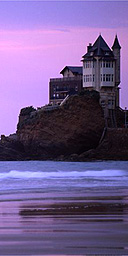
That flavour still remains, and in the grounds of the large Hotel de Palais (once an actual palace) that sits over the ocean, or in the domed Imperial chapel Napoleon III built for his new wife, you can imagine the town's first flowering. Mansions with conical towers line the sea front. No one involved in the original development could have imagined what their work would later lead to on the Spanish costas.
Today people no longer come to Biarritz to see and be seen, although a new breed of tourists keep the place busy. Above all, the town is known for its surfing. Biarritz introduced the sport to Europe and its unforgiving waves still make it the continent's most important surf spot.
It's a good base for exploring the rest of the region, too. Biarritz has impressive beaches, but St Jean de Luz to the south is more picturesque. The mountains are closer and the main street - Rue Gambetta, a long, narrow thoroughfare winding down to the sea - is lined with red and white Basque town houses, some now delicatessens and pastry shops, others selling clothes and jewellery. Behind the bay is an old harbour - still working - where the fishing boats bring in a fresh catch each day. It's a great place to eat.
Perhaps medieval man had a better sense of direction than me, but if you venture to Bayonne - a small city that was once the heart of the area - you are likely to find yourself quickly and irrevocably lost. A short journey from Biarritz, its three well-preserved districts (created by the meeting of two rivers in a T shape) have been allowed to develop at their own pace, retaining small alleys and views of the twin-spired cathedral. More than either St Jean de Luz or Biarritz, it feels like a 'proper' French city: the pavement cafes on its pretty, tree-lined avenues fill up in the early evening as the citizens enjoy a conversation on their way home from work or college. Join in if you can: one of them may be able to point you in the direction of your hotel.
What to do and where to go
Take the waters
Biarritz's Grand Plage - the town beach - has been colonised by surfers. If you want to give it a go, lessons can be booked through French Surf School-approved instructors, who will typically charge around 195FF for a 90-minute lesson. Other packages are available, including a week's full board, equipment hire and tuition for 2490FF from Biarritz Surf Training. If you don't feel quite up to waves - or even getting wet - on a given day, try one (or both) of the two exquisite tearooms which back onto the beach.
Lounge in the sun
In pre-resort days, the Port Vieux's sloping sands were used to beach harpooned whales. The villages would wait for the tides to go out before slicing off the blubber and flesh off the unlucky ones. Unpleasant, but it gives you something to think about as you while away the afternoon sunbathing on this sheltered swimming bay.
The Plage de la Cote Basque is Biarritz's biggest (and probably best) beach, a long, exposed stretch with views of the Pyrenees, a decently deep stretch of sea, and a break from the rest of the of the town. You can swim, paddle or surf here. Further marine diversions include seawater therapy, a pricier version of the previous three available at a couple of expensive hotels.
Be a day tripper
A bus (17FF from the Biarritz tourist office) will take you quickly to St Jean de Luz. It is a compact and attractive port. Highlights include a harbour ringed by half-timbered houses and impressive views of the Pyrenees, unexpectedly close on the horizon. The Maison d'Infante is the dockside's architectural gem - a north Italian style palazzo where Marie Thérèse of Spain stayed in 1660 before she married Louis XIV at the town's church.
The beach itself is gentler than at Biarritz. A large bay sweeps for a mile or so from the next door port to rocky cliff-top gardens. A breakwater makes the waters practically useless for surfers, although wind surfing and small yachts make up the water sport deficit. The sea is warm enough for swimming from spring through to the end of autumn.
Eat out
As night falls, and the fishing boats leave the harbour, it's time to eat in St Jean de Luz. It claims to be the capital of Basque seafood cooking in France: pick one of the restaurants dotted around the harbour and judge for yourself. There are also tapas bars and a market stall selling seafood for al fresco consumption. I opted for a simple looking place near the covered market that served grilled meats and fish advertised on a blackboard menu outside. Sardines, a tomato salad, chips, a jug of wine and cheese for desert came in at just under £15. Similar fare is available in the Biarritz Port de Pecheurs (not a fishing port, but it has plenty of atmosphere at night), while pizza restaurants are prolific in the other parts of town.
Have a drink
Biarritz is best for drinking. Most of the town's bars lead off from the roads around the Port Vieux. There's a good range, many with Spanish sounding names such as La Bodega, and plenty with a surfing theme, all seemingly called some variation of "Le Hawaiian". Midweek can be quiet off-season but the weekend nights are always. One place to avoid is the Queen's Bar on the Avenue de Verdun, a karaoke joint where at any given time some broken-hearted soul or other is singing a mournful French ballad off-key. The audience never consists of more than five people, despite advertisements outside which endeavour to tempt passers-by with offers of sangria and biere flambé.
Spend an improving afternoon
The Musee de la Mer (open 9.30am to 6.30pm daily, until midnight from mid-July to mid-August, 47FF) sits just above the Port Vieux in Biarritz and offers a good introduction to the town and coast. There is a shark tank, seal feedings and an aquarium. Surprisingly, there are no living examples of cod or tuna, the two species which made the name of the Basque fishermen. For that you need to go to the fishing and ecology exhibit upstairs which - in the celebratory style of a Soviet information film - shows how sardines are caught by industrial fishing fleets, fed through decapitation machines and slotted in tins to sit unused in kitchen cupboards for the next 15 years. It does kill the romance somewhat, but the town's chocolate museum (chocolate is a regional speciality) supplies a satisfying desert.
In Bayonne, the newly opened Le Musee Basque (10am to 18.30pm, 35FF) displays artefacts from several centuries of Basque life. There is plenty to look at, from farm tools and pelota balls (a racket sport played with a basket or bare hands) to portraits, filling in the gaps in your knowledge of Basque culture. A 60FF joint ticket also gets you into the city's Musee Bonnat, home to a collection including works by Rubens, El Greco, Degas and Titian.
Go sightseeing
Bayonne - compact, attractive and full of history - offers the best sightseeing opportunities. The vertical reach of its twin-spired cathedral, seen from all directions, is enhanced by the web of half-timbered houses on the streets that radiate from its doors. Historically, it's the area's most interesting town: a frontier city that once provided refuge to Spanish Jews, who first introduced chocolate-making; a stronghold of the Plantagenet kings in France; the birthplace of the bayonet.
Get out of town
A five-minute walk from St Jean de Luz is Cibourne, the next-door hill village. It's well worth an hour's aimless wandering, as it is the closest you'll get to regular Basque life. The steep streets (some are staircases) lead you to a pelota court and an attractive 16th century church. The few cafes and restaurants are markedly more quiet than their St Jean de Luz neighbours.
Stretch your legs
One of the greatest pleasures in Biarritz is also one of the cheapest: walking along the sea front. Natural rock formations and some careful town planning have given it four distinct zones - the Grande Plage, the Port de Pecheurs, Port Vieux and the Plage de la Cote Basque. From the Port de Pecheurs a tunnel takes you to the Rocher de la Vierge, the last in a series of rocks jutting out into the ocean linked by an illuminated walkway. You can watch the sun set, take in the Atlantic air or stare at the sea and think about nothing at all.
