
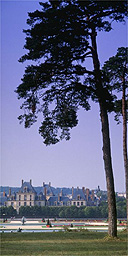
Arriving from central Paris, the first thing you notice about Fontainebleau is the noise. Or rather, the lack of it. The roar of engines, the squeal of brakes, the sharp blast of duelling horns so familiar to Parisian streets are all absent here. No subway noises gurgle up from the bowels of the earth. Mobile phones are set to the briefest and politest ring tones, a subliminal chirrup.
People seem less noisy, too. In Le Denecourt, the local bar next to the municipal theatre on Fontainebleau's high street, the moustachioed patron and various regulars murmur about rugby, food, the weather, gardening. Even the fruit machine, which in Paris would be deafening, is barely audible.
Paranoids will suspect a conspiracy, but there's nothing amiss. It's just that "Bellifontains", as the inhabitants of Fontainebleau are known, tend to be quiet and discreet people, with none of the flash and dazzle that you'll find, for example, in the 15th arrondissement of Paris. They leave the vulgar display of wealth to the chateau which dominates their town, and which serves as a dire warning against the same.
Fontainebleau is small and provincial in the most charming way. Whoever twinned it with Romford must have had a mischievous sense of humour: while Romford is a bustling shopping suburb that merges seamlessly with London, Fontainebleau is an atoll of sandstone buildings in an ocean of forest. Its biggest consumer attraction is the thrice-weekly food market in the square in front of the Lazarist mission building, complete with a strange 1970s concrete umbrella. However, it excels on the gourmand front, with plenty of restaurants offering very reasonable prix-fixe menus, such as the rather grand L'Aigle Noir in the hotel of the same name. Or, if you prefer, the aforementioned Denecourt is a perfectly serviceable pub-grub bar which does salads for €4.5 and stocks a great selection of draught beers including Hoegaarden, Stella Artois, Leffe and bottled Adelscott (a delicious dark beer blended with malt whisky).
The town is easily explored on foot, and most of its houses date from the 17th century, giving it an easy charm and pleasing homogeneity. Perhaps the grandest building is the town hall, constructed in neo-Renaissance style in 1865, during the Second Empire; Fontainebleau evolved simply to service the various monarchs and emperors who inhabited the chateau over a period of nearly 600 years, with most of them adding in some way to the construction, or remodelling existing features.
However, it is not the chateau that dominates the town but the forest surrounding it. Though Fontainebleau's main road, La Rue Grande, passes in front of the chateau, it starts and ends in woodland. The town is dotted with alleyways, called ruelles, all of which lead to the huge forest which served various kings and emperors as a private hunting ground, and thus remained virtually untouched for hundreds of years. These days, it makes for a wonderful rambling area, and perhaps the perfect itinerary would be a two-hour chateau visit in the morning, followed by a long summer afternoon picnic, deep in this green sanctuary.
As for the chateau itself, nothing can prepare you for the sheer gaucheness of unbridled royal patronage. Of course, this is not the officially sanctioned reaction, which is one of reverence and admiration. But I think the chateau is best enjoyed as a temple to kitsch, home to some of the ugliest decor and most overblown artefacts you'll ever see anywhere. It is six centuries of Royal New Money sprayed up the walls, the regal equivalent of a porn baron's home: tacky, cheesy and, despite the obvious expense, cheap-looking.
Much of it has that just-been-restored look which appeals to American tourists, who like their antiquities spick and span, as in the Gallery FrançoisIer, an oak-panelled hall lush with frescoes, richly decorated with giltwork and stucco figurines. Reputedly renowned throughout Renaissance Europe, I'm willing to bet it was the 16th-century equivalent of the Millennium Dome, a marvel of gaudiness and misdirected expense.
This is followed by a corridor in faux marble - the first glimpse of much more - which serves as a perfect metaphor for the place as a whole. The chateau's many sumptuous and fascinating elements are always counterbalanced by leaden paintings, clumsy carvings, and ugly stucco cherubs, their oversized heads misplaced on puny shoulders. The real interest lies in the deliberately grotesque: the gargoyles, strange dogs, demons and mythical beasts crushed into corners, and Renaissance beauties with bowls of fruit on their heads like antiquated Carmen Mirandas.
Fontainebleau makes Disneyland look like an exercise in minimalist austerity and the Taj Mahal look like the Tate Modern. I love it for this reason. Though art historians like to call it mannerism or baroque, the chateau proves beyond all doubt that kitsch is not an exclusively modern phenomenon, but one with a long and terrible history. Fontainebleau will convince you that the French royalty deserved to be guillotined, if only for their appalling taste.
However, those in search of transcendence will prefer the end of the tour. The Trinity Chapel was completed in 1633 with a vaulted ceiling decorated by the Parisian artist Martin Fréminet. Once your eye stops jumping around the frenetic bronze and stucco work, and accepts the sheer weight of scrolling, laurels, cherubs, fruits, garlands, crowns, nymphs, flaming urns and fleurs-de-lys, you realise that these are by far the best (and not coincidentally the most unorthodox and experimental) paintings in the chateau, a series depicting the redemption of man. Lie supine on one of the velvet pews and look straight up God's skirt; another picture has tormented souls falling through the void towards you; the key image is Christ the King on his throne, but painted as if seen from some 60ft below, so that He disappears up his own celestial firmament. Five minutes lying on your back gazing at this wonderful view will leave you aux anges, as the French say.
Where to buy your own little castle
With sterling still riding high against the Euro, French property represents a bargain, and Fontainebleau is no exception. Those looking for a second home or permanent base in France might be pleasantly surprised, given British house prices. A three-bed house close to the chateau, with 103 sq. m of floor space, plus garden and garage, will set you back less than £150,000. For those on a budget, literally across the tracks is Avon. Though separated from Fontainebleau by a railway line and nothing else, Avon's property is considerably cheaper, averaging around £1,000 per square metre. Meanwhile, just out of town in Milly la Foret, four bedrooms and two reception rooms across 120 sq. m, with 2,100 sq. m of gardens, garage and that all-important wine cellar will cost you just £156,000. For further information visit teouleimmobilier.fr.
Way to go
Getting there: Fontainebleau is 65km south-east of Paris. By car, take the A6 to the Fontainebleau exit, then the N7 to the town. The train from Gare de Lyon takes 50 minutes, and a second class return fare from Paris costs under £10. Tickets can be booked in advance over the internet (sncf.fr) with a credit card and collected up to 20 minutes before travel. If you buy your tickets at Lyon station, there's no need to queue; you can obtain them from the machine marked "Ile-de-France", which is located at the right-hand end of the main station ticket hall as you face the ticket booths.
Getting around: From Fontainebleau station, take a taxi or the bus marked "Chateau" into town, a 10-minute ride costing 60p. It drops you off on rue Royale, right outside the tourist office, which is open seven days a week (0033 1 6074 9999). Here, you can get a free town map and a guide to the area's restaurants and services, as well as buying your admission ticket for the chateau - a smart move that will save a much longer queue at the chateau on busy days. You can also get maps of the forest showing hiking paths and picnic areas, and hire all-terrain bicycles for £10 per day, £8 a half-day.
