
We sat in the bar of the George and Pilgrim Hotel, under blackened beams, our whiskies resting on tables so old and split that only the thick layer of polish seemed to be holding them together. As midnight approached, the only other people left drinking were two men in their early forties with long, thick hair. The one wearing a sheepskin waistcoat caught us watching his wrist, thickly festooned with camel bells. He smiled.
"Before we go, I'd like you to smell this," he said. The vial smelled of vanilla and jasmine. We assured him it was pleasant and handed it back. He hoisted a scarlet sack on his back with the air of a man setting off on an expedition to Rivendell, bade us goodnight and went jingling on his way.
Glastonbury is a kind of theme park, unique in that the staff work unpaid and bring their own costumes. The theme is esoteric beliefs and New Age wisdom, and so strong is the town's reputation as a centre for the alternative in everything that, without much effort from tourist boards, it sucks in a cast of brightly-clothed hippy visionaries, travellers, elderly psychic healers and American spiritual seekers to perpetuate its image and fascinate those who have come merely to spectate. At Disneyland, the guy in the Mickey Mouse costume doesn't believe he's a 6ft rodent. In Glastonbury, the hippy greeters are real.
Does the cast extend to ghosts? The George and Pilgrim, dating back to 1455, is said to be haunted, although nobody seemed quite sure who was supposed to be doing the haunting. Yet as we climbed the stairs to bed, there was no sense of foreboding, only that deep, spicy scent of 500 years of keeping rain at bay.
Art, and the imagination, know two kinds of ghost. There's the spirit that haunts for the hell of it, as in Henry James' The Turn of the Screw or countless jokey Scooby Doo sagas of haunted houses and headless Elizabethans. Then there's the Ghost with the Message, like Hamlet's father, a notion eagerly adopted by Hollywood hits such as Ghost and, most recently, the Bruce Willis vehicle The Sixth Sense.
The latter adds the intriguing dimension of ghosts that don't actually know that they're dead. As we dined off scampi and steaks, the thought flitted across my mind that perhaps the staff were unwitting ghosts, condemned as a result of some old gastronomic massacre to re-enact 1970s pub meals for all eternity.
Sometime that night, I was awakened by my wife screaming in horror. In her nightmare, it had seemed that someone else was in the room with us. She tried to switch on the light. It wouldn't work. She woke up, turned and saw a very tall man, with long arms, sheened in a grey mist, standing next to the bed. She crossed herself and reached out to touch the figure. Her hand went through him.
At that point, she screamed and, I believe, really woke up. We had, after all, spent the entire previous day touring Glastonbury and talking about ghosts, energy fields and the spirit world. She's not so sure. She thinks that when she truly woke up, the figure was still there.
If you're minded that way, Glastonbury is kinder on you than on sceptics like me. We have to be content with enjoying the beauty of the place, and that isn't so bad, because it is very beautiful.
History and myth became entwined in Glastonbury early on. It used to be an island, the isle of Avalon, and floods still occasionally surround the town. It made a good sanctuary, and legend holds that Joseph of Arimathea built the first Christian church in the British Isles here in 63AD. This sprig of a tale grew into a mighty tree over the centuries, with subsequent chroniclers claiming that Joseph was Jesus' uncle, that he buried the Holy Grail at Glastonbury, that he brought his nephew over on a business trip one time (whence William Blake's Jerusalem, with its reference to Christ on England's mountains green).
True or not, Glastonbury did become the site of one of England's largest and richest abbeys, which flourished until Henry VIII's commissioners seized and plundered it.
As if the Holy Grail was not a big enough draw for New Agers and imaginative pilgrims, a site within the grounds purports to be the grave of King Arthur and Queen Guinevere. But whether you take it as the genuine Arthurian tomb or a monument to one of the earliest (1191) English marketing ploys, the antiquity impresses.
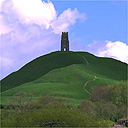
It's an easy walk to the top of the pudding-bowl-shaped Tor. On sunny summer days, from dawn to dusk, the lush daisy-speckled grass of the slopes are scattered with girls in halter tops and boys with no tops lounging, tanning, snogging and discussing the meaning of life.
From the summit, you can see red-roofed Glastonbury slung neatly in the saddle between the Tor and Wearyall Hill, and the patterns of lines on the levels around. There are so many lines - hedgerows, ditches, dykes, roads - you could make almost any pattern you chose: ley lines, or the signs of the Zodiac which, an inventive sculptor in the 1920s claimed were to be found etched in the lie of the land in a circle round the town.
Roy, a local spiritual healer and dowser acting as our guide, was determined to convince me of the special energies that thrummed beneath the earth of Glastonbury.
Roy was no hippy. Dressed in blazer and grey flannels, he slipped out his pendulum to demonstrate some energy-field action. After some swinging and shuffling across the grass, Roy settled on a couple of spots. "Stand there, and hold your arms out straight," he said. "Now I want you to resist me as hard as you can." He laid his hand on my arm and pushed it down, fairly gently. I resisted; my arm remained straight.
"Now stand over there and hold your arms out again." This time, he pushed down with unexpected ferocity, forcing my arm down to my side.
"Do you see?" he said. "Here, you're weaker. The energy is different."
"But you pushed down harder the second time."
"No I didn't!"
My word against his. The choice is there. You can go on a spiritual pilgrimage to Glastonbury, find meaning in the lines and the hills and the energy fields, and dream ghostly dreams. But you don't have to do that to appreciate the beauty of the place, or to browse as an outsider through the full cultural outpouring of the New Age.
