The wizened old man, complete with typical French beret, leans towards me from the neighbouring bar stool to confide that he has the healing touch. 'I can cure people over the phone too,' he mumbles into his glass as I look at his gnarled hands and dirty finger nails. 'It works as far as Marseilles.'
The woman behind the bar insists he is telling the truth - he recently cured her of a chest complaint, one of a number of 'miracles' he performed when not working as the local mechanic.
It isn't the typical apres-ski conversation, peppered with 'Bet you can't guess how many black runs I skied today', and 'Are you going to the night club later?' But Samoens isn't a typical ski resort.
In fact, if you have heard of it, which is unlikely, you will probably have dismissed it as far as skiing goes on the basis that it lies in a glacial valley in Haute Savoie at only 700 metres above sea level. There is no ski-in, ski-out at Samoens : you have to catch a bus or drive your car about 15 minutes up to the slopes before donning your gear. But that turns out to be a small price to pay for a skiing holiday with a real difference.
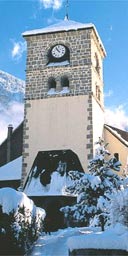
Forget about luxury international ski resorts with little personality but pumped-up prices - Samoens is both a ski resort and a typical French village. This is the real France, full of colourful locals rather than the English-speaking seasonal workers who flock to the slopes every winter. And as French villages go, it is one of the prettiest, listed as an historic monument, and nestling at the base of seven mountains. Once a thriving stone-cutting centre, the medieval village is brimful of traditional timber buildings and features everything from a covered grain market and a linden tree planted in 1483 to old-fashioned charcuterie shops which you have to go in just to enjoy the smell of the hanging ham and sausages.
Of course, you come to Samoens to ski as well as to revel in the eccentricity. And this is where people who object to the resort's less-than-smooth chairlift and its small number of snow canons miss the point. It's not difficult to get to the ski area in the morning: I drive to the spacious car parks by the slopes, though a regular free bus service tours the hotels. I have access to the whole of the Grand Massif, about 260km of piste, the same view of Mont Blanc and the same skiing area shared by the international - and far more expensive - resort of Flaine.
The Samoens side of the mountain is not only cheaper than international resorts, but eating is less expensive too. True, there isn't a huge variety of restaurants, neither do they have particularly scenic views, but the food is good and cheap. At the main ski hub, a friendly bar sells croque-monsieurs for 4 euros (£2.75) and steak and chips for 10.70 euros, a far cry from the 6 euros I forked out for a vin chaud in Courchevel a few weeks earlier.
Heading into the wider resort, we enjoy several glorious runs before coming to a halt to look at the view below. And it is here that the real difference between Samoens and more upmarket resorts is driven home. Lying at the bottom of pristine white slopes is Flaine, a string of ugly grey buildings with an uncanny resemblance to prison blocks. It is only a few steps from the hotel blocks to the ski lifts and at 1,600m snow is pretty much guaranteed. The chair lifts here do not whack you on the back of the knees as they do at Samoens and as we take advantage of them to reach the surrounding slopes, my companion jokes that they are smooth enough to serve coffee on.
Though Samoens is far from a rich resort, it is investing in six-seater chair lifts. It is also investing heavily in change, though still striving to maintain its traditional spirit. While larger resorts might be accused of sitting on their laurels, it has outlined a host of changes it intends to make in the next five years. 'We want to make it easy for skiers,' says Alain Quievre, the dynamic tourism director.
So far, he has negotiated a deal so that transfers from Geneva airport cost 28 euros (£19.30) per person, the same as the bus fare. Ski passes can already be booked on the internet, but from next season a hands-free magnetic-style pass is to be introduced that can be charged in special machines, avoiding queues and having to fumble to show your pass before getting on every lift.
What is more, next year, a swish new gondola that will take eight minutes to whizz skiers from a central car park at Samoens to the ski area should be up and running. That, together with the fact that Samoens is only an hour from Geneva, is likely to propel it into a limelight the few British people I met there would prefer it avoided. 'Don't tell anyone about Samoens ,' one Scottish couple told me. 'It's so reasonably priced and we love the Frenchness of it.'
There's plenty to do as well as ski. On a day off from the slopes, I head to a nearby gorge and a waterfall that is fed by snow. Later, at the Horseshoe Cirque carved from the ice by a glacier, an eerie silence hangs over the landscape as the snow begins to fall and I understand why the locals call it 'the end of the world'.
By the time I head out for an initiation on snow shoes, the white stuff is coming down thick and fast. All I can see are shapes looming around me - chalets half-buried under the snow, fir trees whose branches are bent with the weight of it and a group of people trying to dig out a piste grooming machine that has tumbled down a slope. When we reach what is supposed to be a picturesque 360-degree viewpoint, I have to take the guide's word that Mont Blanc is straight ahead, Geneva behind and the Swiss mountains in between.
I get back to the hotel half frozen and ready for a bit more of Samoens' special brand of apres-ski sustenance. The nightclub here is a small bar called La Clarine, with a wonky picture of the Mona Lisa, a DJ squeezed into the corner and a sign on the door that says, 'Where the spirit of music speaks to you, sings, plays, moves and touches you'. At the nearby Aspen bar, charismatic French owner Patrick Jay shows off both the tasty Criou beer he developed and his photo album of his visits to Scottish distilleries - he is so in love with whisky that he sells 270 varieties in the bar. 'The English look at the menu, but they drink beer and cognac, not whisky,' he says. 'That is for the French. As for the beer, I wanted to call it Samoens but Pepsi had registered the name.'
Then it is back to the Hotel Neige et Roc, a simple, family-run property with so much good food you'll need to do an awful lot of skiing to work it off. Before calling it a night, I chat to one of the resort's ski instructors in the bar. 'In big resorts, they just see dollar signs when the skiers come,' says Guillaume Bozonnet. 'Out of season, it is a desert. Here, it is a real place full of real people.'
They're not just real people, they are real characters, and Bozonnet is no exception. After all, it's not in every ski resort that the local ski instructor works as a fully qualified mason during the summer, keeping alive both the village's stone-cutting traditions and its many stone buildings.
