
We looked out across the Valley of Death, as Lord Raglan had looked 150 years earlier, before the charge of the Light Brigade on October 25, 1854. Rain drizzled down and the view was mistier than it had been then, so the landscape looked flattened out - but then, that seems to have been the mistake he made too.
Olga, our battlefield guide, was dressed up in high Ukrainian fashion - leather jacket, winkle-picker toes reaching halfway to Kiev - which looked out of place on a rural hillside in the rain. But she knew her stuff, launching into a stirring Tennyson recital, in perfect English:
"Half a league, half a league,
Half a league onward,
All in the valley of Death
Rode the six hundred..."
I half expected the valley to be like one of those canyons the Lone Ranger gallops through, with Indians raining arrows down from the cliff tops. It's not that dramatic, but lethal enough if your enemy has cannon rather than bows and war paint.
There are two fairly broad valleys running between modest hills and separated by a low ridge. From his viewpoint on a higher hill further off, Raglan, the British commander, spotted the Russians on the ridge hauling away British cannon they'd captured. This would never do - they might use them as evidence that they'd won - so he sent an order to his generals on the valley floor telling them to prevent it.
He didn't realise that down below, they couldn't see these guns. All they saw was the Russian heavy artillery at the head of the northern valley, and this was what they concluded they were meant to attack. So off they trotted, as disciplined as if they were on parade, breaking into a gallop, and gradually being mowed down from three sides. "C'est magnifique, mais ce n'est pas la guerre," observed a French marshal.
It wasn't as suicidal as is sometimes supposed: 673 men rode out; 118 were killed and 127 wounded. (The loss of 360 horses was the real problem.) But it was a military disaster - as Tennyson, and Olga, noted: "Someone had blundered." The blame was conveniently pinned on Captain Lewis Nolan, who carried Raglan's order to the generals but may have misinterpreted it; as the first to die, he was in no position to answer back.
Now, the Valley of Death is a vineyard, growing in the rich earth for which Ukraine is famous. Bullets and badges still come to the surface in the soil occasionally, as do unexploded second world war bombs. A small white obelisk recalls those who fell.
The battlefield was long off-limits not only to tourists but to locals too: in Soviet times the fleet, like its tsarist predecessor, was based at Sevastopol nearby, and Balaklava harbour was used for repairing submarines - in a cave, away from prying American satellites.
But the Soviet Union has gone, replaced by independent Ukraine, which welcomes foreigners and their money to the Crimean peninsula, its Black Sea playground.
You can see why the British used Balaklava's sheltered, winding harbour as a supply base. It now wants to be a tourist resort. The waterfront is being spruced up; buildings are getting a lick of paint. You can go into the hidden cave. But it all still has that ramshackle Soviet air. Down by the fishing boats, men sit fishing, and women sit selling snacks. The view is spoiled by a rusty floating dock, which will have to go if this is to become the St Tropez of the Black Sea.
As for Sevastopol, founded by the ancient Greeks and also recently opened to the world, it now houses both Ukrainian and Russian fleets in its harbour. This will be the centre for Crimean war commemorations. The Earl of Cardigan, descendant of the Light Brigade commander, will be there with a tour group; the descendant of the overall cavalry leader, Lord Lucan, probably not.
The city has a striking war attraction worth a visit: a 360-degree panorama painted on the inside wall of a circular building, depicting the 1854-55 British siege of the city. Its realistic detail artfully enhanced by three-dimensional artefacts in the foreground, it is 115 meters long and 14 metres high.
Sevastopol was besieged again when the second world war came to Crimea. The best-known name from that era is Yalta, the health resort where Stalin, Roosevelt and Churchill got together in 1945 to carve up the post-war world.
This took place at the white, Italian renaissance-style Livadia Palace, in big gardens overlooking the sea, and you can still see the round table where the deal was signed, once Stalin had fooled the other two into thinking he'd allow a free Poland.
Tsar Nicholas II, who built the palace as a summer home, was not the only Yalta visitor. Chekhov lived here, in a villa with some cherry trees, writing The Cherry Orchard. Khrushchev and Gorbachev had dachas along the coast, and it became more or less the only Soviet seaside resort, replete with socialist health spas. Locals were sniffy about the "cotton tourists" - the workers, who came in summer - preferring the "velvet" ones, the artists and professionals who turned up in autumn.
Russians still flock in, along with Ukrainians and a smattering of other Europeans (a 50-mile trolleybus ride, the world's longest and arguably prettiest, goes to Simferopol, the nearest airport). Ringed by mountains and sea, the town's green, if a bit grubby in its back streets. It offers healthy nature walks, with Europe's highest waterfall, Uchan-su, almost 92m if it doesn't dry up in summer. The spas are still there.
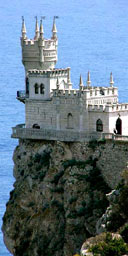
You can visit the Massandra vineyard, the golden-domed Alexander Nevsky cathedral, Chekhov's home, or the vaguely Moorish Alupka palace nearby, as well as taking daytrips to Balaklava. On a boat trip round the bay, you may find dolphins splashing in your wake. Restaurants are cheap and cheerful, though English isn't always spoken. Try the Swallow's Nest: the food is OK but the setting - it's a sort of mini-castle perched on a crag over the ocean - is spectacular.
The traffic-free promenade by the sea, with palm trees and pastel-shaded buildings, is the heart of Yalta. The beach itself is nothing much, pebbles and concrete, but holidaymakers stroll by, stopping to watch chess matches, test bouncy castles, eat big Macs (opposite the statue of Lenin), or dress in 18th-century costume to pose for photographs in drawing rooms set up on the strand.
On a warm summer evening, it's all very relaxed and civilised. You could be in a Greek or Italian town or even, in the dim light of dusk, somewhere on England's south coast. Ukraine, far away on the Black Sea, is part of Europe after all.
Way to go
John Thompson travelled with Prospect Tours (020 7486 5704). An eight-day tour of Kiev and the Crimea, including flights (international with Ukraine International, internal with Aerosvit), four nights at the Oreanda hotel on the Yalta seafront, and a daytrip to Balaklava guided by Olga Makarova, costs £1,150, plus about £60 for a Ukrainian visa.
Other tour operators with Crimean itineraries include:
Voyages Jules Verne (0845 166 7000)
Noble Caledonia cruises (020 7752 0000)
Regent (0117 921 1711)
Intourist (020 7727 4100)
