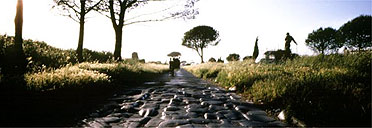
What do you conjure up in your mind when you hear the words Appian Way? A straight ribbon of road stretching over the horizon with total disregard for topography? Legions in heavy armour tramping along, chanting SPQR, like they do in the Monty Python films? Or if, like me, you know Rome and its outskirts, you may recall the sun-streaked stones which lead to the mysterious early Christian catacombs. But what the Appia is, and where it goes, is another matter.
When I described my plans, people would ask: "Where is Appia?" Well, Appia is not a place but a person. The name refers to Appius - Claudius Appius Caecus, a Roman bureaucrat who commissioned the road 2,300 years ago to link Rome with Capua, the second city of the republic. Two centuries later, it reached Brindisi on the Adriatic coast, from where Roman legions ventured as far as the Balkans and Asia Minor. By this time, the road had developed into the first and furthest super-highway of the western world.
But why should anyone wish to travel down a largely neglected Roman road, most of which has been built over hundreds of times since its original construction? When I took my journey, I was chasing an idea. I first encountered the beginning of the Appia a few years ago when visiting a friend near the Pope's summer residence of Castel Gandolfo.
I also knew the region where it ended - the port of Brindisi on the coast, opposite Albania and Greece. What comes between, however, was mostly a mystery. I wanted to search out those remote regions which the Appia crosses - the hot, dry, rural southern territories known as the mezzogiorno - the "midday" - because they bake for much of the year under the unforgiving midday sun.
So, a journey along the Appia was not just a stroll through history, it was a voyage into another Italy. Apart from my regular guidebook, the ever-reliable Cadogan Italy, I took the world's first travelogue - the satires of the Latin poet Horace, who made this very journey and wrote about it in 37BC.
This is not tourist territory. Apart from Naples and the Amalfi coast, the Italians are ambivalent about the south. For centuries, the mezzogiorno was synonymous with rural poverty, crime, bandits and malaria. As the north grew rich, the south turned in upon itself, and even today it has its own customs and culture. Bari, the grandest port south of Venice, is closer to Albania than to Rome. In the Puglian province of Salento, there is a village called Calimera, the Greek word for good morning, and in the white Hellenic towns nearby they still speak Greek dialect.
On a day trip from Rome, you can travel the first few miles of the original road, with the grooves of the chariot wheels still visible, on a special coach called the archaeobus. It departs from an almost invisible bus stop in the far corner of the Piazza Venezia. You will pass all the high spots of classical Rome as well as surprises, such as the restaurant Osteria Antica Roma, a converted burial place for freed Roman slaves, commemorated by the artist Piranesi and the poet D'Annunzio.
The Italian railway network pays scant respect to history, so unless you are on a very tight budget you would be wise to continue by car. A few kilometres from the catacombs are the Alban Hills, enclosing two magical lakes, Nemi and Albano.
You will have to travel a little further to find the genuine article, to the road which hugs the coastline of Lazio and northern Campania. A few minutes' drive from the Tyrrhenian beaches are whole encyclopedias of classical remains. At the stark and massive temple of Jove Anxur above Terracina, naked youths were forced to ride horses over the dizzy cliffs.
Once you cross the border into Campania, you are into the real mezzogiorno, and it is easy to imagine yourself rattling along Horace's Via Appia. It is partly the landscape - the dusty grasses and umbrella pines standing sentry at the roadside. But there is something else - a huge and largely overlooked classical heritage.
In cities such as Capua, Benevento, Taranto and Bari you will find a legion of unsuspected treasures. Capua has the amphitheatre in which the gladiator Spartacus began his slave revolt, and a mysterious mithraeum, an underground temple dedicated to the Persian cult that spread throughout the Roman Empire. You will almost certainly find the temple closed, but the curator of the town museum will arrange a private tour.
Now you begin to penetrate another Italy altogether, closer to Greece than to Rome. Although it is celebrated for Italy's grandest triumphal arch, built by Trajan to commemorate his conquests, Benevento also has a breathtaking museum in the cloisters of the grave neo-Byzantine Santa Sofia church. The Museo Sannio is crammed with ravishing Greek pottery and sculpture. There is also a fine amphitheatre, but the most theatrical location in the town is the Teatro Gastronomico restaurant, with trompe d'oeil décor, and spectacularly cheap local dishes.
At this point, I drifted off the Appia, into the stark hinter land of Basilicata and the city of Matera. This provides one of the most arresting experiences in all of the mezzogiorno. The town is built across a deep ravine enclosing an entire alternate city, hollowed out from the volcanic rock. These cave dwellings are called the Sassi and until the 1950s a single one would house a family of 12 as well as their animals. Today the Sassi have been restored and transformed into chic dwellings, artisan workshops, pleasant bars and restaurants. You can even stay in the Hotel dei Sassi - the best-appointed caves you will ever encounter.
If you are adventurous, you can travel to Aliano, the village isolated in a sea of chalk precipices, where the writer Carlo Levi was exiled by the fascists in the 1930s. Public funds have recently created a literary park, and cultural festivals are organised, celebrating local traditions. Strict Appian travellers will make for Taranto, however, where the Appia hits the coast once more. A wonderfully raffish port, with some of the best seafood in Italy, Taranto used to house the finest collection of Spartan artefacts in Italy until it was dispersed while the building underwent restoration.
Without knowing it, you will have slipped into Puglia. Horace speaks of "Puglia's hills, scorched by the scirocco", but in the spring they are almost obscenely fecund. The rich red earth is crowded with vines and ancient olive trees, and as the Appia strides up from Taranto to Brindisi, you can enjoy a history equally fertile. The handsome baroque of Martina Franca, the blinding white alleys of Ostuni and the remains of Trajan's celebrated city of Egnazia on the northern extension of the Appia are all the more appealing for their relative emptiness.
Here I must make a confession. When I first visited this end of the Appia, I was so seduced by Puglia that I bought a small house there. So my destination was not the louche port of Brindisi, where backpackers sprawl on the grass waiting for the Adriatic ferries, but the white stone-walled countryside and the deserted beaches which fringe the Appia Traiana all the way up to Bari.
However, as my Puglian friend, the writer Raffaele Nigro, says, Puglia has always been a place of passage. Normans, Angevins, Spanish and Bourbons have all left their mark here, as well as Greeks and Spartans. So, after the ardour of the Appian Way, leave time to enjoy the only permanent pleasures of Puglia - the ancient olive trees, the blinding blue sky and the rich red earth.
Getting there: Go (go-fly.com) flies Stansted-Rome Ciampino for £85 return.
Where to stay: For comfortable double rooms at €180 in Rome try La Residenza, Via Veneto (00 39 064880789). Naples: The Britannique hotel, Corso Vittorio Emanuele, is a bargain (00 39 817614145) at €93 for a double.
What to see: The archaeobus leaves Piazza Venezia in Rome on the hour, from 10am to 4pm, and travels the first 16km of the Appian Way. Price is €15 for an all-day ticket with guide. Entry to churches and catacombs extra. Albano/Nemi: A relaxing overnight stop with all the usual water activities.
Where to eat: It is almost impossible to eat badly or expensively south of Rome and east of Naples Expect to pay around €50 for a meal for two plus wine. Rome: One of the best bargains is the Piccolo Arancia in the Vicolo Scanderberg, behind the Trevi Fountain. Via Appia: Just 200m south of Domine Quo Vadis at Via Appia Antica 87, Hostaria Antica Roma serves recipes adapted from classical originals.
Further information: Country code: 00 39.
Flight time Stansted to Rome: 2hrs 30min.
Time difference: GMT + 1hr.
£1 = €1.50.
