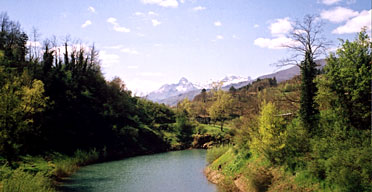
It's Tuscany, but not as you know it. Thickly wooded mountains replace the rolling vineyard hills of the south; snowy peaks and luminous freshwater streams give an Alpine sense and you are more likely to feel as if you have stumbled into a Milka chocolate ad in Switzerland than a mere hour-and-a-half's drive from Pisa airport.
The Garfagnana is a relatively undiscovered wilderness zone in the rural north-west of much-visited Tuscany. Like Italy itself, the region has a pronounced north-south divide: the landscape dramatically becomes mountainous to the north of Pisa and Florence and the tourist numbers plummet the further you drive. Here, smallholdings and cottage industries prevail, with cheese and wine produced predominantly for the locals. Even the sizeable paper and marble industries, which have helped to make this a particularly affluent region, have little discernible impact on the landscape.
In fact it's hard to even find the beaten track where I am staying, in a remote farmhouse walking lodge, deep in the Serchio valley. The Apennine mountains and the Alpi Apuane enclose the valley, ensuring dramatic panoramic views and plenty of walking trails through lush woodlands and meadows. The nearest town, Castelnuovo, is a 10-minute drive through the verdant gorge it straddles. Given its size, the place has some good eateries - a quick stop at the Trito restaurant confirms we are in the gastronomic heartland of Italy - with delicate artichoke cakes, fantastic ravioli, and wild boar sauce and panna cotta. The goat steak, I am told, is also excellent.
I regret having eaten lunch at all though, when faced with the feast cooked up for us on our first evening at Braccicorti. The agriturismo - a farmhouse converted to accommodate visitors with the help of a 90% grant from the Italian government - is run by a warm, friendly family headed by the formidable Mamma Giovannetti, whose sole concern is that you leave her home at least a stone heavier than on arrival.
The food is wonderful, local and fresh. But even after a full day's hike, you are unlikely to make a dent in her provisions. An example evening menu would combine copious pasta to start, followed by a full meat roast (although vegetarians are tolerated), with homemade ice-cream to finish you off. And you're in serious trouble if Mamma decides you need feeding up.
I wander into the kitchen one afternoon, the source of a wondrous aroma that is filling the building. "Your cooking smells good," I mumble in faltering Italian with much gesticulation. "I should hope so," the one-woman cooking machine replies, incredulous.
The farmhouse is the base for trips run by adventure travel operator Exodus, whose activity holidays range from such genteel walking in Italy to trekking in Uzbekistan (the average age for bookings on their Tuscan trips is 30- and 40-somethings). As someone who likes to devour guide books and then pick and choose exactly what advice to listen to, I must admit to having been quite sceptical about an organised trip with a group of anonymous individuals. But the itinerary succeeds in being structured without being regimented and it is fantastic to be shepherded around - when we want to be - by an English-speaker with extensive local and historical knowledge.
Our group expresses an interest in a light walk to work off the food mountain and are taken for a stroll through the wooded hills surrounding the farm. Walking associations mark up paths in the mountains, but local knowledge is essential for rambling lower in the valley. Our Exodus guide, Graham, comes into his own and shows us the lie of the land. In the course of a week's walking holiday (run throughout the year from Braccicorti and from a second lodge during the summer season), he would suggest several local walks interspersed with visits to nearby towns such as the wonderful walled city of Lucca. It's also possible to make day trips to Pisa and Florence by train, and the group always has an input into the itinerary as, of course, does the weather. What is guaranteed is on-tap local expertise should you require it, plus a driver to ferry you home at the end of an evening and a bottle or two of Chianti.
Another day, another dolce, and we set off on a five-hour walk around the valley to prepare ourselves for Mamma's dinner-time onslaught. The abundant wild flowers in the meadows and glistening turquoise streams give the valley a pure, almost heavenly quality. After breathing the mountain air and immersing ourselves in many acres of unspoiled nature, it was time to rest - and eat. Mamma's daughters had arranged a picnic just in case we were getting peckish. Not a chance, but the Parma ham and pecorino, not to mention more roast pork and Chianti, were too good to refuse. We loosened our belts and strode forth: onwards, and outwards.
The next day was spent in the seductive, cycle-friendly city of Lucca, whose imposing medieval walls remain intact. They are 100-foot wide and so strolling, rollerblading, cycling and even driving on the walls is popular. Inside the city, the main mode of transport is the bicycle, and you have to be on your guard for swerving grannies and the two-wheel school run. The opera composer Puccini came from Lucca and his family apartment houses a charming museum of memorabilia, scores - and even his grand piano - while arias soar from room to room to accompany your visit.
Closer to the lodge is the beautiful hill town of Barga, which has a curious Scottish connection. Rosa and Pietro Nardini, who settled in Scotland and founded an ice-cream empire which lives on today, returned to the Tuscan town with their new Scottish families, who have grown into a small community. Today these links are celebrated with an annual Scottish Week booze-up (each August) and permanent exhibitions of resident artists such as John Bellamy. It's got to be the only place you can buy as good a bottle of single malt as extra virgin olive oil.
As we head to the airport, I try out a carefully thought through sentence on Mamma: "Thank you very much, we have eaten very well."
She explains that to her, food is much like petrol: without it one runs out of energy. And hers, we decide, is definitely not unleaded.
Way to go
Liane Katz travelled to Braccicorti courtesy of Exodus. Departures on the eight-day "Tuscany: Garfagnana" trip throughout July and August cost from £644 (plus a local payment of approximately £95). Price includes return flights, taxes and transfers, accommodation, seven breakfasts and five dinners and the services of a group leader. Exodus, 0870 240 5550.
