
Forty years ago, this part of Portugal was too arid to farm profitably, and tourists hardly visited. The first edition of Michelin's guide to Portugal ignores the southern Alentejo. "A proverb has it that 'there is no shade in the Alentejo' and indeed there is almost no vegetation," the book warns. "Flocks of sheep and herds of black pigs eke out an existence on the poorer ground." In fact, the closest the tyre man gets to Santa Clara-a-Velha is the spa town of Monchique. "The only thing to look at particularly in this small town is the Manueline doorway into the parish church ..."
So much for the 1972 Green Guide. And modern-day Michelin man doesn't venture much closer, which might seem a pity - until you realise that, where he doesn't go, nor do the waves of tourists flying in to Lisbon and Faro. But don't expect to find the driving easy (the magnificent Serra de Monchique pass is almost devoid of signage, except warnings not to overtake), or to see Alentejo's attractions neatly laid out before you.
It was sometime after midnight when we arrived at the Santa Clara Pousada - lost luggage and a long, ill-advised route over the Serra were to blame - but the member of staff on duty greeted us warmly. So it wasn't until the following morning that I looked out of the window and thought that something about the view wasn't quite right.
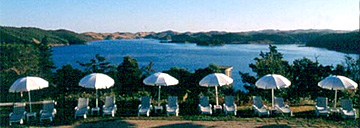
The lake at Santa Clara is the calm, deep blue of a swimming pool, and the ridged hills surrounding it look dry and unweathered. The landscape doesn't seem quite natural. It isn't: Santa Clara is one of Europe's biggest reservoirs, created by damming the Mira river, and intended to generate hydroelectric power and irrigate the surrounding land.
By 1968, the dam was completed, and its chief engineer had built a house from which he could admire the lake. This building later became a pousada, one of the 40-odd state-owned inns scattered around Portugal.
The notion of a state-owned hotel might arouse suspicions among some travellers. It shouldn't, and not just because Britain has some striking examples of an unfettered market's inability to raise standards in the hotel business. The Santa Clara Pousada is a laid-back, unstuffy sort of place whose management has been outsourced to a hotel group. Families and young couples were much in evidence.
It was easy to see why: breakfast, always a good early indicator of the quality of a hotel, was a generous buffet with quantities of fruit for squeezing, a choice of muesli that would not disgrace an Austrian health spa, and even a bowl of M&Ms for younger visitors to scatter over their cereal. Bedrooms were similarly laid-back: earthenware tiles, big louvred wardrobes, marble bathrooms and pale orange linen. Halls and corridors were painted a calm white. The pousada had unheated swimming and plunge pools with beautiful views, and lush gardens cascading down towards the lake.
Supper involved an equally large buffet, though à la carte Portuguese specialties were available at an extra cost. Understandably, perhaps, the emphasis on buffets meant that service was sometimes a little haphazard. Having struggled to attract a waitress's attention, we ordered a local red from the wine list, waited 20 minutes for it, and were just praising it when a free champagne aperitif turned up. If you're in a good mood, this kind of sloppiness won't bother you. If you're in a bad one, tough: the nearest restaurant in Santa Clara is a stiff walk or drive away and is much more basic, though it does serve well-seasoned chicken and vegetables and drinkable cheap white wine.
Santa Clara-a-Velha itself ("velha" means old) is a village of typically Alentejan white buildings edged with broad bands of blue, and a church decorated with azulejos - Portuguese painted tiles. Azulejos are everywhere; you can even find them on the police station in Odemira, the nearest middle-sized town and a 15-mile drive north-west of Santa Clara. You'll also see elderly women in black dress and veils and, on Saturday mornings, people rifling through stacks of brightly-coloured clothing in the market. Take the E393 towards the Atlantic coast and you reach the estuary and seaside town of Vila Nova de Milfontes. Most people come here to surf, or to sunbathe on the relatively uncrowded beaches, but there's also a 17th-century castle (Forte da Boca do Rio) featuring a drawbridge and a garden planted with handsome succulents. Unfortunately, it's not open to the public.
Vila Nova de Milfontes' Largo da Praça has several airy restaurants and cafes where phrasebook Portuguese is not frowned upon - which is just as well, as menus can be quite impenetrable to non-speakers. Expect simple dishes, usually grilled meat or fish, with vegetables on the side. I liked the caldo verde soup, a local staple with cabbage and fatty bacon, and custard tarts with cafe pingado - an espresso with a tiny splash of milk.
The following morning I set off over the dam with one of the hotel's suggested walks in hand. The construction is so enormous that it takes nearly 10 minutes just to reach the other side, and I spotted some divers in wetsuits along the way. After a short walk through the woods and a very steep haul up a hill, I was rewarded with a panorama of the lake and the overwhelming smell of eucalyptus. I decided to text a Portuguese-speaking cousin to show off my new grasp of the language.
"Como aprendeste portugues tao rapidamente? " he texted back. Emboldened, I told him I was in a eucaliptal.
He corrected the tense. "Mas o que é um eucaliptal? Isso é uma nova palavra para mim." A eucalyptus forest, I explained. "Muito impressionante," he replied. At this point my Portuguese was exhausted, but it was indeed impressive: the perfume, the tall trees with their spindly trunks, and the seed pods the size and shape of buttons scattered over the forest floor.
A few hours later it was time to head for Faro airport, but there was one more place I very much wanted to see: the ruins of Castro da Cola, a village with traces of Neolithic, Roman, Moorish and Christian habitation. It wasn't marked on any of our maps, but the hotel receptionist traced a route on her map - shaking her head when I pointed to a shortcut, "No, that is not a good road" - that led to the other end of the lake.
And here our luck ran out. I hope a reader will be kind enough to tell me how to find Castro da Cola (described here briefly) because, hard though we looked, it proved completely elusive. Perhaps it was at the end of one of the unsigned gravel tracks leading off the back roads? Someone is going to have great fun writing the first guide to the southern Alentejo. It really is uncharted territory.
Way to go
Ros Taylor travelled to Portugal courtesy of the Portuguese National Tourist Office, GB Airways and the Pestana Pousadas Group (020 7616 0300, www.keytel.co.uk).
British Airways operate daily flights to Faro from London Gatwick with return fares starting at £69 including taxes (0870 850 9850, www.ba.com).
A range of tour operators offer packages to the Alentejo, including Caravela Tours (0870 443 8181), Destination Portugal (01993 773 269), Sunvil Holidays (020 8758 4722) and Mundi Color Holidays (020 7828 6021 or 0161 848 8680).
Further information
Portuguese National Tourist Office (local call 0845 355 1212, www.visitportugal.com).
