Gamini, 50-something and a fount of Sri Lankan wisdom, was patiently explaining as yet again I failed to get to grips with the obvious and everyday.
You can eat the hairy red rambutans, though too many make your head spin; but it is the fruit of the palu, or rosewood tree, which makes bears drunk and easy to catch. Neither of these is to be confused with toddy: this is what intoxicates the giant fruit bats that are hanging from the trees just above the roadside. And no, that isn't a pair of dogs over there, just a man with a couple of porcupines on a lead. What could be more normal?
It's the little casual asides that give the game away in Sri Lanka: that despite its straightforward tourist appeal - magnificent beaches and top-class hotels - we were after all in an exotic location where you can find a lot more than the holiday basics. Yet for British tourists, who make up some 20% of visitors, there is a frequent peculiar sense of being at home: in language (a precise English), beverage (superior tea) and food (curry). Nowhere does this feel more pronounced than in the southern central hill country where, some half a century after Sri Lanka declared independence, we passed tea plantations with names such as Edinburgh and Sussex. One of the rare pieces of flat land between the monumental cascading hillsides was given over to a cricket pitch, though you're as likely to see the locals playing it in the streets.
Another legacy of the colonial era is found in the hills above Nuwara Eliya, a town whose major landmark is a golf course which runs its entire length (or at least as far as the racecourse and Surrey-style brick houses). The converted Tea Factory hotel, complete with giant cogs and pistons, owes its existence to a dubious fire that took down the original wooden processing plant in the 1930s. It looked suspiciously like an insurance job, but the factory proprietor, a Mr Waterfall, was never fingered. "Of course not," laughs today's hotel manager. "He was English."
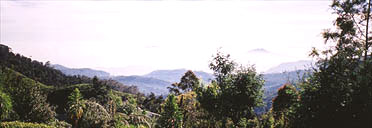
At the hotel, in the morning sunshine, we looked down through the cultivated gardens to the peaks of hills coming through the mist below. With tea growing up as far as the eye could see, a cool breeze and a G&T, you could imagine it was not far off being that certain type of Englishman's heaven.
Equally serene is the extraordinary Kandalama: a hotel built around a rock face, on the edge of a spreading green plain. It's difficult to imagine how a construction of this size can have a small impact on the environment, but with a water recycling programme, local employment and numerous green awards, that's their claim. Far from the nearest town, you can approach the hotel as one might stumble on a Bond villain's base, little imagining the colossal structure behind the creepers.
We entered through a tunnel to swim in a pool set high in the rocks, with a panoramic view and a family of monkeys playing in the treetops nearby. Signs on each room's balcony doors give stern injunctions not to feed the monkeys, while pictures of hawks deter the abundant birdlife from crashing through the panes. And the bathroom comes fully glass-fronted so you can shower with the jungle before you (but discreetly, exhibitionists should note, out of view of the neighbours).
The major impediment to achieving inner peace was our relentless quest to see more: so much to do, so little time. Barely had we encountered the orphaned elephants at the Pinnewala sanctuary than we were scaling the gigantic rock fortress at Sigiriya; temples flashed by and I soon gave up trying to learn the identities of the baffling flora and fauna. But the temptation to cram in the sights is hard to resist.
Our basic maps of the island didn't make clear that the road from A to B would generally take us via terrifying hairpins and perilous inclines, and at other times into a melee of people, animals and assorted vehicles: so, for example, the 48km journey from Kandy to Nuwara Eliya can take the best part of a day. Yet somehow the traffic moves, and with astonishingly few accidents given the constant danger. The key to withstanding the journey is to ride in the largest, air-conditioned vehicle you can find, and only ever to look out of the side windows.
Fortunately, many of the best sights are on the roadside, where a rich array of life unfolds. Driving from Colombo to Kandalama, we passed through villages specialising in their one particular local product. In one village vendors sell cashew nuts under straw canopies; in the next, the peculiarly elongated pineapples of the island; and then stall after stall of cane furniture, baskets and ornaments. Weavers work precariously as traffic streams by; in the next village, roadside workers turn coconut trunks into rafters. Beyond, towering trees and dense, lush vegetation surround the rice fields where occasional buffalo and attendant egrets loll in the sun.
While a whistlestop tour can't do any country justice, it provided a barrage of sights, which ideally would be combined with a week or two on the beaches at the end. We stopped - all too briefly - at the Triton hotel on the brochure-perfect south-west coast. Staying in rooms by a beautiful beach and eating fabulous food felt like real luxury; but actually this luxury proved much more affordable than one might expect.
Hit by a drop in visitors after the Tamil attacks on Kandy and Colombo airport, Sri Lanka's tourist trade hasn't quite recovered, even though a ceasefire is firmly in place. Rooms were being offered in one deluxe hotel, the manager said, at around a third of the normal rate. With direct flights from Heathrow on the vastly improved Sri Lankan national carrier, it's a good value destination even for simple sun and relaxation.
And if the Mount Lavinia hotel, south of Colombo, is anything to go by, plenty of Brits are taking advantage. The families and young couples didn't meet with everyone's approval: one older patron surveyed the pool and said: "You know, only the very best sort of people used to come here." Colonial snobbery aside, there's a definite incongruity between the hotel staff in immaculate pseudo-regimental dress - white safari hats and gleaming brass buttons included - and us lobster-skinned tourists in t-shirts and trunks. Although in fairness, it's hard to imagine anyone born after 1948 and the fall of the Empire looking entirely at home in these surroundings: a mansion built by an early British governor largely for the purpose of discreet liaisons with his Sinhalese concubine.
Our final evening there saw a brief tropical storm. Huge forks of lightning and torrential rainfall, leaving the beaches and Colombo to the north bathed in a strange orange hue. In the stunning light, with the noise of seabirds and of bathers racing shrieking into the waves, the shore was transformed into an awesome, otherworldly scene. The Lavinia, like much of old colonial Sri Lanka, is impressive and comfortable, but it's the natural backdrop that takes the breath away.
Ways to go
Where to stay
As well as the Tea Factory, Kandalama, the Triton and Mount Lavinia, Gwyn Topham stayed at the Earl's Regency in Kandy and the splendid Colombo Hilton.
· Gwyn Topham travelled as a guest of Sri Lankan Airlines, the Ceylon Tourist Board and Aitken Spence Travels. A tailor-made tour of the island including half-board accommodation in deluxe hotels, air-conditioned transportation, entrance fees to places of interest and services of a professional English speaking guide costs from £420pp from Aitken Spence, Colombo (00 94 1 308 308). The excellent Sri Lankan airlines fly direct from Heathrow to Colombo daily. Call 0208 538 2000.
