We never got the chance to meet Gualtiero Marchesi. He was around, no doubt about that. The bartender told us so, and when it comes to keeping up with events in a hotel, especially in a five-star luxury hotel, there is no better source of information. So, yes, Mr Marchesi had been around earlier, making sure everything was in order in the kitchen.
But if our paths had crossed, what would I have said anyway? "Mr Marchesi, can I just say that dinner was fantastic." Or "Hey, Gualtiero, you know that thing you do with the baby squid? Just run it past me one more time."
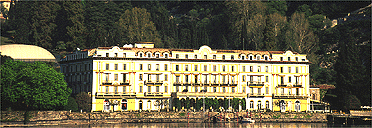
No. On reflection, it was definitely for the best. After all, when you are not only credited as being the first Italian to pick up a third Michelin star but also lauded as the father of l'alta cucina, then there can be no more unappetising sight first thing in the morning than an over-excited guest pacing towards you over the lawn of L'Albereta. The 19th-century hunting lodge, which has been transformed into a country house hotel and stands in the Franciacorta region of northern Italy, is where Marchesi chose as the home for his restaurant after many years in his native Milan.
Nevertheless, it would have been a pleasure to have shaken the hand that designed the previous evening's 12-course dinner. Called simply "Oggi", meaning today, the menu is constructed from whatever catches the eye at that morning's market. Marchesi and his team of chefs then transform the produce into dishes that are as visually exciting as they are delicious, using the plate as a canvas upon which to construct each masterpiece.
On the evening in question, this approach was exemplified by our calamaretti, the detached bodies and tentacles of the baby squid separated by a broad black brush stroke of their own ink that arced across the white china plate. The dish served to confirm what an earlier flirtation in the evening with raw scallops in ginger accompanied by slightly sweet, pungent pink pepper had suggested: that Mr Marchesi had a considerable appreciation of Japanese cooking. But European influences were there, too, in the shape of fois gras wrapped in cabbage, a delicately roasted quail, and the largest prawn I have ever seen. "No sir, it is not a langoustine." Was I arguing?
We were expecting the unexpected but even so nothing prepared us for the ice cream made from taleggio cheese or the uovo della passione, which comprised a sugar-coated egg yolk. Strange combination? Perhaps, but it was all delicious, and as light on the palate as it was on the stomach. No heavy sauces here, thank you very much.
We went to bed feeling that the need for pampering that had brought us to the hotel had reached a new level. Yes, the Jacuzzi, indoor pool and sauna had all been very nice. The invitation to play the local 18-hole course had been politely declined in the interests of self-esteem, although for one moment I had thought of taking up the offer of a tourist-friendly horse for a ride in the Franciacorta countryside. But the reputation of Marchesi was what brought us here, and he had not disappointed, his chefs busying themselves at the stoves visible through the large glass window at the end of the gallery restaurant.
It was easy to see what inspired Marchesi to head for the outer reaches of Lombardy in the early 90s. Not only was he slap bang in the middle of one the most fertile centres of viniculture in the world, but the country house allowed him the space in which to develop his ideas away from the constant gaze of big-city restaurant critics.
New territory was very much on our agenda, too, and foregoing the pleasures of the mountain bikes for four wheels - come on, Sophia Loren ranks among the high-profile guests to have graced the well-appointed halls and bedrooms of this establishment, and do you really think she had packed her bicycle clips? - we began our tour with a visit to the monastery of San Pietro in Lamosa. The building was taken over by Benedictine friars from Cluny on the other side of the Alps in the 11th century, but since being abandoned by the order had endured both neglect and repeated acts of vandalism. However the efforts of local parishioners in recent years have saved it and the precious frescoes within from destruction.
Lake Iseo, visible from the monastery, has long existed in the shadow of its more famous near neighbour, Garda, but in the summer months there is no shortage of expensive yachts mooring at the quayside while ferries transport a steady stream of sightseers to Montisola, the largest island on the Italian lakes. For many years, Montisola was renowned for the quality of the nets its inhabitants supplied to the local fishing industry, but perhaps the most notable success came when the craftsmen were chosen to supply the netting for the goals at the 1982 football World Cup in Spain. This not only proved to be a stroke of good fortune for the locals but indeed the Italian national team, who went on to lift the trophy.
National pride was also evident in Iseo's Piazza Garibaldi, where a statue of the hero of Italian unification who had earlier helped the Lombards in their struggles with neighbouring Austria looked down on the bustling square. But this is not a place that lives in the past, the fashionable boutiques and abundance of restaurants ensuring that visitors are never short of somewhere to spend their money.Naturally, lunch is a serious business. Certainly the expression on the face of the tinca , or tench, sitting on my plate told me this was not a fish to be taken lightly. Tinca can be found in abundance in lake Iseo and they are prepared by stuffing the body with a generous amount of butter, breadcrumbs, and parsley before baking in the oven. A side dish of p olenta bresciana completes the perfect accompaniment to a hearty appetite. Granted, the tinca may not have the looks to grace Marchesi's culinary catwalk, but as we discovered, in this case beauty was most definitely more than skin deep.
The same can be said of the grapes that populate the acres of vines visible from L'Albereta, and which go into the production of both the red and white wines from the nearby Bellavista and Contadi Castaldi cantine which grace the tables of Marchesi's restaurant. The respective tour guides dutifully took us through the various processes, well aware, I am sure, that it wasn't our thirst for knowledge that had originally brought us knocking at their door. Even so, we did pay attention, braving the chill of the cellars where the sparkling wines that have had producers in Champagne casting nervous glances in their direction sit maturing in the bottle. There was also an array of fine " fermos ", or still wines, including Mancapane. This distinctive white takes its name, literally "lacking bread", from the fact that the soil in which the vines grow proved to be inadequate for cereal crops but was ideally suited to the vines upon which its chardonnay grapes flourish.
Naturally Franciacorta wines were much in evidence during our evening at La Mongolfiera dei Sodi in the nearby town of Erbusco. Tuscan dishes such as onion stuffed with cheese, pappardelle with pigeon, and veal chop gave us ample opportunity to give full rein to our newly-acquired knowledge, although there was healthy competition for the attentions of the sommelier's corkscrew in the shape of some robust Tuscan and Piedmontese reds.
One beautiful sunny morning we awoke eager for another slice of the good life, only to realise that three days had flown by and there was only time for a final stroll through the woods and lunch before the car for the airport arrived. We had come in search of pampering, and we had certainly got it: whether it was simply sitting in the hotel garden by the fountain, sipping sparkling wine, watching the more energetic wander down to the tennis court; or relaxing on our balcony overlooking the Lombardy countryside. In truth, it was like stepping into somebody else's life for three days. By the end, I was almost surprised that we hadn't found time to use the helicopter pad; so thoroughly in tune with my surroundings that was I that if someone had leant over to inform me my pilot was ready, I would not have batted an eyelid. Mind you, the chances of us getting off the ground after that not so little tinca in Iseo would have been slim.
We descended the steps into the piano bar for the last time, choosing a light lunch of bresaola and parmesan on peppery leaves, ideally suited to a bottle of the Bellavista Rosso Franciacorta. "Thank you," I said to the bartender who had prepared our meat and cheese, "That was delicious."
"I know, sir," he said, his wry smile betraying not the merest hint of conceit but of quiet confidence in his own ability. Mr Marchesi would have been proud of him.
Way to go
L'Albereta, Via Vittorio Emanuele 11, Erbusco, Brescia Tel: 00 39 030 77 60 550; fax: + 77 60 573; e-mail info@albereta.it. Doubles start from L235,000 (£75) a night (breakfast L35,000 extra) in low season to L280,000 in September and over Christmas. Price includes use of the pool, Jacuzzi, gym and tennis court. Dinner at Ristorante Gualtiero Marchesi: Menu Oggi L240,000 excluding wine; Degustazione L260,000 excluding wine. By road, the hotel is 15 minutes from Brescia airport, while Milan Linate is 40 minutes away. From Brescia or Milan take the A4 motorway and exit at Rovato, left towards Erbusco-Sarnico. Ryanair (0870 3331231) flies from Stansted to Verona-Brescia from around £90 return inc tax. British Airways (0845 7733377) flies from Heathrow to Milan from £230 inc tax.
Ultimate weekends
Dream tickets
The Ice Hotel in Lapland, shopping in Dubai, or perhaps touring Britain in an Aston Martin DB6. Charlotte Atkins suggests something a little more adventurous for the weekend
Game on
What are you up to this weekend? Follow our examples and you could make your free time go a lot further. Charles Burgess swaps his civvies for a safari suit
Comfort zone
Katharine Viner dons regulation robe and slippers, and destresses in style in the Chilterns
High society
It's close, but about as different from Europe as you can get. Lisa Sykes walks through the High Atlas with Berbers and soaks up the atmosphere Marrakech's souks
Horse power
Fancy some sunny days at the races? Former jockey Thomas Rees recommends a spectacular new course on the Costa del Sol
