
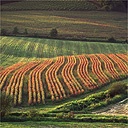
The thing about Gascony is that it doesn't exist. Rather in the manner of old Yorkshire being interfered with by Humberside and Teesside, Gascony has been consumed by Gers, Landes, Haute Pyrénées and parts of half a dozen other departements. But as Yorkshiremen always know where old Yorkshire is, true Gascons not only know where Gascony is but see the old Dukedom as superior in every way.
Gasconner is an old word that means "to boast" - and why not? They have fine wines, armagnac, hunting, the corrida and even rugby; and don't forget the Three Musketeers.
In the Armagnac area, I was chatting to a local man. "But how does armagnac compare with cognac?" I asked. "Cognac?" he said. "Never heard of it."
Gascony runs, very roughly, from Biarritz in the west almost to Toulouse in the east, and from Roquefort in the north to the Pyrenees. The southern and western parts are particularly special, not only because they take in Biarritz, Pau, Lourdes and Tarbes but also because a railway runs obligingly round.
Biarritz is absolutely prime for a trundle through southern Gascony for many reasons. It is a terminus for the motorail from the north and a destination for Ryanair from Stansted. A dinner of ttoro and Rioja wine emphasises that Basquedom comprises the western extremity. Ttoro is the prince of fish soups and locals will tell you that it beats bouillabaisse to nothing.
The early morning train from Biarritz runs up to Bayonne and down to Pau, 60 miles (and an hour-and-a-half) away. It runs along the Gave de Pau with the boulevard des Pyrénées and the town vertically above on a high escarpment. At 7am, the station was hardly open and the left luggage place barred and shuttered. My heart sank at the prospect of scaling vertiginous roads up to the town centre. "Quel direction au boulevard des Pyrénées?" I asked a young commuter with a briefcase. "Par le funiculaire," he pointed. Sure enough, 10 yards across the street a small cable car waited with its sliding doors already open. Small, ancient, weathered by the decades, it seemed part of the natural geology. This is not a tourist attraction but, like roads and telephone lines, an integral part of the working of the town.
Its location and ambience made Pau a health mecca for the British long before Nice and the Mediterranean resorts were popular. It has a Sussex feel - only with a view of the Pyrenees.
I played a few holes at the Golf Club de Pau, the first golf club in continental Europe, created by Britons in 1856, along with tearooms and, to the disbelief of the locals, cricket. King Henri's castle dominates the old town. It is here, in 1553, the mother of an heir to the throne was rushed back from the north so her child could be born in Pau and have his lips rubbed with the garlic and Jurançon wine needed to make him a proper Gascon.
Another diesel on the same line, drab, grey, taller and longer than British ones, clanged us away from Pau and, half an hour later, on to Lourdes. Life here is of schizophrenic extremes - of devotion, belief and quiet faith; of crowds and noise, fast food, trinkets and money. Go straight into the middle of the Cité Religieuse to get the best impression. The grey walls of its churches and towers surround the huge square, criss-crossed by nuns in black, priests in white and phalanxes of nurses wheeling stretchers, pushing wheelchairs and helping the hopeful rows of the lame and frail. Clerics give blessings to ad hoc open-air gatherings seated on benches marked "Pour Malades" and, in English, "Beware pickpockets".
I say it is best to go directly here because if you dally along the approach streets (especially the boulevard de la Grotte) you get a very different impression. If you're into candles, it's for you. Shops are filled with them by the thousand - some small enough for a birthday cake, some too large to lift, white, coloured, with or without spangles. And there are shrines, crosses and figures of Christ. In a shop bearing the sign "The Sacred Heart of Jesus", church organ music pumped out from a tape-player while a small sea-shell grotto lit up and flashed.
One of the same trusty, now familiar, diesels snorted and clanked me 15 minutes further east to the town of Tarbes. Dr Johnson once didn't quite say that the best thing about Scotland was the train back to London, but much the same could be said of Tarbes. Put at its most diplomatic, the town is something short of attractive but it has unrivalled transport connections, especially to Auch, the old capital of Gascony.
Much as I love travelling by train through the countryside, the bus does something which the train does not - namely, make its way through the middle of the small towns and villages. We passed through a dozen of them, some tiny, some larger, such as Mielan and Mirande, but every one a picture; the square with the old men in flat caps under the trees, the duckpond (there are more ducks than people here), the old inn.
In the early afternoon at each bus station, middle-aged ladies in their best frocks and hats came on board, carrying boxes of cakes to sister Claudette or aunt Françoise in the next village. They all knew the driver and, once seated behind him, would continue to exchange the day's gossip in loud voices. To my terror, he would turn his head completely to emphasise a point as the vehicle sped around the bends.
As we passed farms with names such as "M Laugier Producteur de Foie Gras", I asked my neighbour about the gavage or alleged force-feeding used to grow the liver. "Look around," he said. "The birds are free, they peck the ground, they drink at the pond." "But at Christmas?" I persevered. "Listen," he said, "I have fed them in the yard in the morning, forcing it down through the funnel. They scamper away, free, and in the evening they run back for more."
In Auch, the old capital of Gascony, the word "somnolence" comes insistently to mind. Shops open late in the morning and close early in the evening, with a long languorous close-down for lunch in-between. The wonder is that this place managed to produce such a dashing hero as d'Artagnan.
Yet the drowsy setting of Auch harbours two of the country's greatest artistic achievements. Halfway up the 370 steps to the dominating cathedral, high on the hill, you pass the statue of d'Artagnan. Up in the church itself, you are immediately immersed in coloured light from the 18 stained glass masterpieces created by de Moles 500 years ago.
Even more special are the carved choir stalls. The oak had been soaked in water for 50 years to make it hard enough to carve the minute detail - the eyes, noses and mouths - of the small biblical characters. And it took a further 50 years for three generations of craftsmen to complete those 1,500 figures.
Another day, another bus east across the rolling, sweeping breadth of Gascon farmland. Through Gimont, past farms advertising take-away foie gras, to Toulouse on the Garonne and the limit of the old Dukedom.
It had not been a place of clubs and nightlife, but of country folk and countryside. Country food, too. To finish off, I indulged in a large bowl of garbure, a mortally calorific but heavenly soup of sausage, goose, salt pork and cabbage. What more is there to say?
Way to go
Getting there: Ryanair (0870 156 9569 and 0870 333 1231, ryanair.com ) flies daily from Stansted to Biarritz from £20 return. For Motorail, Rail Europe, 179 Piccadilly, London W1 (0870 584 8848). Also Continental Rail 0906 302 0080.
Where to stay: In Biarritz, Café de Paris (0033 5 5924 1953) four star; Hotel Ibis (0033 5 5950 3838) two star. In Auch Hotel de France (0033 5 6261 7184) four star; Hotel de Paris (0033 5 6263 2622) one star. In Toulouse, Grand Hotel de l'Opera (0033 5 6121 8266) four star; Park Hotel (0033 5 6121 2587) two star.
Further information: French Tourist Office, 178 Piccadilly, London W1V 0AL (0906 8244123, mdlf.co.uk).
