I had 30 days for 12 major cities, two fairytale castles, a medieval town and essential relaxation on a Greek island. I left England with an overflowing rucksack, Lonely Planet, bags of enthusiasm and an all-zone Inter-rail pass (£229) for Europe for one month. I returned with a severely depleted bank account, sunburn, sore feet, invitations to various improbable corners of the world, and memories that will take some beating.
Anyone under 26 can get an Inter-rail pass. As can the over-26s - for £319. Both can be bought from Rail Europe (08705 848848, (raileurope.co.uk).
The practicalities
I flew to Vienna (£65, with Buzz, and two hours late), and went on to Bratislava, Prague. Then Munich, Salzburg, the Czech border town of Cesky Krumlov, and Prague again. Then Frankfurt (one rainy morning), Paris, Venice, Rome, Naples, Athens (via the Brindisi-Patras ferry), the nearby island of Andros and back to London with EasyJet (£80, booked well in advance).
My budget didn't stretch to much in the way of luxury. I slept in hostels or cheap hotels, on apartment floors, on trains, on ferries and in Athens airport. The liveliest hostel was YoHo in Salzburg; the cheapest (and nicest) was the Travellers Hostel in Cesky. Four of us shared a long, low, stone-floored chamber in a 14th-century building for the princely sum of £4 apiece.
Venice, Rome and Greece were most expensive. An Athenian friend assured me that £25 each for a double on Andros was a very good price. Besides, it was worth incurring the extra overdraft for the ocean view, and a spot of night-time swimming.
Food was cheapest from supermarkets and hostels (the shared kitchen is always pivotal to traveller sociability). But it would be a mistake never to venture out: outdoor cafes are, after all, the ideal lazy way to admire a city. Again, I paid more in Italy, and drinks (wine excepted) were at London prices in both Italy and Greece.
Brezlgölb near Herrengasse in Vienna, was hard to track down but worth the effort, with authentic Austrian fare, wooden tables and gothic lanterns warming dark corners of what might once have been a castle cellar or crypt. All for £7.50 apiece.
U Dwori Maryu, nestled on the riverside in Cesky, cost next to nothing and served such medieval fare as soup with daisies. The rather pricier Alla Rivetta, almost squashed under Ponte San Provolo and described by a friend of a friend as the only place to eat out in Venice, provided ambrosial seafood and a window on to the canal.
Then there were picnics - in trains, in parks, and by moonlight on the deck of a Mediterranean ferry. It may not make the tour guides, but you don't get much better than ciabatta, fresh cheese, basil, tomatoes, grapes and cherries from the Rialto market, eaten in streaming sunshine in Venice's Campo di San Marco.
The problems
The trains had their moments. Travelling from Prague to Bratislava was like being in a 70s communist movie, with those six-person compartments, terrifying guards and yellow-brown decor. They didn't go everywhere, and rarely without slow and complicated changes. A couple of days with fellow travellers in a hire car took me to Neuschwanstein in Germany (whose castle inspired a scale model in Disneyland), as well as Cesky. Both are very much worth seeing; both difficult to reach by public transport.
I wasted too much time queueing in stations. It took two hours in Rome's Termini station to get tickets to Naples. I also forked out for supplements on most intercity trains in Western Europe.
Only six of my trains ran on time and some were spectacularly late. From Venice to Florence, we clocked up an impressive two-and-a-half-hour delay. Most annoyingly, something went wrong with the Prague-Frankfurt train at five in the morning: we were all shunted out of our carriage - first to stand jammed like sardines in the next one, then to wait on the cold platform until a replacement was found.
The overnight ferry was fun - once you were on it. Lonely Planet swore you had to book weeks in advance, but Hellenic Mediterranean Lines claimed it was impossible to book over the phone. Getting from check-in to the ferry without a car involved a long, hot, anxious wait with about 50 other backpackers for a minibus. When it finally rolled up, all traveller solidarity was forgotten in the fight to get on board.
The compensations
It was definitely worth the effort. I made friends in one place, and then travelled with them for a week, or passed evenings in lively debate with people I had just met and would never see again. I stayed in an artist's garret overlooking Sacre Coeur with the friend of an American I met in Munich, and played cards for tequila shots with the Australian bartenders of a Parisian pub.
I met a trainee chef who planned to open a restaurant in his native Chicago. And a London law graduate determined to follow his parents into shipping, with a North Carolina girlfriend who could have been the fourth member of Destiny's Child.
An elderly Chinese couple were staying in a hostel in Venice, painstakingly cooking their own elaborate meals and speaking barely a word of Italian or English.
A Swedish girl in Prague had chucked in her latest job and was hanging on until the money ran out - or she thought up a bestselling novel.
Then there were the places. I am left with a mismatch of memories, all of which seem slightly unreal reviewed from the gloom of south London. A small boy playing Mozart, and very well, too, on a Viennese sidestreet; painters, dancers and singers creating an agreeable cacophony on Prague's Charles Bridge; La donna è mobile, from Verdi's Rigoletto, played, whistled or sung just about everywhere in Venice.
But some stand out. Pompei was fascinating, and worth the trip to a too hot Naples, with its less than beautiful architecture and lethal drivers. Central Athens is similarly uninspired, but the Acropolis is a must-see, even in blistering heat. We ate in Plaka afterwards, a feast worthy of Athena herself, and admired it from a safe distance.
The grounds of Vienna's Summer Palace were the stuff of fairytales, even in a rainstorm. And I spent hours in Prague's Old Town Square, sitting, standing, drinking or just attempting (in vain) to take it all in.
Hofbrauhaus, Munich's infamous beer garden, was an astonishing, noisy, cheerful mass of people of all ages and nationalities, swigging from vast tankards at hundreds of wooden tables. It was worth the (not insignificant) price of the beer just to soak up the atmosphere.
In Cesky, I sat on a castle wall with four near-strangers, now friends, and watched the sun set over a town seemingly untouched by time. It has to be one of those essential moments that travellers go on about, and that no one else understands.
The Snake Bar lived up to its name, too. Happily, (for us rather than the snakes), they were confined to a tank kept under the counter.
Kutna Hora, also in the Czech Republic, was weirdest of all: a church decorated with human bones. Bones in pyramids, in shields, even in a chandelier. But strangest by far were the skulls and crossbones hanging in loops from the ceiling, like paperchains at Christmas.
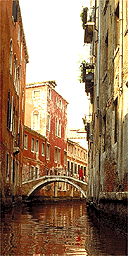
Venice, of course, was spellbinding. Yes, it's a tourist trap, but with good reason. And the crowds seldom venture far from San Marco. It's pricey, but worth it. I sat with a friend in a quiet side street, feet not quite touching the murky canal waters, and watched the gondolas drift by with their loads of Japanese tourists and middle-aged Italian opera singers. It was cheaper than hiring one, and probably more entertaining.
Rome, already an addictive city, was magical by night, as each new moment of almost cliched beauty capped the last. Birds (or were they bats?) lifting in clouds over the Vittoriano monument and a sickle moon in the night sky. Then eating pizza in Trastevere. Climbing the Spanish Steps. Sipping cocktails in Piazza Navona, and watching the world go by. Throwing a coin into the Trevi fountain and making a wish - although I suspect it would take more than L200 (about 6p) to get me Jude Law.
Ten tips
• Do some research before stumping up for an Inter-rail pass - supplements are pricey in Italy, and trains in Eastern Europe are very cheap anyway.
• Save queueing at stations by checking train times on the internet or investing in a Thomas Cook timetable.
• Take a Cirrus/Maestro cash card. Many hostels don't take credit cards; commission on traveller's cheques adds up, unless you seek out the relevant American Express shop.
• Book in advance in Italy and Greece.
• Take insect repellent.
• Invest in proper city maps. The ones in the guidebooks are not adequate.
• Organise your E111 and take out travel insurance.
• Learn a few words of the language just to show willing. 'Thank you' and 'How much does it cost?' come in handy.
• Be prepared for bad weather. I failed to take either trousers or waterproofs and, contrary to fond hopes, it can be cold in Paris in the summer, and rain does fall, even in Venice. Sensible footwear is also essential: sandals are not ideal attire for climbing volcanoes.
• Buy a suitable sunscreen - and remember to wear it.
