
In a classic French film I used to like, the hero resolves to look for reasons to live, for simple signs of happiness in his social circle, before - finding none - he ends his quest by putting a gun to his head. On the plane to Vancouver, I watched Elf, in which the friendliness and good will of a few people infects the world with Christmas spirit, saves Santa and, ergo, humanity itself. This difference in attitudes is, more or less, the main difference between skiing in Europe and North America.
There is something quite astounding, almost unsettling, about the cheeriness you encounter in Whistler. From the hotel laundry to the lift attendants, people here seemed to respond to any request with extraordinary ebullience. In fact, the word respond doesn't do them justice: they were reaching out, touching desires hitherto unborn. A fellow guest is baffled by the "random acts of kindness" he recounts. Everyone has a story, a cheery word, a piece of advice, and even to my cynical mind, manages to inquire after your wellbeing without sounding like they are taking the piss. By the time the ski hire shop assistant asks me if I am having a good time, I can only tell him with all sincerity that, yes, dammit, I am, and he beams back like I've made his day.
In the night I wake, faintly troubled: if I can't keep the flame of misery burning, who can?
Workers in Whistler wear a badge announcing their name and where they are from. The resort is jam-packed with accents from all over the English-speaking world, so this is probably a good sanity-preserving idea - I do feel a constant impulse to say, hey! guys! where are you from? Astonishingly, it reveals that quite a few of these sunny people are from the UK. Penny at the lift, looking out for us with that sweet smile - from Skelmsersdale? The Fairmont hotel valet who carries in our skis and gives us hot cider like it's what he's always wanted - from Leeds?! I know people from Leeds, and, well, this isn't normal.
Whistler barely needs friendly people: it has already, in its comparatively short lifetime, built up a reputation as one of, if not the, top ski resorts in the Americas. What is today a town of 10,000 permanent residents and millions of visitors was only first conceived of in the 1960s. Even our hotel, the excellent Fairmont Chateau, which looks like some medieval Bavarian castle on the website photo, was actually only built in 1989.
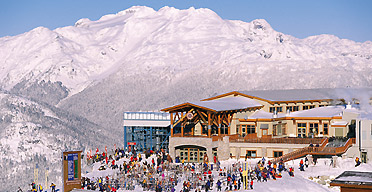
The ski area is made up of two facing mountains, Whistler and Blackcomb, both massive, forested with cedars and firs, and home to long and extremely wide pistes. From the top of Blackcomb we could all but ski into the Fairmont's hot tub - or at least could have if our ski guide hadn't been a bit more solicitous about not scratching the rental skis on the relatively patchy snow down below. The covering looked pretty generous even there, but these Canadians are used to more. A dump of 31cm had fallen the night before we arrived in December, and compared to Europe's slow start to the season, powder was plentiful on the west coast.
Above the treeline, Whistler's ridges form several huge bowls. If in some ways this makes the landscape less dramatic than the jagged peaks of the Alps, their shape allows enormous broad sweeps of skiable snow, both groomed runs and a large amount of off piste skiing. The pioneer spirit of adventure is still thriving in these parts, judging from the stream of people making their way past the warning signs and skiing out of bounds. Within the resort area, there are also many off piste trails through the trees, making it easy for advanced skiers to try something a little more challenging and cut back onto the groomed runs further on.
While the facilities, lifts and overall functioning of the resort (few queues) make it a pleasure to be in, it's ultimately the enormous scope of the place that makes Whistler such a draw. It's the largest ski area in North America, which meant that even for an early intermediate skier coming at a time when not all lifts were open, there were more than enough superb runs to try. Many greens (more the equivalent of a European blue) are extensive with more challenging sections, but broad enough to give novices confidence. The broad upper Olympic trail back to the midstation on the main Whistler gondola looks relatively flat and yet is deceptively fast (there are even marshals to slow you down), and we also enjoyed Franz's run, earmarked for the women's downhill in the 2010 winter Olympics.
Boarders make up a very sizeable minority of the population on the slopes, complete with stunt culture. From the chairlifts, we timid skiers enjoyed the views of daredevils in the terrain park pulling off spectacular jumps. It could make you feel a little old, though, especially when you don't get the lingo. I made the mistake of asking a young guy with a goatee whether he was into boarding, as opposed to skiing. "I ride, man, yeah," he replied (still friendly, of course). "I like to ride."
There are other ways to get your kicks in the snow. One such activity - about whose merits, forgive us, we had been extremely sceptical - was snowshoeing. We were won over, not least by our passionately enthusiastic guide, Mark (adventureswhistler.com). As intermediate skiers, we hadn't really had the chance to get off piste and play in all the fabulous snow falling around. Snowshoeing let us plunge into light fresh powder, up above our knees.
The trees, which when viewed from a distance form a fairly monotonous coniferous forest, turn into magical iced shapes close up. We cut trails through the drifts between them, shaking off the huge lumps of light snow clinging to their boughs. The trees at this altitude up the slopes, while tiny compared to the giant trees elsewhere in British Columbia, are still impressive by most standards. These particular firs would have been standing, Mark reckoned, long before the Scottish botanist David Douglas classified them with his own name 180 years ago.
Perhaps the best way to really appreciate the trees here is via a slightly more nerve-racking, if less energetic activity, the ZipTrek (ziptrek.com). These tours also stress the ecological aspects and the guides are informative about the surroundings. I was, though, more preoccupied by the thought of imminently hanging over a ravine on an 1100-foot long cable.
The series of cables connect some wonderfully elaborate platforms built around some enormous Douglas firs that span the Fitzsimmons creek between the Whistler and Blackcomb mountains. Zip trekking - known elsewhere as death slides or canopy slides - means hanging on a steel cable via a harness and clip and whizzing to the other side; more terrifying in the moment of stepping off into thin air than in the actual ride across. It's the sort of activity I'd more associated with summertime, but doing it in the snow gave it a different feel - not least the thud of snowballs hurled by those who'd already got across when I came in to land.
Way to go
Gwyn Topham travelled as a guest of Crystal/Thomson. He flew with Zoom airlines from Gatwick via Glasgow to Vancouver, and stayed at the Fairmont Chateau Whistler, tel 604 938 8000, fairmont.com/whistler.
Seven nights at the Fairmont Chateau Whistler, including return flights from Gatwick or Heathrow and transfers cost from £997. Crystal reservations on 0870 160 6040 or 0870 160 4090 or visit crystalski.co.uk.
Early season departures (Nov 27, Dec 4 and 11 Dec 2005) are available with two nights at the Fairmont Waterfront in Vancouver followed by five nights at the Fairmont Chateau Whistler, for only £549 per person (based on two sharing, including return flights and transfers).
Zoom Airlines operates services three times a week to Vancouver from Gatwick, which offers the flexibility of 7-, 10-, 11- or 14-night stays. Zoom also operates a weekly flight from Gatwick to Montreal, which is suitable for skiers travelling to the famous Tremblant ski area.
Prices on Zoom's winter flights start at £129 one way for Vancouver including tax (£89 one way for east coast destinations). The service includes meals, drinks, in-flight entertainment, a generous baggage allowance with no additional charge for skis or snowboard. Passengers can upgrade to Zoom's premium economy seating for £49-£79 each way, for a 36-inch seat pitch, dedicated check-in, priority baggage, additional baggage allowance, choice of meals and complimentary drinks throughout the flight. See flyzoom.com or call 0870 240 0055.
More information and useful links: whistlerblackcomb.com
Snowshoeing: adventureswhistler.com
ZipTrek Ecotours: ziptrek.com
