
Back in the late 70s, when I was taking my first train trips on grimy blue and yellow diesels, Jimmy Saville was boasting on posters that this was the age of the train. A few years later, I travelled unsupervised to London on an InterCity 125. And when I went to live in France in 1996, I didn't fly: I took a sleek new Eurostar from Waterloo and held my breath as it slipped underground for the 20-minute ride under the Channel.
I did notice when the train plunged underground this time, but only because the signal cut out on my mobile phone. This time, I was going to Germany, and covering the 451 miles to Hamburg by night train.
I did have good reasons. I was attending a friend's wedding on a Friday, which meant I couldn't be flexible about dates and times. The lowest airfare was just under £300. What's more, I hate flying; and it was on the same airline that I had suffered a violent, takeoff-induced nosebleed and been forced to pay for the dry-cleaning of a teddy bear belonging to the child sitting next to me.
Rail trips to Europe are generally handled by an agency called Rail Europe, which doesn't yet offer online bookings, so I explained my requirements to a phone operator. The first unpleasant discovery was that the trip would not be as cheap as I'd thought (even with the benefit of a youth fare on the London-Brussels leg, it cost £212), and the second was that the private cabin I'd hoped for would set me back an additional £400 or so. I would just have to bunk down in a couchette with five unknowns, any of whom might be waiting to pounce on me or my belongings while I slept.
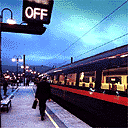
Nonetheless, the trains were convenient. I could check in to Waterloo at half past six, catch the Eurostar to Brussels, and connect to a direct train to Hamburg at around 10.30pm. All went well. The Nacht Zug's corrugated silver carriages pulled in on time and I set off in search of my cabin.
We had left Belgium by the time I found it, thanks to a peculiar numbering system and an initial panic when I realised that most of the train was going to Berlin. By that time, my companions had climbed into their bunks and turned out the light. There were bad-tempered protests in various languages when I turned it back on and tried to shove my rucksack into a space by a Belgian's toes. Anxious not to antagonise everyone, I quickly turned it off and squeezed into the foot-high cavity of the bottom bunk. Should I undress and try to change into pyjamas? It seemed a bad idea. Better to sleep and try to find a shower in the morning.
Sleep. Who was it that told me "the rhythm of the train" would mean I would "sleep like a baby"? The Nacht Zug had no rhythm. It shunted, growled, hissed, sped up, braked sharply, and went on to explore every onomatopoeic possibility in the English language. Sometime in the early hours, I clambered out of the hellish bunk (situated directly over a particularly creaky wheel) and hung out of a window in the corridor. We had stopped at Osnabrück, a series of sodium-lit concrete platforms close to the site of a Nazi concentration camp. Mail trains and expresses hurtled past. This was the best moment of the trip: I was somewhere - I had no real idea where - in the middle of Europe, and I might have been travelling 50 years ago.
Couchetters rise early and shamelessly, and by the time we rolled into Hamburg just after eight my cabin companions had breakfasted, packed and flashed naked shins and thighs a few centimetres away from my face. Here's a useful tip, by the way: if you get up during the night - and more than one trip to relieve your bladder is likely to be unacceptable to your companions - couchette etiquette demands that you Velcro together the curtains shutting out the light through the cabin door. If you don't, the lights from towns and stations flash through the cabin and make it twice as hard to fall asleep.
On the return trip I managed to secure a middle bunk, which I also recommend: it avoids the need to negotiate a wobbly ladder, and is considerably less claustrophobic than the bottom one. Although I only managed two hours' sleep, I was woken at a quarter to five by a handsome French conductor who was anxious that I didn't miss my stop. Rail Europe, unfortunately, mis-timed my connection and I was two hours late into Waterloo. Did I save money? Yes - probably over £100, taking London-Stansted and Hamburg transport into account. Was it relaxing? Absolutely not. Would I do it again? Only if you quartered the price and gave me a free cabin. This is the age of the plane.
