
In 1928, two men stepped ashore in Corsica, having fled the bloodshed of the Russian Revolution. Tao was a handsome dancer; his friend, Felix Yusupov, a nobleman and alleged assassin of Rasputin.
Then Corsica was a remote, poverty-stricken Mediterranean island, yet it lay just across a strip of sparkling water from the Cote d'Azur, playground of the rich and famous. When Tao opened a nightclub, where dazed debutantes could tango all night with swarthy, flashing-eyed fishermen, he kick-started the transformation of Calvi into one of the Med's most sophisticated spots.
Today, Calvi is Corsica's St Tropez. The quay has a strip of self-consciously pricey bars, their crammed tables and sun canopies just a short hop from the decks of the yachts which crowd the harbour. For the millionaires who own these floating gin palaces, Calvi is an easy day out from Nice or Cannes.
Chez Tao still exists, and though rough trade Bohemianism has given way to super-cool cocktail-sipping, it's one of the places where the cast of Hello! (or Paris Match) are most likely to be found. Charter flights (from Gatwick, Stansted, Manchester and, as of this month, Bristol) have brought Calvi within the range of the UK budget traveller - though the really low-cost airlines have yet to arrive.
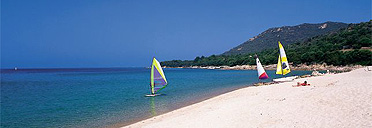
There's no chance of Calvi heading down-market. Rigid planning controls govern the look of new buildings, and the town's mostly low-rise hotels have a reputation for high quality. In bars you often see reproductions of Art Deco posters from the 1930s, celebrating Calvi's plage. The town couldn't have achieved - or held on to - its fame without the sabre of white sand that curves east for almost three miles. The beach, with its stylish bars, belongs to bare-breasted women coolly posing on rented sun-loungers while muscled windsurfers run around competing for their attention.
Calvi is still headquarters to the elite para regiment of the French Foreign Legion, so there's no short age of muscled men, closely observed by scowling military police. Thus, the town has retained some of the testosteronal qualities that excited debs in the 1920s.
As you walk or drive further along the beach it becomes more relaxed and less crowded - and free. There are still bars and windsurfer rentals, but the family crowd is more dominant. Behind the beach is a lush strip of maritime pines, planted by a thoughtful mayor a century back, shaggy and shady all year round, with half a dozen camp sites tucked among them.
The beach is also the scene of the famous festival of kites, the Festiventu, held every October. There's also a railway line with request stops to visit visit beaches further east. But it's the dramatic sight of the Citadel, rising like Mont Saint Michel directly in front of you, that makes the Calvi plage unique. It's a constant reminder of the other pleasures that await you when those of sand and sun begin to pall.
The bank of posey cafes along the marina may be pricey, but why come to a place like Calvi if you don't like lounging on la terrasse? People go out to see and be seen - which must account for the huge number of clothing shops in Calvi. There are several designer hotels and restaurants too, and after cocktails Chez Tao, the nightspot of preference is Le Calypso, located on the quay just underneath it.
But not all Calvi's visitors are hedonists; every year at least 17,000 people pass through en route to France's most famous walking trail, the cross-island GR (Grande Randonneé) 20. Some aficionados say the trail's physically challenging, 15-day combination of sea, rope bridges over raging torrent, and granite mountaintops make it the best long-distance hike in Europe. It's also one of the best-organised and well marked routes, with refuges at every stage complete with food brought up daily by mule.
The GR20 starts in the hills just behind Calvi, an area known as Balagne. If you haven't successfully completed the London Marathon and don't have a fortnight to spend scrambling over scree and chewing Kendal Mint Cake, you can always drive 20km from Calvi to the Cirque de Bonifato. This sheet of vertical red rock rises out of forest and soars 6,000ft vertically, and there are plenty of relatively easy hikes to be had around its base - as well as a refuge with an above-average restaurant, specialising in local goat's cheese and wild boar salami.
But Calvi also offers a sort of lazy man's GR20. The town is the terminus of what's jokingly known as the TGV - train à grand vibration - which will carry you up into the central mountains to Corsica's former capital, Corte, then back down to the seaside resort of Ajaccio.
The miraculously unspoilt hills of Balagne are famous for wine, honey, olive oil, and as a retirement centre for members of the Marseille mafia (remember The French Connection?). They also have the thickest concentration of traditional craftsmen anywhere in Corsica. A route called the 'Artisan's Road' winds for 50km or so among tiny villages which cling to vertiginous hillsides, with stunning views across the Mediterranean.
The ancient houses, the granite pavements and neat gardens with lemon trees give an impression of a world untouched by modernity. It isn't quite true: agriculture is struggling to compete with more industrialised methods, and the island relies increasingly on tourism. But the villages of Balagne give off a proud, stubborn sense of wanting to stay just the way they are.
Even fashionable Calvi has its unchanging qualities. It isn't a big town - the streets behind the port only go back a block or two. With its tubby baroque church and just-so buildings, it even fleetingly reminded me of Portmeirion, that artificial Italian village in north Wales. Calvi was Italian until the mid-18th century, and its ancient citadel is well preserved. The locals also claim Christopher Columbus was born here. His supposed house was unfortunately destroyed by Nelson, when he besieged the town in 1794, but the ruins still mutely insist that the Genoese sailor was born in Calvi, when it was part of the Genoese empire.
Nelson lost his eye at Calvi, and drily commented that he hoped he'd never see the place again. I found it in my heart to forgive him for shelling Calvi when I learned that he'd been supporting the cause of Corsican independence. In 1768 the Genoese sold Corsica to France, and the Corsicans resented being bartered like a herd of sheep - hence the independence movement that rumbles on to this day. One restaurant I visited had cancelled its usual live music, declaring a day of mourning in memory of the execution of some Corsican freedom fighters - 150 years ago.
The citadel, clinging to its immense crag, has a sleepy feel, its pavements huge hunks of time-smoothed granite, bedsheets dangling from tenement windows, a sense of life going on almost unaltered. Chez Tao is up here, with fine views across the bay. Strange to think that if you'd been here in July 1794, you'd have been ducking cannonballs from Nelson's 64-gun Agamemnon, which over five weeks reduced much of Calvi to rubble. Today, the large boats moored in the bay probably belong to film stars or footballers.
That's the charm of Calvi - a trendy yet historic little port on the edge of a miraculously unspoilt country interior. I even heard it rumoured that Calvi had rejected overtures from Ryanair to introduce really low cost flights - that it wants to preserve an air of exclusivity. Could it possibly be true?
Factfile
Getting there
Charter flights from Bristol, Manchester, Stansted and Gatwick cost from £200 return off-season to £280 in August and can be booked through a travel agent or online. British Airways (0870 850 9850; www.ba.com) flys to Bastia, 90 minutes from Calvi, for around £170.
Accommodation
The following prices are for a double room in July-August. In June and September the weather's delightful, and prices drop 40 per cent. The hotel for the style-conscious is La Villa. €380 (£250) a night, with sea views (www.hotel-lavilla.com). In the town centre the three-star Hotel St Christophe (www.hotel-saint-christophe.com) has balconies and terrific sea views for £100. Over the road, the two-star Christophe Colomb (www.hotel-christophe-colomb.com) has unpretentious décor and fine sea views for £70. For a budget choice, the Hotel Cyrnea is a 20-minute walk from town, has a pool, and is close to the beach (www.hotelcyrnea.com). There are well-placed camp sites among the pines behind Calvi's beach - around £20 a night for a family of four.
Food and drink
Chez Tao's (rue St-Antoine) is still the spot for a cocktail, and a light meal needn't cost the earth. The cafes of the Quai Landry are the heart of Calvian conviviality, but try the Café Rex (Boulevard Wilson) for a more authentic taste of local life. The Quai fish restaurants are good, but expensive. There are plenty of affordable back-street pizzerias, and U Minellu (near the port church) does Corsican specialities.
