
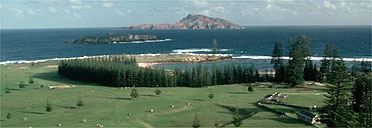
Norfolk Island is about as far away from mainstream sport as it is possible to get. But the islanders love competition and have, in Carmen Anderson, produced a bowls player who has actually won a world championship.
However, not all the inhabitants are as successful - in the Commonwealth Games this week their entrant in the marathon, Jamie Donaldson, finished one and a quarter hours behind the winner, holding up the start of the men's 200 metres race that followed. But Donaldson produced a personal best time of three hours, 30 minutes and 20 seconds, and, as with the Olympics, it is after all not the winning but the taking part that counts.
Norfolk Island is a speck, a mere pin-prick in the Pacific, even on a large-scale map. It is five sailing days due east from Sydney, four from Auckland; it measures a mere five miles by three, and if it is a mystery as to how Captain Cook discovered it in 1774, it is a bigger one that he was able to find it again.
But he did, and since then Norfolk Island has laid claim to two of the most extraordinary historical events witnessed anywhere in the world. This tiny island has played an incredible part in the history of Great Britain and what, in those times, was its empire.
In its first incarnation, it housed perhaps the most brutal collection of men ever gathered in one place, and when its time as a penal colony was over, it was given to the descendants of the mutiny on the Bounty, whose forebears had participated in one of the most infamous naval episodes of them all.
Although it is one of the most physically isolated places on earth, Norfolk has transformed itself into a modern, and quite magnificent, holiday destination. It deals with its past, as it quite properly should, but it emphasises its solitary beauty, too.
There are only 1,800 inhabitants on Norfolk, many of whom reside in the commercial centre of Burnt Pine. Two minutes from its main street, which is dominated by duty-free shops, you can find as much peace and tranquillity as you desire. Beautiful beaches abound, as do fantastic cliff-top views, while the interior of this volcanic peak pitches and rolls like the sometimes mountainous seas that surround it.
It is full of ravines and gorges filled with forests that are dominated by the Norfolk pine, that oddest of arboreal specimens, which grows in such an orderly fashion that it really has no right to be called a tree. Its trunk is ramrod straight, its branches grow straight out at an angle of 90 degrees at regular intervals. When Cook saw them, he immediately salivated at the thought of a whole island full of masts and spars with which to supply his nation's fleet. But Norfolk, being full of contradictions - Cook called it paradise and yet for thousands of convicts it was a literal hell - the Norfolk pine proved too soft for his purposes.
There was nothing soft, though, about what happened following the island's discovery. It was turned into a penal colony to house the worst of the worst; those men who had re-offended after being transported from Britain to Australia. It was designated as "a place for the severest punishment short of death", and Sir Thomas Brisbane, the then governor of New South Wales, wrote: "I wish it to be understood that the felon who is sent there is forever excluded from hope of return."
Many of the felons entirely lost that hope anyway, so cruelly degrading were the conditions. One commandant, a sadist called Major Joseph Foveaux, instituted an orgy of flogging, with one man, Joe Malmesbury, receiving 2,000 lashes over a period of three years. It was said that his back was quite bare of flesh and his collar-bones looked like polished ivory horns.
Prisoners could be flogged for anything. The official registers record offences such as "not walking fast enough", or "smiling when on the chain" or even "saying 'Oh my God' when on the chain". One man was flogged "for singing a song". Little wonder then that men prayed for death.
A visiting priest, later Bishop Ullathorne, once had the job of telling a group of condemned men that some of them had been reprieved. He records in his autobiography: "It is a literal fact that each man who heard his reprieve wept bitterly and each man who heard his condemnation of death went down on his knees and, with dry eyes, thanked God they were to be delivered from this horrid place."
One commandant's wife records part of her time there. "We went to that terrestrial paradise where the clanking of chains and the fall of the lash rang in the air from daylight to dark - these sounds accompanied by the report of a discharged musket, and the shriek of some wretch who had fallen mortally wounded. These shots became too frequent that at last they ceased to disturb us, even at our meals.
"During the 12 months that we were on the island, 109 were shot by the sentries in self-defence and 63 bayoneted to death, while the average number of lashes administered every day was 600."
This hell on earth finally came to an end in 1854 when those convicts that were left were transferred to Van Diemen's Land, now Tasmania. It was to be another two years before Norfolk Island was to be disturbed again, this time by 193 men, women and children from Pitcairn Island who were the descendants of the mutineers of the Bounty. They had outgrown the island to which Fletcher Christian had led them and the Crown, in an extraordinary decision for its time, forgave them and gifted them Norfolk.
There were only eight family names, five from the Bounty: Christian, Quintal, Adams, McCoy and Young, plus three arrivals on Pitcairn, Buffett, Evans and Nobbs. This has resulted in a situation where even the phone book has to identify people by their nicknames as well as surnames. There are, for instance, 35 entries for the family Christian, 32 Buffetts, 30 Quintals and 19 Evanses, and among the Quintals, for instance, there is one known as "Lettuce Leaf", another as "Kik Kik" and another as "Boof". The Christians have a "Toofy" and a "Loppy", while among the Evanses there is a "Diddles", a "Bubby," a "Trigger" and, wait for it, a "Tardy".
The descendants from Pitcairn were actually a mixture of crew members and the Tahitian women they took as wives, and they developed a form of language all their own. It exists strongly on Norfolk today, and is taught in the island's school. "Da bass side orn earth," for instance, means "the best place on earth", while "morla el do" means "tomorrow will do". In the local paper, the official government notices are printed in both English and Pitcairn, and on February 1 last year a bill was announced in English that began: "This Bill arises from the alleged employment... " which translates as: "Dieh Bill se kamabout bin kweschen... "
Little wonder that Norfolk Island, once a home for both dealers of death and reformed rascals, is now a place of fascination.
Way to go:
Getting there: Norfolk Jet (+73221 6677,Norfolk Jet) flies return from Sydney and Brisbane for A$700 and A$630, respectively. It also offers packages including seven nights' accommodation plus return flights from Sydney, transfers and island tour for A$929pp (two sharing).
Where to stay: Norfolk Island Tourism (+6723 22147, Norfolk Island Tourism) lists hotels, B&B and self-catering accommodation as well as restaurants and car-hire firms. Recommended reading: Hell and Paradise by Peter Clarke (Shearwater Press, A$50).
Further information: Australia, or call 0906 8633235 for a free copy of the Australia Travellers Guide (all calls cost 60p per minute). Country code: 0061.
Flight time (Sydney-Norfolk Island): 2 hours.
Time difference: GMT +11hrs.
£1 = A$2.79.
