
Michael Winner
Film director and restaurant critic
The big difference between travelling when I was a child and now is that when I first went on holiday I could see the places I went to. Now, you see much less because they are so over-built that the beautiful stuff is hidden, and everywhere is overpopulated.
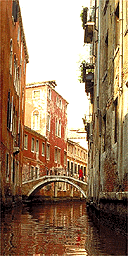
If I look at photos I took in Venice in 1952, for example, there are hardly any people there at all. If you looked at the same spots today, there would be thousands of people in tour groups, all following guides holding umbrellas aloft. So I'm very grateful that I saw at least some places as they should be.
My most memorable childhood holiday was in Switzerland in 1947 after the Second World War had ended, when I was about 12 years old. There had been no foreign travel during the war, and I remember walking out onto the balcony of the Palace Hotel in Lucerne to see the lake and the mountains. I was literally gasping and reeling at the extraordinary beauty of the scenery. I had never been out of this country, and the newsreels during the war only showed buildings being blown up; they certainly didn't stop and show you the scenery.
My parents, thank God, had enough money to splash out and take two trips. Foreign travel was rationed and you were only allowed to take a certain amount of money with you because of currency restrictions. You could be a millionaire, but would still have to take quite a modest holiday. The following year we went to Italy when the Mediterranean coast was full of little villages. There were little boys with no shoes and ragged clothes, so it was like an old movie but still unbelievably beautiful. For someone brought up in the war, to suddenly be able to go to abroad made quite an impact.
Kathy Lette
Author of 'Altar Ego' and 'Mad Cows' (Picador)
The best time to go on holiday was probably 1922. No Club Meds, no crowds, no oil spills, no karaoke, no jet-skis, no matching his and her thongs, no leisure co-ordinators, no phlegm yellow fitness -clothing, no flotsam and jet-set.
Holidaying as a kid Down Under came close. We'd go to an uncle's sheep station in the Snowy Mountains. We'd help with the shearing, poke sticks at snakes, catch rabbits and catch kangaroos whose joeys we would try to dress in dolls' frocks.
Oh, and camping under the stars - with no one else for 100 miles. Despite the delicious solitude, it was impossible to sleep, mainly because some exotic Aussie insect was blinking it's 9,000,754, 889,002 eyes at you.
Now, holidaying in Europe, I seem to spend the entire time on one seven-lane, sub-orbital ring road. When we get where we're going, everyone in the car resembles a passenger on the raft of the Medusa. These days, I need a holiday from my holiday.
Nik Kershaw
Nik Kershaw's album, 'To Be Frank', is out now on Eagle Records
My most memorable holiday is also my naffest. If there's anything worse than a large holiday camp, it's a small one, and Gunton Hall, where we ended up when I was seven or eight, was a small one. I still don't understand why we went there. It wasn't the sort of thing my parents usually did. I think they gave up on us kids and decided that they couldn't be bothered to look after us any more.
I got thrown in the creche where I think our time was pretty regimented - the attitude was 'you will do this, you will stand over there, you will have fun'. The worst thing about it is that I remember actually enjoying it. I developed a bit of a crush on the woman who ran the creche - I used to run about cleaning and making myself useful to attract her attention.
We stayed in a wooden hut which purported to be a chalet. It didn't seem bigger than our garden shed, but it was a bit of an adventure. It was a 30-minute walk to the toilet and seemed to fit perfectly with the Donkey Derby atmosphere of the whole place.
I have an aversion to those places now. It's my idea of the worst possible holiday to have activities organised for me, so my family and I usually go to an alternative camp - all cold showers and tepees, with no organised activities at all so the kids can run about getting filthy. It doesn't smack of 'Hello Campers' the way my childhood holiday did, but I enjoyed that at the time.
Kate Grenville
Winner of the 2001 Orange Prize for her novel 'The Idea of Perfection' (Picador)
When I was eight my parents bought land in the bush, and from then on every school holiday we'd go there, camp and build more of a house.
As a city kid, it was a life-changing experience to live rough for weeks in a remote place. We just had the tent, the camp fire to cook on and a freezing lake to wash in. The nearest town, a tiny hamlet, was 15 dirt-road miles away, the nearest neighbour a sheep farmer who'd visit us on horseback... It was the bush Australia of the pioneer myths, straight out of my school history books - suddenly made real to an urban child.
Each time, the first few nights were scary. The bush makes strange ticking, rustling and scraping noises at night. To a city girl, used to hearing cars, distant sirens and a neighbour's radio, the way the bush seethed with sound at night kept me awake. But after a few nights, those sounds became music to drift off to sleep by.
My most vivid image is of Mum and her friend Joan down by the lake doing the washing. These respectable middle-aged ladies reverted to the primitive. They stood beating and rubbing the clothes on a log with a cake of soap, rinsing them in a bucket, draping them over bushes to dry - wet work, so they'd strip down to nothing but their sun-hats. I can't tell you how mortified I was, little prude that I was.
