
In Oslo, you can bump into the Norwegian prime minister walking back, hands in pockets, from a session in parliament. The crown prince can marry a single mother he met at a rock concert without anyone condemning the union as scandalous. Instead, most Norwegians cried in front of their televisions when the bride's son waved hello to the crowds as the two lovebirds tied the knot last August. Norwegians are a relaxed and liberal lot, and their capital reflects the laid-back attitude of its inhabitants, offering an array of cultural gems and an exciting nightlife.
What to do
Pay a visit to the Munch Museum
Dedicated to the expressionist painter and son of the city Edvard Munch, the Munch museum is home to a large selection of the artist's work, including his best-known painting, The Scream, as well as other temporary exhibits. The museum is at Toyengata 53 (tel +47 23 24 14 00. Admission: adults Nkr60, concessions Nkr30, groups of 10 people or more Nkr35 per person. Opening hours: June 1 to September 15, every day from 10am to 6pm; September 16 to May 31, Tuesday-Friday 10am-4pm, Saturday-Sunday 11am-5pm, closed on Mondays). The National Gallery also exhibits another original version of The Scream together with other works by Munch such as Death in the Sickroom, The Dance of Life or Puberty.
Take a walk through Vigeland Park
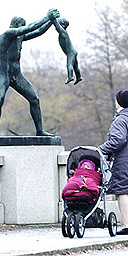
Fans of the Munch museum should also spend time wandering in Vigeland Park in the western Frogner area. The park is dedicated to another Oslo-based artist, the sculptor Gustav Vigeland, who created the statues and designed the garden's layout. The centrepiece of the park is the towering monolith representing 121 humans scrambling over one another to reach the summit. The work is intended to symbolise the struggle for existence coupled with a longing for spirituality, although you might think it bears more resemblance to a giant penis - the medical students from a neighbouring university did, and consequently covered it with a giant condom a few years ago.
Vigeland Park is a favourite with Oslo inhabitants who come to see the sculptures, ice-skate at the nearby rink in winter or attend the annual rock festival in the summer. It is open daily and admission is free. The main entrance is on Kirkevein. If you want to know more about Gustav Vigeland, go to the Vigeland museum (Nobelsgata 32, tel +47 22 54 25 30. Opening hours: October 1 to April 30, Tuesday to Sunday 12am-4pm, May 2 to September 30: Tuesday to Saturday, 10am to 6pm. Sunday noon to 6pm, closed on Monday. Admission: adults Nkr40, children and students Nkr20).
Have a cup of coffee in Frogner
Elegant and sedate Frogner is a lovely area to walk through: stop for a coffee at one of the numerous cafes and watch the crowds of tall, blond, chic Norwegians going shopping on a Saturday afternoon. Frogner has been a fashionable spot since the turn of the century when playwright Henrik Ibsen moved into the area. Ibsen, best known for his plays A Doll's House and Peer Gynt, moved into a building overlooking the royal palace at the height of his success and spent the remaining years of his life there. His home has recently been opened to visitors. It is still being refurbished, but the parts which have been recreated already - his study, his sitting room and his bedroom - make for an absorbing visit. I learned about Ibsen's life as a fashionable dandy in what was then Christiania, and found out that he stopped working at 11:30am on the dot to go to the fashionable Grand Cafe, home of all self-respecting bohemians, where he would sit every day at the same table and be served by the same waiter.
The Ibsen museum organises guided visits of Ibsen's home at noon, 1pm and 2pm, Tuesday to Sunday. Overlooking the royal palace, it is situated at Arbiens gate 1 (tel +47 22 55 20 09. Admissions: groups, Nkr40, individuals, Nkr25).
Make the most of Oslo's military past
Given that this is Norway, better known as the land of the Vikings, why not go and see some of the excavated Viking ships on display? Many of these are housed in a museum on the Bygdøy peninsula (Huk Aveny 35, tel +47 22 43 83 79. Opening hours: May 2 to September 30, 9am-6pm daily, October 1 to April 30, 11am-4pm daily. Closed on bank holidays. Admission: adults, Nkr60, group of 10 or more people 30Nkr per person, families Nkr80, children Nkr20).
Alternatively, try Akerhus Slott, the medieval fortress overlooking Oslo's harbour, which houses several museums (among others, a museum about the Norwegian resistance, and the prison museum). Or you can just go for a walk around the grounds and enjoy a great view of the city. (tel +47 23 09 39 17).
Where to eat
Ibsen's old haunt, the Grand Cafe, is inside the Grand Hotel on Karl Johansgata 31 (tel: +47 24 14 53 00). The cafe is quaint and nostalgic, and serves upmarket traditional dishes like reindeer in game sauce. If you feel adventurous, try lutefisk: acid-marinated cod that feels like jelly on your palate, served with potatoes, bacon and pea mash. Excellent service.
Another very good - if pricey - restaurant is Arakataka. We tried the reindeer on salsify and glazed red cabbage, which was delicious. (Mariboesgate 7, tel: +47 23 32 83 00). The bar is open until 12:30am Monday to Thursday, 3am on Friday and Saturday, and midnight on Sunday.
The no-frills canteen Kaffistova in central Oslo serves traditional Norwegian food at reasonable prices. Dishes include meat balls with pea mash, lapskaus (lamb stew), raspeball (boiled potato balls with salt meat and sausage), vaffel (waffles, served with jam and sour cream) or karamell pudding (caramel flan). Rosenkrantzgata 8, tel +47 23 21 42 10.
The turn of the century Theatrecaféen, behind the National Theatre, has long been an essential feature of the city: as one resident put it, "you're not an intellectual in Oslo until you've been thrown out of the place". Stortingsgaten 24-26, tel: +47 22 82 40 50.
Where to drink
Grünerløkka is an absolute stop if you want to go out in Oslo. Some people insist that the Grünerløkka area is a bit rough, but that's rough Norwegian style: finding a littered street or a run down estate here is as difficult as finding a Norwegian who does not speak perfect English. It may seem empty when you first arrive, but that's only because the crowds are inside enjoying themselves. Thorvald Meyers Gate is lined with bars and restaurants where 20- and 30-something Norwegians come to enjoy a pint. Tea Lounge (tel +47 22 37 07 04), a 70s-feel bar, is a great place to start the evening. Another worthwhile destination is Bar Boca (tel +47 22 04 10 80), a tiny bar oozing with charm where the bar tender prepares you a whole range of cocktails - try an aquavit-based drink if you want to sample something Norwegian - and where the punters are relaxed and chatty.
After Grünerløkka, go to Grønland, the area east of the main train station. It has a large immigrant population, and alongside its many bars, are dozens of kebab shops and ethnic restaurants. A great place to go out in Grønland is Teddy's (Brugata 3a, tel +47 22 17 36 00), founded 50 years ago and still stuck in its original decade - all in brown and orange shades and fake wood tables. Another good choice is Café con Bar (Brugata 11, tel: +47 22 05 02 00), a more modern-looking bar on the same street.
Further east is Lyst (Sorligata 40, tel +47 22 19 41 01), a relaxed, airy bar, which serves tapas at lunch, and on Friday and Saturday nights.
The Underwater looks like a boat and is an enjoyable place to head for on Tuesday and Thursday nights, when professional and student opera singers sing favourites such as Carmen or Turandot (Dalsbergstien 4, tel +47 22 46 05 26).
Overlooking the royal palace is Café Arcimboldo in the Kunstnernes Hus ("the artists' house"), a hip 'see and be seen' bar with hit and miss service (Wergelandsveien 17, tel +47 22 69 44). It also serves lunch and houses an art gallery on the first floor.
Finally, for panoramic views of the city, head to Summit 21, the bar at the top of the Radisson-SAS hotel on Holbergsgate 30 (tel +47 23 29 30 00).
Other useful links
More on Edvard Munch
More on Gustav Vigeland and the Vigeland Park
More on Henrik Ibsen
Virtual Oslo
Oslo city guide
· Gwladys Fouché flew with SAS (0845 60 727 727).
