
Mario Vargas Llosa calls Peru 'a country of sad people' and I suppose he should know. But it struck me as rather a cheerful, buzzy place, despite all the poverty. Even the boys selling postcards make good jokes: 'You are my mother. For you, 10 dollars!' 'I am not your mother - how much?' 'Three sols.' (About 15p.)
And the Andean hill people, the Quechua, must be the most chic peasants on earth, with their sticking-out skirts, brightly woven shawls and exciting hats. The brown homburg is standard, but some of the younger women wear a sort of floral tray on their heads, while older women favour a tall, white stovepipe that seems to be made of waxed cardboard.
My big fear in going to Peru was that I'd be forced to listen to pan-pipe music, but none of the people we saw was armed with pan-pipes. Nor was I forced to eat guinea pig, though I rather wish I had. There is a wonderful Last Supper in Cuscocathedral with Jesus and the disciples staring glumly at one small guinea pig on a very large plate.
Peru is always described as 'a land of contrasts' (what country isn't? The Netherlands, perhaps) and certainly my holiday had its highs and lows. Saturday night found me tucked up in bed with an oxygen cylinder; Monday night found me sitting under a tree among the Inca ruins of Machu Picchu being whooshed at by a shaman. The latter was more interesting so I'll start with that.
We were staying at Sanctuary Lodge, the only hotel actually on Machu Picchu mountain; the others are at Aguas Calientes in the valley below. The hotel manager, though French, seemed to have swallowed California whole and told us that the Incas moved stones by getting a shaman to align their shakra. He said you could do anything once a shaman had aligned your shakra - he himself had been enabled to phone his father which he couldn't do before.
Anyway, he urged us to visit the current Machu Picchu shaman in the ruins at night. So, after dinner, we crept out with torches and eventually found him and two acolytes sitting under a tree. He was warmly and prosaically dressed in anorak and combat trousers - he looked like someone who would be helpful in B&Q. But he had an exotic array of props on the carpet in front of him - two crystal skulls and a child's nightlight shaped like a serpent, a range of different-sized glass salad bowls, some condor feathers and a brass pot containing charcoal.
Oomba, woomba, shoomba, he droned, while one of the acolytes explained that he was invoking the god of fire. Eventually, the god of fire appeared in the shape of his cigarette lighter and he lit the charcoal and came running round whooshing condor feathers over our heads and banging a drum. We were supposed to keep our eyes shut but I preferred to watch as he set up different ringing tones on the glass bowls, tinkled bells, clashed cymbals, made birdcalls with a whistle (real birds answered back) and upended his rain stick so that the seeds inside pattered down like rain.
Meanwhile, his acolyte ran round behind us blowing in our ears so we could feel the spirit breath. It didn't do much for my spiritual life (always sluggish at the best of times) but it was a damn sight more fun than country-house opera or any other entertainment I can think of that involves sitting on damp grass listening to strange noises on a chilly evening.
But I almost didn't get to Machu Picchu, I was so unhinged by altitude sickness. It struck me the minute I stepped off the plane at Cusco; a feeling that my legs had turned to concrete and my brain to mush. I had no idea who or where I was, but luckily I was labelled Hotel Monasterio so I was bundled on to the hotel bus. Thank God I was staying at the Monasterio; apart from being a beautiful hotel with all the usual five-star luxuries, it also has oxygen cylinders you can take to your room. I spent the rest of the day cuddling up to my cylinder and becoming rather fond of its gentle hiss.
According to the hotel brochure, the mild symptoms of high-altitude sickness include 'headache, nausea, unusual tiredness, trouble sleeping, lack of appetite', while the severe symptoms include worse versions of the above plus cyanosis (blue nails and lips) and a 'cough with frothy sputum'. Luckily, I never got to the cyanosis and frothy sputum stage, which would have meant being flown straight back to Lima, but I was jolly glad of the hotel oxygen.
Anyway, it was all worth it because the next day we took the train to Machu Picchu which was total joy. The single-track railway winds over the pass from Cusco by a series of switchbacks which doesn't mean (as I assumed) zigzags or hairpin bends but literally switching back - driving up a slope into a dead end, then switching the points and reversing back up another slope into another dead end, and doing this at least half a dozen times. It's a painfully slow means of progress but also a brilliant way of seeing Cusco and its surrounding snow-covered mountains. Then over the pass across a luscious fertile plateau and into the deep gorge of the Urubamba river which leads down to Machu Picchu, far enough down to mean no further risk of altitude sickness.
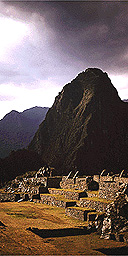
Why is Machu Picchu so wonderful? Well, first, location, location, location. It's on a spiky little mountain surrounded by much bigger jungle-covered mountains but cut off from them by the broad valley of the Urubamba winding round its base. It's in the cloud forest where the mist curls up the valleys and winds across the mountains, so that you rarely see the whole panorama at once, but glimpse it through fraying banners of ever-shifting cloud. And the ruins themselves are beautiful, a pastoral scene of white granite walls densely covered with lichens and ferns, clumps of orchids and gladioli in every corner, llamas and alpacas grazing on emerald lawns, swallows swooping over the whole site.
The ruins are intriguing because nobody knows what exactly they are. In size, Machu Picchu looks like a small town surrounded by agricultural terraces, but the Incas would hardly have lugged all those tonnes of earth and stone up a mountain merely to build a farming town in the middle of the jun gle. The mountain-top site makes it seem like a fortress, but it has no outer wall and, anyway, the Incas at the time had no enemies to fear. Our guide told us it was a university, but other guides were telling other groups that it was the refuge of the Virgins of the Sun (Inca concubines) or a seminary for priests, while there was a strong new-age contingent chattering about ley lines and solstices and healing powers; they seemed to see it as the Inca version of an alternative therapy clinic. The fact is, nobody knows.
Nor do they know why the Incas, having built the place in the mid-fifteenth century, seem to have abandoned it soon afterwards, certainly before the Spanish arrived. There is no mention of Machu Picchu in conquistador surveys.
It remained lost in the jungle until it was rediscovered in 1911 by Hiram Bingham, an American archaeologist who was looking for a quite different Inca city. Two years later, he brought an expedition from Yale to photograph and excavate it properly. So the great advantage of Machu Picchu over most Inca sites is that, having been abandoned and then 'lost', it was never robbed or pillaged or built over, as Cusco was.
The thatched roofs have fallen in and some of the walls have been dislodged by earth tremors but basically it remains as built five-and-a-half centuries ago. It is an absolute jewel - and well worth risking altitude sickness for.
Factfile
Getting there: Lynn Barber travelled to Machu Picchu with Cazenove & Loyd Expediciones (020 7384 2332), specialists in tailor-made holidays to Latin America. A two-week holiday in southern Peru staying in Orient-Express properties with private vehicles and private guiding throughout, inclusive of all international and domestic flights, costs from £3,000 per person. She stayed in the Hotel Monasterio, in Cusco, the Machu Picchu Sanctuary Lodge, Machu Picchu, and Hotel Miraflores Park Plaza, Lima. Flights with Iberia daily from London (Heathrow) via Madrid to Lima. Journey time approximately 12 hours.
Health: Recommended vaccinations: hepatitis A, typhoid, tetanus. If you plan to go trekking for long periods and will be away from medical assistance for longer than 24 hours, a rabies inoculation is also advised.
Best time to visit: April to September. You'll miss the rainy season, and it will be slightly cooler.
Further reading: Lonely Planet Peru (fourth edition, rrp £11.99).
