
Halfway through my trip to the Rockies, I make a solemn vow. I will never tell anyone a bear story.
Frank is a veteran Banff tour guide, a man who's seen a furry thing or two. Come on, Frank, I ask: don't you get sick of hearing people's bear stories? He frowns. "Well, I guess they can get kinda boring." Then he brightens: "Though this one bear ..."
It's enough to make you shoot a moose. I go through a mental ursine odyssey in the Rockies. At first, I think the Canadians are inventing all this bear stuff to make their lives - mountains, trees, golf - sound more interesting. People carry on talking bears until you think, well, you have bears, let's move on. Then you see one, and another, and another, and suddenly, they are thrilling. And then you go back and tell your own bear stories, and presumably make everyone else want to strangle you in turn. The only silver lining is that some Canadians have never seen a bear, and are envious of tourists who run into several in a week.
Since then I've been breaking my vow, slightly: here are my bear stories, but mercifully abridged. One: a grizzly with three cubs coming out of the woods by Banff Springs hotel towards the golf course, seen from a very safe distance. Two: the same one again, known as Bear 66 (a bit of a local celebrity), with cubs in tow. Three: a black bear, munching dandelions on the grass verge by the road. Four: two more grizzlies popping up on a layby by a lake. (And you can chuck in an elk, mountain goats, big-horned sheep, a sackload of squirrels and a bald eagle.)
So you've got bears, hulking great mountains, fresh air, gorgeous lakes, wonderful views, and yet I didn't always feel completely sold on Canada. There are two types of people in their element here. First, ageing Brits and Australians in coaches, Japanese of all ages in coaches, or American couples in RVs the size of coaches, all doing the Rockies at road level. The second type are the hardcore outdoors adventurers, hiking off into the hills, camping, fishing and doing nature. These ones, who sweat for it, will presumably get the best views to themselves. Some spots can feel quite crowded, a strange experience in such huge expanses of wilderness.
That said, the panoramas you can drive to in the Rockies have a magnitude that withstands a viewing platform shared with a hundred others. We take in Lakes Minnewanka (pronounced less hilariously than you'd hope), Louise, Peyto, Bow, Maligne, Moraine, all places whose signposts or guides are eager to describe them as the most beautiful in Canada, and you're inclined to agree, at least until the next one.
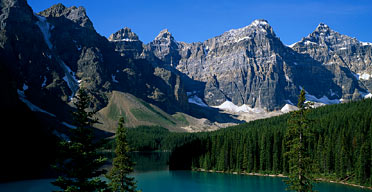
My favourite? Moraine. Some say it's better in late summer when the water levels rise to the treeline, filling up with that astonishing turquoise-blue you find throughout the Rockies, but I liked the wide basin floor, filled with stones and driftwood. We arrived in the middle of a snowstorm that made it look harsh and forbidding; it was barely recognisable five minutes later under clear blue skies.
As the locals have been warning, in the mountains you can never tell with the weather. The torrential rain that greeted us at lunchtime in Banff vanished by dessert and never returned over the course of a week; but the heat of early summer sunshine can be eliminated here in moments by the smallest shade or breeze. By the creek in Johnston Canyon, huge lumps of ice lurked below the greenery where the sun hadn't penetrated.
So don't go - as I attempted - to the Columbia Icefields wearing shorts. These huge glaciers cap the continental divide: on either side of the peaks, icy rivers run off to the Pacific, Arctic and - a long, long way away - the Atlantic Ocean. An icy localised wind blasts down, making it even colder than it sounds. It is marketed as Canada's Eiffel Tower, its must-see, and getting onto the ice fields is done via a procession of huge snowbuses and chirpy tour guides, making it the best or worst of Rockies tourism, depending on your point of view.
But, as locals stress, most visitors barely venture from the highway; head slightly off the road here and you can find yourself very much alone. As national parks, most of the region is pristine and untouched, although the manmade developments are impressive too. The road from Banff to Jasper, today's Icefields Parkway, was largely dug by public work gangs set up during the Depression. The railway line that stretches across Canada brings mile-long cargo trains through the landscape. And the hotels built by Canadian Pacific to accompany their railroad are extraordinary places in their own right. The Banff Springs hotel, opened as a stop in 1888, looms out of a forest like a fairytale castle; the Jasper Park Lodge's lakeside cabins hosted Marilyn Monroe and royalty; the reflection of the Victoria glacier hanging in the mountains fills the lake when viewed from Chateau Lake Louise.
Framed black-and-white photographs are common here, tracing a western settler history that in some places dates back only a matter of decades. The boathouse at Lake Maligne, a wooden cabin built in the early 20th century, seems in this context like a medieval church. On a rafting trip down the Athabasca river, our guide showed us a remote riverbank outpost established when the only way to get here was to somehow paddle upstream. We briefly attempted to follow the eddies against the current, and failed miserably.
It made me painfully aware that I am more coach party than pioneer. So we just stretched our legs with a few moderate hikes around Lake Maligne and Larch Valley, and tried something billed as an "interpretive hike" - a phrase that promised all the excitement of "theatre in education", but turned out to be surprisingly enjoyable. Our walk in the woods to Old Ford Point, above Jasper, had been the scene, as our guide Heidi showed, of all manner of natural drama. Bears had sharpened their claws on aspen trees, which secreted toxins in their bark to ward them off; coyotes had made dens; a wolf had left faeces stained white with the bones of its victims. Calypso orchids were feeding off fungal networks that were feeding off tree roots in turn, keeping the orchids tied in their shadows. Violets were bending over backwards to pull butterflies and eventually pollinating themselves in sexual frustration.
After discovering the minutiae, we spent our last day taking in a magnificent, broad sweep of scenery. Those without the time, ability or inclination to hike far off the beaten track can cheat a little by splurging on a helicopter tour. Away from the road, we swooped over rivers, waterfalls, and glaciers, at eye level with the mountaintops, seeing peaks fading into the distance. It was an exhilarating new take on the mountains we'd been admiring from below. The pilot dropped us on a ridge and we walked down through undergrowth of mountain willow, finding bear tracks that our guide said would have frozen here from a year before.
We rounded off the day with a meal at another old Rockies log lodge, the Num-ti-jah, on the shores of Bow Lake, and still left time in the long Canadian evening to drive off in daylight. And time too to get a close, unhurried sighting, profiled in the setting sun, of a bear foraging for food. But you don't want to hear about that ...
Way to go
Gwyn Topham travelled to Canada courtesy of Inghams (reservations line 020 8780 4433; brochure hotline 09070 500500, calls cost 50p/minute), who feature a selection of three-star to five-star hotels in Jasper, Banff and Lake Louise. Seven nights on a room-only basis - based on two sharing, including scheduled flights with Zoom from Gatwick, Manchester or Glasgow to Calgary and transfers - starts from £925 at the five-star Fairmont Chateau Lake Louise in May. A three-centre tour combination with 14 nights' accommodation starts at £832, or £1400 for the five-star Fairmont Jasper Park Lodge, Fairmont Banff Springs and Chateau Lake Louise.
A scenic helicopter trip with Icefield Helicopters costs $139 (about £62) for a flight or $399 (£175) for a full-day heli-hiking trip, including transfers and guide.
· This article was written about a trip taken in late May this year, and we were not aware of recent events in Alberta until after publication. We apologise for any apparent insensitivity.
Visitors should always follow local advice on wildlife.
