
"Can you hear this noise ... kisss-ka-dee, kisss-ka-dee?" asked Wagner, our Brazilian guide, as we tramped through the undergrowth. "It is the kiskadee bird. And this is the kona vine. It is used by the Indians to make a lethal fish poison called tingui." So impressed were we with his botanical knowledge and enthusiasm, we hardly noticed we were slipping into murky, tea-coloured waters. It seemed he had forgotten to mention that in order to reach our canoe we had to wade through the bubbling gunge of a mangrove swamp.
As my toes sank into the mud, only one thing dispelled thoughts of quicksand and anacondas: one of our group asking, "Did someone say leeches?" Luckily for us, leeches don't like the salt water of high tide. As the water level reached our thighs, we flinched when red-clawed crabs scuttled up the overhanging vines. But we emerged on to dry land, paddles in hand, pleased to have waded through unknown creepy things. The sun was setting and we paddled down the Sauipe river in a traditional wooden canoe, landing on the beach as the violet-blue evening set in.
I returned reluctantly to the manicured lawns of the SuperClubs Breezes resort; after the tangled wilderness of the Atlantic rainforest, the all-inclusive golf and spa resort seemed less appealing. Situated on the north-east coast of the state of Bahia, the 500-acre Costa do Sauipe development is an advertisers' dream. I saw smiling mothers pack their smiling children on a shuttle bus for an afternoon of horseriding, smiling families sipping coconut water by the poolside and a fellow guest waving emphatically as she hung upside down from a trapeze, smiling. In this sanitized complex of packaged fun, even minor holiday nuisances such as mosquitoes were strangely absent.
But my reservations didn't last long. Trotting across sand dunes on a docile horse named Beautiful Field, with only a curious burrowing owl for company, I reflected that if aqua aerobics wasn't for me at least Bahia's scenery and wildlife were close by. Just beyond the palm tree-filled no man's land between resort and beach, there is a spectacular five-mile stretch of coast so empty you can hardly believe it is shared by the five hotels on the complex. There are no jet skis or volleyball, just the Atlantic surf whipping up a thick spray that blurs the edge of the coast until it disappears into mist. I could have stayed all day had my shoulders not acquired the crimson tones of the fire dragon orchids we had spotted earlier.
Cycling the periphery of the enormous complex, with its village-like atmosphere, cheerful music and round-the-clock helpings of pineapple and mango, I found it safe and comforting. On my return home I learned a friend had been shot in the leg during Carnaval in Recife, and another had been mugged twice in Barra. Later, in Salvador, my hotel owner warned me a guest had suffered a broken pelvis when robbed on a short walk to the Old Town. If I was travelling with children, I would be checking straight into the Costa Breezes.
A short drive down the Green Line Highway, the main road that connects the 200km stretch of beaches and coconut groves along Bahia's "coconut coast", is the Pojuca river. Soon, we were zipping past palm oil, mango and manioc trees (used to make the flour served with most Bahian dishes) in our motorised canoe, as a kingfisher dipped in and out of the water and dozens of lemon butterflies hovered above. As the temperature rose, naturally there was only one way to cool down in the midday heat: fling ourselves across the river on a rope from a wooden platform, to land in the water.
The fishing village of Praia do Forte is named after the 16th century fortified castle that stands in ruins above the settlement. Stalls line the main street, which opens out onto a pretty church square overlooking the sea. Under a parasol, a woman in the traditional white dress of Bahia, ladled out spicy vatapa, a shrimp, pepper and tomato sauce, into a puffy cocoon of mashed beans fried in the pan of sweet-smelling dende oil at her side. It's wrapped in paper, messy to eat, and - like fish and chips - best enjoyed when dangling your legs off a stone wall above the beach, staring out across the ocean.
Hundreds of marine turtles lay eggs here every year and the broad shore is now protected by the Projeto Tamar turtle reserve. The hatching season begins in December, when thousands of the tiny creatures make their way into the sea, before an internal GPS navigates them back to the same beach 20-25 years later to reproduce. The village has developed largely because of Projeto Tamar's pioneering preservation project, which has helped shape Brazil's approach to wildlife and the environment.
After 300 years of deforestation, our guide told us, the slow-growing Atlantic forest along Bahia's coast will take centuries to recover. It is uneasy listening given the extraordinary rate of development taking place across north-eastern Brazil. Further up the coast, the four-year-old Breezes complex appears to be built with this new eco sensitivity in mind; there is a tree replanting scheme, a ban on motorised boats and you can see recycling bins for cans, glass and organic material around the complex. Most importantly in an area where 50% of the local population are illiterate, the development has set up the Programa Berimbau, an ambitious responsible tourism project benefiting eight local communities.
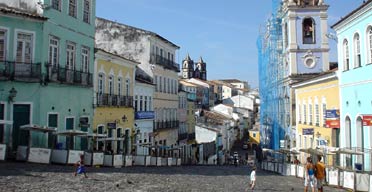
Two hours' south is the colonial city of Salvador da Bahia. Brazil's first capital and most important city for three centuries, it is built on a peninsula overlooking the sweeping Bay of All Saints on one side and the Atlantic on the other. Today the city has an 80% black population, deeply rooted in its African traditions and religion. The secretive and mysterious ceremonies of Candomble are practised alongside Catholicism, sometimes in the same churches. In the Old Town, Pelourinho, the sound of samba echoes out of open windows and children practise the Brazilian martial art of capoeira in the cobbled squares.
The first sight of Pelourinho (or Pelo) is momentarily disorientating: the pastel buildings and elaborate baroque facades could have been transplanted from anywhere in central Europe. We visited the dazzling church of Sao Francisco, where every surface of jacaranda wood carving is covered in gold leaf (1,600 kilos of it), and the momentous Elevador Lacerda, a 72m concrete tower-lift that juts out dramatically from the bluff dividing the lower and upper cities. In the midday heat, the town's hilly streets seemed strangely steep, the hawkers in the Praca Anchieta unusually sullen and the capoeira performance on the Praca Tome de Souza a little languid.
That evening a carnival-like commotion of music, crowds and noise greeted us: Pelourinho had woken up. It was December and a month of celebrations had begun, starting with the Dia do Samba (Day of the Samba) a fiesta in honour of the composer Ary Barroso. Lampposts had been decorated with beautifully embroidered flags of the Virgin Mary in red, gold and blue alongside plastic angels and stuffed Santas.
We threaded our way through the streets to the Fundacao Mestre Bimba, a capoeira school where the day's work is performed most evenings. To the accompaniment of clapping, singing, drums and the berimbau (an Angolese one-string bow), two dancer-fighters touched hands before breaking into an elaborate Matrix-style display of somersaults, cartwheels and one-armed handstands without ever touching each other. Successive pairs competed to outmanoeuvre their fellow combatants, displaying more gravity-defying dexterity with every move.
After a sweaty, energetic and exhilarating hour, music filled the studio through the open windows and the capoeira masters whirled to a stop. Outside, the samba festival had started and those who could not see the sambistas on the stage in the Terreiro de Jesus had set up their own sound systems and filled the pavement with an assortment of chairs. We bought capirinhas in plastic cups and sat on the steps of the cathedral to enjoy the music as people partied around us into the night. Now we understood why Pelourinho was a little sleepy by day. There was still a whole month to go before Christmas and the next evening, it would all start over again.
Way to go
Kuoni Travel (01306 747 008) offers seven nights at SuperClubs Breezes Costa do Sauipe on an all-inclusive basis from £1,219 per person. This includes international flights to Salvador with TAP Air Portugal via Lisbon, transfers to and from the resort and is based on two people sharing. For more information visit www.superclubs.org.
Useful links
Listen to the sound of the berimbau
