
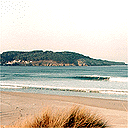
The first time I visited Galicia, I was taking a long and leisurely culinary tour on a motorcycle from Santander to the Douro valley in Portugal. We would drive through the morning until reaching a predetermined lunch destination. The very nature of my type of lunch - lots of albarino and the local aguadiente, oruja - precluded any possibility of further driving, so the afternoon would then be set aside to find a place to spend the night and somewhere to go for dinner.
Two things about that trip remain fresh in my memory: the astonishingly fine corniche roads that hug the coastline with their succession of rias - the Galician equivalent of fjords - and the mind-blowing fish markets in La Coruña and Vigo. Seafood and shellfish, in particular, are the region's passions - every possible species, from scallops and gooseneck barnacles to razor clams and lampreys, are harvested, and every ria has its own oyster and mussel beds.
Inland, there is market gardening everywhere - Galicians are famous in Spain for their short, green pimientos de Padron, which are fried in olive oil and served with rock salt as a tapas; for their turnip and beet greens (grelos), an essential component of caldo Gallego, a strictly-for-winter pork and beans variation; and also for their tiny new potatoes, hardly bigger than a grape, which are known as cachelos (the nearest equivalent that we have is the Jersey Royal). Fine free-range veal and beef from the local light-brown rubia Gallega cattle also enhance the region's table. But, above all, it is that incomparable seafood that is the jewel in Galicia's culinary crown.
Ensalada de verduras y jamon
Or spring vegetable salad with Serrano ham. This is a typical example of the young vegetable salads of the Galician region, all of which are made up of the very best in local produce. I've enjoyed similar salads in which tuna or chorizo has been used instead of the ham, and on one occasion with some perfectly cooked eggs being the only accompaniment to those amazing Galician new potatoes.
To do it real justice, this is one of those dishes that demands that you use only the freshest of seasonal vegetables, so modify the ingredients as necessary. Serves four as a starter.
350g boiled tiny new potatoes (Jersey Royals would be ideal when in season) 200g fresh small broad beans, unshelled weight (if the beans are any larger than a little fingernail, then they should be popped out of their skins after boiling) 200g asparagus, cut into 4cm pieces 100g green beans 8-12 slices Serrano ham (ie, 2-3 per person) 75ml olive oil 15ml white-wine vinegar Sea salt and black pepper 2 large cloves garlic, crushed with the flat of a knife and chopped fine 2 hard-boiled eggs 1 bunch flat-leaf parsley, chopped roughly 3 spring onions, chopped 1-2 dried chillies, chopped fine
Boil the green vegetables successively in well-salted water, ensuring that you do not overcook them, so they retain some bite. Drain, then quickly refresh in cold water so that they maintain their natural colour. Leave to dry on a tea towel.
Make a dressing by whisking together the oil, vinegar, salt and garlic. Mash up the egg yolks, and stir them into the dressing, along with half the parsley, the onions and the chilli.
Arrange the dressed vegetables and the ham on plates. Garnish with the chopped egg whites and the remaining chopped parsley.
Gambas y almejas en salsa verde
Or prawns and clams in green sauce. Hake is the more normal vehicle for salsa verde, found on almost every restaurant menu along the north coast of Spain; but I much prefer it with shellfish. This recipe also works well with mussels and even with their famous new potatoes all by themselves. Serves four as a main course.
500g fresh large-ish prawns (unshelled weight), shelled, with tail intact (keep the shells for the stock) 500g clams, washed, scrubbed, and soaked in cold water 500ml by volume flat-leaf parsley, roughly chopped 250g boiled small new potatoes 2 large cloves of garlic 100ml white wine 1 medium white onion, finely chopped 1 tbsp flour Olive oil
For the stock
400ml of water 1 small piece onion half a lemon 1 bayleaf Some parsley stalks 1-2 sprigs fresh thyme A few peppercorns
Fry the prawn shells with a very little olive oil in a small saucepan until they colour, add the rest of the stock ingredients and bring to a simmer for 20-30 minutes. Strain and reduce by a third in the same pan.
Blend the parsley in a food processor with the garlic, wine and stock. In a wide frying pan, fry the prawns in two tablespoons of olive oil with salt and pepper until barely cooked. Remove from the pan, then tip in the onion and sweat in the prawn-infused oil until soft but not brown. Add the flour, stir, and cook for a minute or so. Gradually add the green sauce, stirring and shaking the pan until the sauce starts to thicken. Add the clams and, when they open, return the prawns to the pan with the potatoes. Season and serve with a wedge of lemon.
Tarte de Santiago
Or Galician almond tart, the region's signature pastry dish, though why is a bit of a mystery as almonds do not grow in so damp and chilly a place as Galicia. Still, it is popular all over Spain. This makes a 20cm tart, easily enough for four.
For the pastry
1 egg 125g caster sugar 1 tbsp lemon juice 125g (or more) plain flour
For the almond filling
4 eggs 250g caster sugar 250g blanched almonds, finely ground 1 tsp ground cinnamon Grated rind from 1 unwaxed lemon
First, make the pastry by beating in a food processor the egg, sugar and lemon juice until very light. Gradually add sufficient flour for the mixture to start to leave the sides of the bowl. Now do the almond filling: beat together the eggs and sugar until light and creamy, then fold in the remaining filling ingredients.
Roll out the pastry and line a shallow 20cm tart tin. Prick all over and cook in a 150C/300F/gas mark 2 oven for 10-15 minutes. Half-fill the tart case with the almond mix, smooth it over, and bake for 30 minutes at 175C/350F/gas mark 4 until lightly browned. When cool, transfer to a plate and dust with icing sugar
David Eyre is chef at Eyre Bros, 35-42 Charlotte Road, London EC2, 020-7739 5345.
