
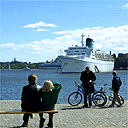
Does Stockholm have it all? Name any other major European city and the Swedish capital can probably give it a run for its money.
Like Venice, Stockholm is best appreciated from one of the waterways around the city and its archipelago (some 24,000 islands). In the city centre, shoppers can ricochet from one designer shop to the next, imagining they are in Paris or Milan rather than a few hundred miles from the Arctic Circle. The 170 museums and galleries, including the Museum of Modern Art, should make even a jaded Londoner's mouth water. While a stroll through the labyrinth of alleys and cobbled roads in Gamla Stan, the city's medieval heart, might persuade any visitor he or she had stumbled into an undiscovered district of Prague or Budapest. And at night, joining the crowds of youngsters thronging the city's many bars and clubs, I, for one, could believe I was hanging out in trendy Berlin.
Stockholm may not dazzle like its more famous rivals, but then again it doesn't cloy half as quickly either. Some of the city's charm comes down to good fortune (Gamla Stan) and good location (the archipelago). But there is another reason why Stockholm has so much to offer. Swedes appear ready to embrace anything and everything, so long as it improves the quality of their lives (after all, this was the home of Mr Nobel).
Stylishness and originality are high on the list. Here is a city where shops all too often baffle you with their strange gadgets and ornaments. In one of the city's many design shops, I spent several minutes studying an odd-looking soapdish before realising it was a nifty CD rack. Even McDonald's has had to succumb: every month, branches feature a new gourmet burger. And when that's polished off, diners are expected to take their trays to the recycling section and separate all the meal's components, including the ice in their Cokes.
The difference of approach is clear in other aspects of Stockholm life. There is a wonderfully democratic feel to public space. Seventies' modernism, like that embodied in the 'glasshouse' Kulturhuset (House of Culture), rubs shoulders with more traditional treasures like the the seventeenth-century Royal Castle and the thirteenth-century Storkyrkan (cathedral) without anyone bemoaning architectural carbuncles. A short walk and you can move though the Parisian-style boulevards and squares of Södermalm, past the Disneyesque romanticism of the Stadshuset (City Hall), to the almost Stalinist edifices of Norrmalm.
It's a policy of live and let live that can be disarming. On a Monday morning, I wandered into the main park at Gustav Adolfs Torg to find a woman moving gracefully to loud music. I joined the large crowd watching in rapt silence. As she finished, there was a pause before everyone waved enthusiastically to her. It took me a moment to realise I had chanced upon a karaoke concert for the deaf.
Stockholmers have plenty to trumpet that is unique; it's just that they're too modest to mention it. Without a guide book, you'd hardly know of the joyous green lungs of the Djurgarden royal park, a ferry-hop from Gamla Stan, and its fascinating open-air museum and zoo of Skansen. Or that on the waterfront there is a sight almost as awe-inspiring as the pyramids at Giza. Housed in a museum are the almost complete remains of the massive seventeenth-century warship the Vasa, which was raised from the depths of the harbour in the Sixties, 350 years after it sank. Restoring it took three decades.
I came away from a long weekend in Stockholm wondering whether visiting was enough. From an open boat, watching Stockholmers take their lunch break basking on rocks by the water's edge, I wondered how difficult could it be to learn Swedish.
If you only do five things...
1 Visit the Vasamuseet. Never heard of the Vasa? In any other country, they'd be shouting about it from the crow's nest. The almost perfectly preserved warship sank in the harbour in 1628 because of its overly ambitious and top-heavy design. The museum puts Portsmouth's Mary Rose in the shade. The Vasamuseet is on Djurgarden (0046 8 5195 4800). Admission is £4.50.
2 Stockholm is really a series of islands and the best way to see it is on a boat trip. There are several to choose from but the best is probably the two-hour 'Under the Bridges' route. Most boats leave on the hour - and very punctually - from the harbour front at Nybroplan. Details: Stockholm Sightseeing (0046 8 5871 4020).
3 Go for a walk in Gamla Stan. This is the medieval heart of Stockholm, a maze of winding alleys and timbered buildings, many now boutiques and restaurants. You'll find the Kungliga Slottet (Royal Palace), Storkyrkan (cathedral) and Riddarhuset (House of Lords) here, but it's better just to soak up the atmosphere.
4 Hire a bike and cycle around the huge royal park on the island of Djurgarden (make sure you also take in the open-air museum of Skansen, with its replicas of Swedish homes through the ages). Skepp and Hoj bike rental (daily rate about £5) is conveniently located by the Djurgardsbron (bridge). No 47/69 buses run frequently from the Centralstationen, or take a ferry over from Gamla Stan.
5 Wander the streets of Södermalm, with their air of calm, Parisian sophistication. The northern cliffs, reached via Katarinavägen, make an ideal spot for a romantic evening walk, with stunning views across to Gamla Stan and Djurgarden.
Where to eat
Fast and filling: try what Laplanders allegedly eat for lunch - tunnbröd, a giant dough cone filled with bangers, mash and anything else that can be squeezed in. Available from most fast-food street vendors for about £2. It is also possible to benefit from the 'felafel feud' being waged by rival members of a large Arab family. At any of the variations on the name Jerusalem Kebab, in Gamla Stan or along Götgatan, the main street in Södermalm, you can get a tasty dish for little more than £1. You won't get service with a smile, though.
A safe bet: get radical - as well as fed - at the Krup In. Run by the leader of the Left Party - formerly the Communists - the decor of the Krup hasn't changed as much in the past 50 years as its owner's politics have in the past decade. It has a folky atmosphere, with traditional dishes like reindeer steak and lingonberries (about £13), a staple of the menu. Not the place for vegetarians. Kryp In, Prästgatan 17, Gamla Stan. Tel: 0046 8 208 841.
Totally sinful: if you want to indulge, try the Swedish and Mediterranean fusion cuisine of the newly opened Bon Lloc. Chef Mattias Dahlgren, a recent winner of the Bocuse d'Or cooking Oscars, is reputed to do amazing things with fish and veal. À la carte meals are about £35. Bon Lloc, Regeringsgatan 111, Ostermalm. Tel: 0046 8 660 6060.
Don't even think about...
Tough licensing laws mean many bars are attached to restaurants but, given that there are more than 1,500 restaurants, finding a drink shouldn't be a problem. Alcohol is not as prohibitively expensive as in other Scandinavian countries but it is still worth taking advantage of happy hour, usually between 6pm and 7pm. Try two atmospheric bars in Södermalm:
The Mosebacke in Mosebacke Terass has a great open-air terrace from which to watch the sun set over Gamla Stan. Live jazz inside on many evenings.
And fans of Södermalm's mainly unsuccessful football team meet to commiserate in Kvarnen at Tjärhovsgatan 4. At the back is a hip bar called H 2 0.
In the north, try the Trannen restaurant at Karlbersväg 4, Vasastaden, near the Odenplan metro stop. It has a lively cellar bar with a good mixed, slightly studenty crowd.
The most famous nightclub in Stockholm is the Spybar (Birger Jarlsgatan 20; 0046 8 5450 3700), although it may be a little too slick for some tastes.
The Tip Top (Sveavägen 57, Norrmalm; 0046 8 329 800) is a gay club but it attracts a diverse crowd.
Behaving badly
• Trying the local delicacy of surströmming - or fermented herring. The concoction ferments in its container and the smell is said to be so 'rich' it makes even some hardened Swedes turn pale. Residents of blocks of flats are banned from opening tins on the premises because the smell is so hard to eradicate. Expect to be rendered unconscious if you try it in a confined space.
• Jaywalking. Swedes are well behaved and only ever seem to cross when the little man is at green. They are equally strict about recycling. Expect a lecture if you transgress.
• Having a night out in Stureplan, along the Birger Jarlsgatan. This used to be a cool place to hang out but has now been taken over by the gold jewellery-wearing brigade. Expect dinner accompanied by Barry White's greatest hits - played at maximum volume.
• Failing to queue properly in public places. In many shops, you must take a ticket, as you would at the supermarket deli counter, then wait for your number to be called out. Expect no service at all if you don't.
What the tourist board doesn't say
• No, you haven't made a terrible mistake and stumbled into the gents - you're in a mixed toilet. Swedes aren't bashful and most restaurants and bars offer only shared facilities. There are separate loos at Ocean restaurant (Nor Mälarstrand 76) - but there's also a seethrough mirror into the ladies.
• If invited into someone's home, always take your shoes off. Don't ask me why.
• Avoid late nights on the last weekend of the month. This is when Swedes are paid and most go straight out and pour their earnings down their throats. The city centre can get overrun with noisy - though rarely nasty - drunks.
• Although everyone speaks English, something gets lost in translation when it comes to telling the time. A Swede who says half two may really mean 1.30.
• Look out for the dagens rätt (daily special) offers at restaurants on weekday lunchtimes. They usually include a meal, drink and dessert and are a bargain.
Getting around
The ideal ways to see the city are by foot, boat and bike. Longer journeys can be made on the metro - trains never seem to be more than two minutes apart. A single ticket (£1), which also includes buses, is valid for an hour. If you're planning a lot of sightseeing, invest in a Stockholm Card : for 24-, 48- and 72-hour periods, costing 220 (£15), 380 (£25) and 540 (£36) kronor respectively. As well as transport, it covers entry to more than 70 attractions. Available from the tourist office, the Centralstationen and Hotellcentralen.
Taxis are plentiful but expensive. Reckon on paying London black cab fares plus a bit more. A high tariff charge makes short journeys particularly painful to the pocket.
Get out of town
• Venture further out on the water and see some of Stockholm's archipelago. The quickest trip is a two-hour round journey to Vaxholm. Boats run by Waxholmsbolaget leave regularly from the harbour front at Nybroplan.
• Visit Drottningholm, the royal parks and residence west of Stockholm. You can take the metro to Brommaplan and catch a bus, or take a more leisurely ride on the SS Drottningholm steamboat (0046 8 5871 4000).
• Sigtuna is Sweden's oldest town, with wooden buildings organised on the medieval town plan. The Mariakyrkan church dates from the thirteenth century. Tourist office: 0046 8 5925 0020.
Objects of desire
• Swedes have regular opportunities to get paralytic, with drunken festivals celebrating the midsummer, Walpurgis Night, Lucia Day etc. A must for any of these is a conical schnapps glass hung by a cord around the neck (that way, you have no choice but to drink whatever is poured in). Available from souvenir shops.
• Delicious lingonberry and cloudberry jams. These are an essential accompaniment to much Swedish food. In Ikea stores, the restaurants always serve meatballs with lingonberry - or, at least, they do in Sweden. In Britain, I'm told, you have to ask specially.
• Stockholm is design-obsessed. You can find all sorts of strange ways to store your CDs or display a photograph. The best affordable shops are DesignTorget - there are two, one in the Kulturhuset (House of Culture) at Sergels Torg and another at 31 Götgatan, Södermalm - and Granit, also at 31 Götgatan.
• Sweden is famous for its glassware. There are two varieties: the coloured, slightly gaudy bowls, vases and plates of the Kosta Boda glassware company, or the more restrained crystal objets d'art of Orrefors.
• A handpainted wooden Dalarna horse. You'll see versions up to 10ft tall outside some shops but if you want your own you'll probably have to settle for a 10in tall one. Widely available.
Room for the night
There isn't a great deal of variation in hotel prices. But most offer big discounts on Friday and Saturday nights, which means you can affordably stay in luxury accommodation at the weekend. All rates include breakfast.
Budget: Langholmen Hotel (0046 8 668 0500) and Youth Hostel (0046 8 668 0510). On their own small island close to Södermalm, the hotel and hostel are in an old prison that has been sympathetically (though not too sympathetically) converted. A double cell in the hotel costs 995 kronor (£70) a night at weekends. A bed in the hostel is 235 kronor (£17) a night.
Mid-range: Nordic Light and Sea hotels, Vasaplan (0046 8 5056 3000). A choice of two new Swedish design hotels opposite each other. The Light is airy, bright and minimalist; the Sea offers a friendly intimacy in blue. A double room is 1,250 kronor (£90) a night at weekends.
Luxury: Birger Jarl, Tulegatan 8 (0046 8 674 1800). A recently refurbished hotel that takes its design very seriously. Several rooms have been individually styled by artists. Expect to pay from 2,700 kronor (£180) per person for a two-night stay as part of the hotel's design package breaks.
Getting there
SAS (0845 60 727 727) flies daily from Heathrow and Stansted to Stockholm Arlanda from £91 return. There is a more limited service from Manchester and Edinburgh.
Ryanair ( 0870 333 1231) flies Stansted-Nykoping Skavsta from £19 one way. There is an 80-minute bus journey from Skavsta to Stockholm.
British Airways (0845 77 333 77) flies from Heathrow and Gatwick to Stockholm Arlanda from £78 return.
From Arlanda airport, the airport bus (Flygbuss), which leaves every five-10 minutes, takes 40 minutes to reach the city centre and costs 70 kronor (£5).
The Arlanda Express leaves every 15 minutes, takes 20 minutes and costs 140 kronor (£10).
A taxi takes 30 minutes and costs £25-£35 depending on the time of day.
Find out more
Swedish Travel and Tourism Council
The Swedish Institute provides information on Sweden and Swedish society
Swedish embassy, 11 Montagu Place, London W1. Tel: 020 7917 6400
Information on Stockholm's events, restaurants, hotels, nightclubs and sports fixtures: www.alltomstockholm.se
Stockholm's main tourist office is on the ground floor of the Sverigehuset, Hamngatan 27. Tel: 0046 8 789 2490
Further reading
Sweden (Lonely Planet, £11.99)
Sweden (Rough Guide, £10.99)
Scandinavian phrasebook (Lonely Planet, £4.50)
The Xenophobe's Guide to the Swedes, Peter Berlin (Oval Books, £3.99)
Miss Julie and Other Plays, August Strindberg (Oxford Paperbacks, £7.99)
Pippi Longstocking, Astrid Lindgren (OUP, £6.99).
