As anyone who has opened a holiday brochure knows, tour operators will use every trick in the book - from purple prose, to soft-focus photography and confusing price structures - to give the best possible impression of what they are selling. So, whether you are downloading a virtual pdf brochure or leafing through the real thing, it's worth reminding yourself exactly what you need to take seriously and when to dispense your pinch of salt.
Photographs
The classic tricks are either the wide-angled view, which makes a room or a garden look bigger, or the tightly framed shot, which cuts out the building site, or motorway next door. If you are suspicious of a picture, it's worth asking the operator specifically about buildings or roads in the immediate vicinity. Do it by email if you can, then you will have an answer in writing for the record.
In the UK, or countries like France, where it is easy to get large-scale maps of the area, you may even want to look up the property and see exactly where it is situated. This is especially worth doing if you are looking for a quiet cottage in the country - a detailed map will show you exactly how far it is from the nearest main road for example.
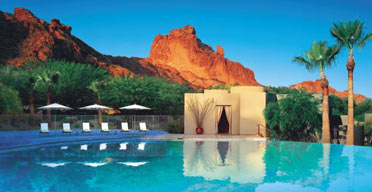
Be particularly wary of photographs of swimming pools. A clever angle can make a tiny pool look much bigger, especially if there is no one in it to give an idea of scale. Good tour operators will give the exact dimensions and depth. If they don't - ask.
Brochure descriptions
"Golden sands", "luxury hotel", "idyllic tropical island" - you don't have to look far to find the cliches. The best corrective is a second opinion, and in this respect, the internet is a great help. Even a tour operator's own site may have useful extra details not included in the brochure, while a hotel's own site may be useful - 360-degree QuickTime tours of bedrooms or even an entire hotel are fairly common now, and can give you a fuller impression of what to expect than a photograph. The net has also made it easier to find independent reviews of hotels, so you no longer need to rely entirely on the operator's or the hotel's own account. A useful address for this is tripadvisor.com, an American set up which lists reviews of hundreds of hotels around the world, especially at the upper end of the market.
Climate
Most operators give some kind of information about climate, but it is often either buried away in the back, or summarised only very briefly. If you are booking a winter sun holiday, or travelling early or late in the season, or travelling for example on a safari when the time you visit could be crucial to what you see, you would do well to double check the details from an independent source such as bbc.co.uk/weather - or in the case of safaris or special events, in a guidebook.
Pricing
The one thing you can be sure of when trying to decode the prices in a brochure is that you will almost always pay more than the headline price. In some ways this is understandable. Holidays have always been difficult to price clearly - there are so many variables of date, departure airports, flight times and the number of people in each party to take into account.
But recently the problem has been getting worse, as more and more extras are being stripped out of the basic price - to make it look cheaper - and then added on as "optional" charges at the end. This might include your seat reservation on a charter flight, the in-flight meal, even the coach transfer to your hotel on arrival. By the time you get to the bottom line on the final invoice, the cost may even have doubled. These are some of the main supplements and extras to watch for:
· Under-occupancy supplements
These mean you have to pay extra if fewer than a designated number of people share the accommodation. In most cases, if you want a decent amount of space, you will have to pay more - a one-bedroom apartment, for example is normally based on four - not two - sharing.
· Cheap or free child places
These may seem like a good deal, but the children don't normally count towards occupancy - so you'll be charged an under-occupancy supplement, and the deal suddenly doesn't look so good.
· Flight supplements
Prices are normally based on a flight (often at night) out of Gatwick. To travel at a better time, or from different airport, you can get stung by supplements of over £100 per person.
· Hotel supplements
These can be levied include extra payments for singles booking a double room, for sea views, for half or full board, for a bathroom rather than a shower room.
