
Mike Turner adjusted his head torch and studied the map as dusk fell on the broken mountain landscape. "OK, you two," he said. "I'd like you to find this little col here, then drop down to the stream by that rock outcrop there, then find that little lake we saw earlier, and I'll see you back at the campsite - right?"
Darren and I nodded sagely, pored over the contour lines, took bearings, which more or less agreed, calculated the distance and headed up the rocky slope, trying to allow for height gain as we paced out 300m. Above us the threatening outline of Carnedd Llywelyn, a 1,064m peak in northern Snowdonia, was merging into the dark sky.
The col was easy enough, but when we crossed the stream we weren't sure if we had the right place, so we couldn't find the lake. We moved off sideways, then we had a disagreement, then it turned out we'd been right all along - well, you know what it's like. Night navigation can fray the nerves a bit.
Back at camp, by a tarn still eerily strewn with the remains of a Canberra bomber which crashed in 1959, Mike was waiting patiently. "Don't worry," he said, not for the first time that day. "Navigation isn't an exact science - there's always the fudge factor. The only things you can really trust are your bearing and the contour lines.
"At night, you've got to break it into small chunks - take bearings for small distances, do your pacing carefully, work within an error rate of about 10%, try to tweak it all the time."
The wind and rain were closing in, and we retreated to our tents to drink hot chocolate and study the map for the next day.
This was night four of a week's course in mountaineering skills at the Plas y Brenin National Mountain Centre, designed to turn an averagely experienced hill walker into someone who really knows what they're doing. Mike and his colleagues, Steve Howe and Pete Cattrell, were teaching us navigation, reading the weather and terrain, and coping safely with the steep and rocky stretches.
The first day was navigation and weather, the second more navigation or a bit of single-pitch rock climbing, the third was scrambling with simple rope work, and the fourth and fifth a mini-expedition into the hills, putting things into practice. The brochure says that it is meant to give you "the techniques required for multi-day journeys and travel in the sometimes hostile conditions and rocky terrain encountered in the British mountains."
Like many of the staff at Plas y Brenin National Moun tain Centre, Mike is a bit of a mad climber. He has pioneered routes with names such as The Starfish Enterprise and Gonzo With The Wind, and is into big walls - so far in, actually, that he spent 21 days last year suspended on the mile-high face of Trango Tower in Pakistan. That's longer than your entire summer holiday.
But the main concern of all three instructors was safety, and they inspired great confidence. An illustration came when Ruth Lancaster, a computer programmer from High Wycombe, looking wide-eyed with exhilaration, reached the top of a grade-II scramble up the north-east ridge of Y Garn. "I was sure I couldn't do it, but when someone like Steve Howe tells me I can, I believe him," she said.
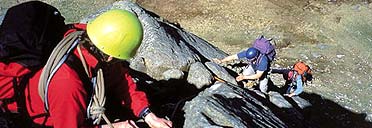
Steve, whose main interest is training rescue dogs, pushed back his pink baseball cap and grinned modestly. "A good guideline is not to go up anything you wouldn't feel happy going back down again," he said, coiling the rope we'd used. Glancing back down the airy rib of rock we'd just ascended, I thought that this was a guideline I'd probably just broken. Still, you never know until you put it to the test, so I said nothing and stared round at one of Britain's most impressive mountain amphitheatres, lit by spring sunshine - the peaks of Tryfan, Glyder Fach and Glyder Fawr, hung about with great slabs and fissures and bristling ridges. For the descent, we took a different route, on the Sheep's Path past the Devil's Kitchen, spotting spring flowers and watching buzzards along the way.
Another example of growing confidence had come two days before, when some of us had spent the day climbing 70ft pitches on the upper tier of Tremadog, near Porthmadog. When Linda Haworth, an administrator with the British Horse Society from Rugby, slipped off one of the slabs and dangled for a few seconds on the rope, the rest of us thought she might give up. Instead, she tackled the rock with extra vigour and was at the top about a minute later.
"There were many things all week which I thought I couldn't do, but I discovered that actually I could do them," she said after the course. "I pushed myself harder than I thought I could and found some extra confidence and belief in myself.
"But I'd never have done any of the climbing if I had not trusted the instructors, because you put your life in their hands. I feel I've also got more confidence in navigation now and would probably be ready to go out in poorer weather off the beaten track. I've got to grips with measuring distances and timing."
As well as Ruth and Linda, there were Linda's husband Dave, an HGV driver; Darren Harris, a personal trainer from Surrey; a radio reporter; and a garage owner from Dumfries who was training for a mountain leader qualification. Plas y Brenin tends to be a melting pot for people of all backgrounds, brought together by an interest in the outdoors. It sits between road and river near Capel Curig, with a magnificent view across a lake to the summit of Snowdon. There are climbing walls, a dry ski slope, a canoe pool, a warren of simple but comfortable rooms, and an auditorium for lectures by various off-the-wall adventurers. We heard from a man who'd set off with his girlfriend to get to Australia in kayaks (they got as far as Greece), and another who'd spend two years in the Antarctic.
At the core are the bar and dining room, where people come down at 8am in their socks and make up bulging packed lunches before consuming vast cooked breakfasts. A compensation for the somewhat institutional food is the afternoon ritual of tea and freshly made cakes, which cause groups to rush back from the hills at 4.30pm sharp.
The cakes tasted best after a final day toiling along the ridge of Carnedd Dafydd in stinging horizontal hail and 100m visibility. "Definitely not a day to go out scrambling," said Mike at the final debriefing. "But it's good experience to be out in the hills in all kinds of weather because you're learning all the time.
"People on this course tend to focus on the harder skills, like ropework and navigation, but the most important thing is probably awareness - how your companions are feeling at any time, the terrain, how the weather is changing. The other important thing is enthusiasm, going out there and trying things, going a little bit out of the comfort zone."
Darren said afterwards that he'd been hillwalking happily on a variety of routes for 10 years. "But I was amazed at how much more could be learnt about navigation and relocation on the hillside, especially in atrocious weather. The confidencederived from identifying your position to a 10m radius is uplifting. And if you thought you couldn't sleep for nine or 10 hours straight, spend a week with these guys."
Top tips
· Maps are in metric measurements, so forget about feet and inches.
·Know exactly how many of your paces make 100 metres.
·Know how many metres your forefinger represents when pressed on a 1:25,000 map.
·Know how long it normally takes you to walk 1km on flat ground.
·For every 10 metres of climb, add a minute to your time per kilometre.
·Maps are an artist's impression: woods, walls and streams come and go.
·The least fallible navigation tools are contour lines and compass bearings.
·The temperature drops 1C every 300 metres in wet air, and 3C in dry air.
·The wind at 900 metres will be at least twice the speed at sea level.
·Get some waterproof gloves and carry them, even in summer.
Way to go
Getting there: Plas y Brenin National Mountain Centre is at Capel Curig, Conwy LL24 OET (01690 720214, pyb.co.uk). Run by the Mountain Training Trust, it holds courses in rock climbing, summer mountaineering and hillwalking, winter climbing and mountaineering (in Glencoe, Scotland), and alpine skiing and mountaineering (in the Alps).
There are courses in kayaking and canoeing, personal development courses, and training and assessment for mountaineering qualifications, such as walking group leader, mountain leader and European mountain leader. The five-day mountaineering skills course costs £340 including use of equipment and full board. The price of a two-day course starts from £160.
