
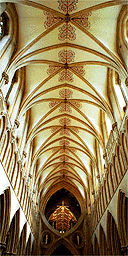
The voices of nine men and 18 women harmonise in the time-worn prayers of Evensong as the light drains out of the gold and orange tracery of the great Jesse window above the choir: "Lighten our darkness, we beseech thee, O Lord, and by thy great mercy defend us from all perils and dangers of this night."
It brings a shiver to the spine of the sturdiest unbeliever and calls up a time when wolves inhabited the darkness and winter nights seemed infinitely long - the time when our ancestors, in a burst of creativity, devotion and toil which lasted some 200 years, built the glorious medieval cathedrals of England and Europe.
This one at Wells is among the best of them. It was the first cathedral built entirely in the Early English style, which began around 1175, and is widely thought to have the finest west front in the country. Like a huge altar screen built in stone, it is encrusted with more than 350 carved statues which tell the Christian story of the world with Christ in Glory on the central pinnacle.
It was a unique inspiration, the first outdoor display of its kind in the Christian world, predating similar facades in the rest of Europe by 50 years. The architectural his torian Sir Nikolaus Pevsner, in his book Buildings of England, said that Wells "represents the most original treatment of space in architecture of which any country at that time was capable".
The Dean of Wells, the very Rev Richard Lewis, shares Pevsner's enthusiasm. "It has a simplicity of line, and the proportions are right," he says. "It's built on the pattern of the double cube which the Greek philosophers thought was in harmony with man's perfection. It's huge, but it's not so overpowering that it takes away your humanity.
Wells first became the seat of a bishop in the 10th century, and in the 14th century it was Somerset's largest wool town. But the industry was lured away by water power and coal, and little has happened since except the modern arrival of an electronics factory and a firm that makes most of the country's supermarket trolleys.
Christopher Booker, the Sunday Telegraph columnist and co-founder of Private Eye, has lived near Wells for 16 years. He says that when he introduces friends to the city they spend a day looking at the cathedral and wandering round the old centre, and then head for nearby attractions like the Cheddar Gorge and Glastonbury.
"The cathedral dominates the town in the way a good cathedral should," he says. "I love wandering round the cobbled square when the market's there on Saturdays - there's a very good fish stall. And the cathedral has a perfect close, with some very fine architecture in the street next to it called the Liberty."
The Dean puts it more bluntly: "There is no reason to come to Wells other than the cathedral, and if the cathedral wasn't here it would be just another struggling Somerset town. The cathedral and the cathedral school add vibrancy to Wells and their contribution to the local economy is enormous: the school employs about 250 people and we employ about 100."
The consequence is that there is no urban sprawl and no modern intrusion on the ancient buildings of England's smallest city, granted its first charter by King John in 1201. You can see the best of Wells in a day - two if you really want to get under the skin of the cathedral. It's small-scale, well-preserved and pleasantly provincial.
Next door to the cathedral is the Bishop's Palace, fortified and moated from the time when he was considered an enemy by the local people, now occupied by the Very Rev Jim Thompson, star of Thought for the Day. When the swans on the moat are hungry, they pull a cord by the gatehouse which rings a bell - something I wouldn't have believed without seeing it.
In the bishop's ground, you can also stick your head through a hole in a wall to look at the eponymous wells, which pump out 40 gallons of water a second: some of it still runs in deep gutters down the market place, where it was first directed to swill away the refuse from butchers' stalls.
On the opposite side of the cathedral is Vicar's Close, built originally for the Vicar's Choral (the choristers), perhaps to keep them from the temptations of the town. It is claimed to be the oldest continually-inhabited medieval street in Europe: some of the houses are now practice rooms for Wells Cathedral School, and on warm evenings visitors perch on the walls to listen. The pupils also put on free lunchtime concerts.
You might bump into the choristers as they walk over to the cathedral in their blue-and-white surplices. Then there are Harper's and Bubwith's almshouses in Chamberlain Street, and if you're still feeling ecclesiastical there's St Cuthbert's parish church, which has a lovely painted ceiling and an even more impressive door than the cathedral.
At the top of the High Street, you come to Penniless Porch, the gateway between the Market Place and the Cathedral Close: it was built for beggars in 1456 by Bishop Bekynton, whose chapel in the cathedral contains one effigy of him in full regalia, and a second of him as an emaciated cadaver. No doubt, the compassionate Bishop would be happy to see his porch occupied nowadays by a figure with an earring, a blanket and a dog, asking for spare change.
How to get there
The M5 is 15 miles to the west, the M4 20 miles to the north. Driving time 2-3 hours from London, 2-2€ hours from Birmingham. By rail to Bath, Bristol or Castle Carey, then bus or taxi: national rail enquiries 0845 7484950. National Express coach services to Wells from most regional centres: 0870 5808080. Local buses mainly operated by First Badgerline, 01749 673084.
Where to stay
Main hotels in the city are the Market Place (01749 672616), the Swan (01749 678877), the Crown (01749 673457), and the White Hart (01749 672056). Mendip District Council's official accommodation guide, including B&B and camping, is available from Wells Tourist Information Centre, 01749 672552. General tourist information on www.somerset.gov.uk/mendip . Cathedral information 01749 674483.
Where to eat and drink
Cafés and bistros near the cathedral and market place include Cloister Restaurant at the cathedral and the Café Bleu in Sadler Street.
Nearby attractions
Glastonbury, with its Tor, ruined Abbey and new-age culture (Tourist Information Centre, 01458 832954). Clarks Village, a factory shopping centre and shoe museum at Street, near Glastonbury, 01458 840064. Cheddar Caves and Gorge (01934 742343, www. cheddarcaves.co.uk). Wookey Hole Caves (01749 672243) The Peat Moors Centre, illustrating Iron Age life in the Somerset Levels, Westhay, near Glastonbury, 01458 860697.
