
It's customary at Christmas time to visit the relatives so I decided to pay a visit to some of our closest relatives the high primate Mountain Gorillas. An endangered species, there is estimated to be only around 700 of these animals surviving in the world, some of which live in the mountains of Bwindi Impenetrable National Park in south-western Uganda.
Getting to Bwindi is no mean feat in itself, once there I stayed at a Buhoma Community Rest Camp and listened to horror stories from people who had climbed for six hours that day before seeing the elusive gorillas. I considered asking whether there was a helicopter-drop option, took another look at the basic facilities and pit latrines and thought better of it.
Our entourage comprised of six tourists, two armed soldiers, a guide and a few porters. The armed escorts are now a regular visible presence at Bwindi after the kidnap and disappearance of a group of eight tourists in 1998. Security had to be stepped up in a major way before tourists felt comfortable about returning. What concerned me most was the likelihood of the soldiers carrying me when I got too knackered. Sadly they were too busy looking intimidating to bother with a wheezy old bird like me.
We were given a briefing before we set off which included guidance on how to behave while close to the gorillas. You are only permitted to go as close as three metres to any of the group and should not attempt the trip if you are in any way ill, as the animals are vulnerable to human disease and are fiercely protected by the Uganda Wildlife Authority. Lastly, if they decide to charge at you, crouch down and avoid eye contact. My favourite part of the briefing was when we were told not to hug the gorillas - who in the world would even consider such a thing? I heard the loud American tourist from another group sigh in disappointment.
We set off under the instruction of Moses, our expert guide, and under the stern protection of soldiers one and two. My co-trackers were a mixed bunch: three elderly American doctors, a young US Peace Corps couple and me, a random English girl who looked like she might be more comfortable at the bottom of the mountain with a cold beer, watching it all on video.
The climb up the mountain was the hardest thing I've ever had to do. Walking up an incredibly steep gradient in the heat and humidity was almost unbearable in parts and I was relieved to see that some of the group were also struggling. Moses, all the while, was checking in with his walky talky, discussing the whereabouts of the Mubare group of mountain gorillas, our designated group.
We reached the top of the mountain and the edge of the forest in about two hours. We had a report that they thought they had the rough location of the Mubare group and we waited for confirmation. I know that this shouldn't be classified officially as tracking, because you get tipped off as to the rough location, but we still had quite a way to go as the gorillas can move at a fair pace when they are feeding. Had it not been for the advanced trackers, we might have been there long into the night trying to locate our primates.
After a short wait on the outskirts of the forest, Moses announced, "so, are you ready to see some gorillas?" I suddenly had butterflies and felt like a child on a school trip. We left our bags and armed just with cameras, entered Bwindi Impenetrable Forest. The feeling of anticipation is hard to describe, as we thrashed our way through the dense foliage, thorns, stinging nettles and bushes. All my senses were on red alert waiting to see the mighty silverback and his troupe. Eventually our pace slowed as Moses spotted the group. I craned my neck to see through the group and there he was, silverback, top primate of the Mubare clan.
He looked as regal as I had expected, although clearly aware of our presence, he continued to slowly eat the leaves of the nearby bush. Almost reclining, his giant paunch interfered slightly with access to the branches he was pulling languidly towards him before chomping on a few tasty leaves. He reminded me of a rotund grandfather figure; you could tell from his attitude that he knew he was in charge of the group and the situation, a smoking jacket and pipe would have been fitting. Watching his mannerisms and movements made me acutely aware of how remarkably similar to humans these animals are. We watched as he decimated the choice foliage around him and then heaved himself up on all fours to plod along to the next patch, baring his striking silver cummerbund as he moved.
We then heard some movement to the right, following the rustling noises we could almost see two juvenile gorillas play fighting in the undergrowth, one was beating his chest in between bouts of the two of them rolling around grabbing each other. The noises they made almost sounded like a couple of teenage boys arguing. They caught wind of us standing close by and scampered off further into the forest. Just as we were about to move on someone spotted them scampering up a tree, they made it look so easy, shinning up to the top at quite some speed.
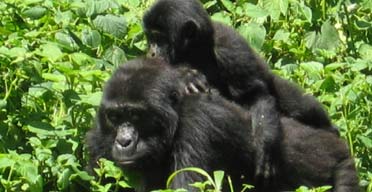
Soon afterwards as we stalked slowly behind the silverback, Moses spotted a mother and baby some way in the distance. The mother was carrying the baby on her back and soon clocked us watching and photographing her. She looked understandably wary and defensive as she stepped up her pace and headed behind some trees. Apparently a female gorilla starts to bear children from the age of 10 upwards. She has a close relationship with the infant for about four years when another sibling may be born. Most of the children in the group are fathered by the silverback, not leaving the other blackback males with much of a look in.
The gorillas gradually followed in the general direction of the silverback. Effectively the "tribal leader", the silverback leads the search for food, mediates in disputes within the group and protects the group against outside threats. In short - he's the big boss.
We continued to watch as the individuals paced from one patch of foliage to another casting us wary looks as they went. I noticed a black face staring out of a bush directly ahead of me and there was a blackback sitting on his haunches regarding us with a look of disdain. He had a deep stare unflinching and quite intimidating, his eyes glaring out from the shiny leathery skin of his face. We had a semi staring match for almost five minutes and I didn't want to disturb the moment by taking a photo. He even maintained his steely glare unphased by the zoom and click of the camera. We carried on the face off for a few more moments before he ducked down into the undergrowth and followed the trail of the grazing group.
Visits with the gorillas are limited to an hour and when our time was up I felt like I'd been holding my breath for the whole hour. We stumbled back through the forest to start the descent back to camp and I couldn't stop smiling. What an incredible experience.
The trip downhill was easier on the lungs but harder on the feet. Back at camp I had a well-earned rest before heading on a community village tour, part of the Buhoma Community Tourism project. We visited the local traditional healer, saw how banana wine is made and ended the trip with some dancing from the Batwa tribe of pygmies who have been relocated from the forest as part of the gorilla protection project. The community tourism project is admirable and a great insight into life in a Ugandan village, but somehow I couldn't help thinking how dull we humans are in comparison to our primate cousins.
Tracking mountain gorillas had long been on my list of things to do,. It's expensive, an arduous journey and tough in parts, but it was worth every dollar and ache for that one hour of monkey magic.
