
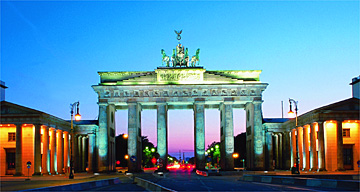
Divided for almost three decades, Berlin became the capital of reunified Germany in 1990. Since then, Europe's biggest post-war construction project has transformed the no-man's land that once separated East from West into the Potsdamer Platz, a vibrant heartland of shops, offices, flats, eateries, bars and cinemas. And all that is left of the wall that the East German government built in 1961, to stop its citizens from escaping to the west, are a few graffitied remnants.
As this shiny new centre has risen from a forest of cranes, so the crumbling buildings of historical East Berlin have slowly been restored. The result is a city where grand public buildings, museums and theatres rub shoulders with buzzing beer halls, style bars and pumping Latino nightclubs. A suitably atmospheric place, then, to host the final of the Fifa World Cup 2006 on July 9 in Olympic Stadium. And lest you should forget that date, a giant Countdown Clock set up beside the Brandenburg Gate is already counting down the days to the kick-off.
Sporting pedigree
Berlin's new Olympic Stadium is home to Hertha Berlin, who play in the Bundesliga (equivalent to the Premiership in England). But in the 1960s, Hertha was relegated to the regional league, Regionalliga, after it breached the Bundesliga's player salary rules. As it was felt that there should be a first-league football team in the capital, Tasmania 1900 Berlin was promoted to the top flight, only to become the worst team in Bundesliga history and be relegated after one season.
1966 and all that ...
The very first bomb dropped by the Allies during the second world war killed the only elephant in Berlin Zoo.
Where to stay
· Search a selection of 400 hotels in Berlin at Berlin Tourist Information.
· Rooms at more than 550 German hotels can be booked during the World Cup through Fifaworldcup.com. The hotels will be rated from two to five stars and all will be located close to match venues. Simply specify which team you want to follow and the period when you'd like to be in Germany.
· Soccerphile in partnership with tour company VIP Hanse Touring is offering World Cup tour packages including hospitality, hotel bookings, venue and match day transfers and city tours.
· Hotel.de offers a selection of hotels available in the 12 participating World Cup cities along with information on draw dates and venues.
· World Cup Trips organises accommodation and tours incorporating transport to and from matches.
· Find accommodation in each of the World Cup host cities at Walking-in-Germany.co.uk.
· Find people with rooms to rent in the host cities at ImmobilienScout24.
· Fanproject 2006 is offering accommodation at giant campsites around Germany during the World Cup.
Getting there
By air: Berlin has three airports: Tegel (TXL), in the north-east, 5 miles from the city centre; Sch?nefeld (SXF) in the south-east, 11 miles from the centre, and Tempelhof (THF) located 4 miles to the south of the centre. Cheapflights.co.uk has flights from UK airports to Berlin.
By rail: There are international rail links from London Waterloo to Germany's gateway cities of Aachen and Cologne. Book through Deutsche Bahn. European Rail offers transport to all the World Cup destinations. Also, check out special offers from Deutsch Bahn for World Cup travel.
By road: Eurolines, the overseas wing of National Express, offers return fares from the UK to all major German cities. Within Germany, Eurolines is represented by Deutsche Touring and tickets are available from Deutsche Bahn ticket agents in major railway stations.
The stadium
Built for the 1936 Olympic Games at which American sprinter Jesse Owens won four gold medals, Berlin's Olympic Stadium became the HQ of the British military administration after the second world war. The stadium hosted three games in the 1974 World Cup, and since 1985 has held the German cup final. Currently being upgraded to the tune of €242m, come 2006 World Cup kick-off, the stadium will seat 74,500. You can take a look around on non-match days for €2. For information on opening hours and guided tours, go to olympiastadion-berlin.de; +49 (0)30 25 00 23 22.
· Where is it? On Bismarckstrasse in the western part of Berlin in Charlottenburg. If you're travelling by train you'll need the Olympiastadion station on the S5 line. If using the underground, you'll want the Olympiastadion station on the U2 line. It's 13 minutes from the Hauptbahnhof to the Olympiastadion station (exit the train on the left), then a five to seven-minute walk from the station. Alternatively, jump on bus 154.
Or watch it in a bar
The Oscar Wilde Hotel's backroom big screen attracts hordes of British, Irish and German football fans when the English Premiership's teams do battle. You can down pints of Caffreys and feast on hearty Irish and English pub grub while you watch.
Been there: A readers' guide to Berlin
