
A sewage plant may seem an odd place to launch an exploration of the heavens. Yet from such a site, Britain's most ambitious astronautical endeavour - the National Space Centre - lifted off yesterday, aiming to ignite the nation's interest in extra-terrestrial travel. Given the mire into which our space industry has sunk, its location - a Leicester rubbish tip - is entirely fitting.
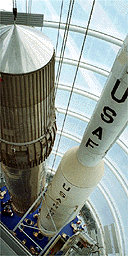
It has cost £52 million to fire Leicester from the sludge to the stars, and turn its former Abbey Tank sewage works into an interplanetary theme park, the handiwork of architect Nicholas Grimshaw, creator of London's Eurostar terminal. He has designed a centre dominated by a 140ft tower of inflated plastic sections. From a distance, it resembles a multi-storey maggot. Close up, it looks like nothing on earth - which, presumably, was the architect's intention. This is the Space Tower. A giant US Thor launcher dangles from its roof, beside Blue Streak, the booster that was supposed to blast Britain to space domination, but which was axed in government cutbacks. You can wander round the café below, survey its pitted casing and ponder its fate - a sobering experience.
Other UK goodies include the personal effects our first astronaut, Helen Sharman, took into space (on a Russian rocket) and bits of debris from our Cluster mission, which blew up during its 1996 launch. For a nation that gave the world Dan Dare, it is a meagre list and forced the staff to go abroad to cadge or buy their other exhibits. Among the treasures they have brought back are a piece of moon rock - and an old Soyuz space capsule. The latter once rested outside a Ukrainian museum, where it provided a home for local birds - whose droppings took months of scraping to remove.
Inside the centre, there is a mock-up of America's primitive Mercury capsule - whose minute dimensions led its astronauts to dub themselves 'Spam in a can'. Next door there is a full-sized section of the International Space Station with its computers, sleeping quarters and zero-gravity toilet. By contrast Mercury astronauts could only cross their legs and pray their mission would end quickly. You can also try the Blast-Off Experience, in which you are shaken like an astronaut during take-off. It's like riding on the Northern Line, minus the winos.
However, the centre's real sparkle comes from the verve and humour with which its displays have been designed. The Mars exhibit is viewed from a house destroyed by a Martian war machine; a model of Saturn floats in a bath to demonstrate how light and gaseous are the sun's outer planets; while visitors to the Venus stand have to step over a crushed model of Venera - the first probe to land on the planet and which was flat tened by its fantastic atmospheric pressures.
There is also a planetarium; a Challenger classroom where you can learn how to run space missions; and an inquiry desk where major launches will be screened and where experts will answer your questions: What is a black hole? Where is Pluto? Is Ann Widdecombe an alien? That sort of thing.
The centre estimates it will take an average family two and a half hours to tour the place. Give it more if you can. It is certainly worth it. Britain will soon be bursting with science theme parks, for the space centre is only one of 10 such enterprises backed by lottery cash. I suspect, however, that this will be one of the best and most imaginative.
Fact file
The National Space Centre is near the A6, two miles north of Leicester city centre, and is signposted from Jcts 21A and 22 on the M1. For those using public transport, Midland Mainline and Central Trains serve Leicester station.
Contact the National Space Centre on 0870 607722; info@spacecentre.co.uk; or study its website at www.spacecentre.co.uk.
Admission for adults is £7.50, children (5-14 ) £5.50. Family tickets (two adults, two children) £22.
