
The best bit about buying a flat on the Mediterranean is the moment when the notary stands up, says 'I'm just going to wash my hands', and leaves the room. This is the cue for you to get out your £4,000 wedge (known as dinero negro, black money) and pass it under the table. Make sure you pass it under the table as it makes the whole occasion much more louche, especially as you're sitting next to your bank manager who knows exactly what's going on.
A friend of mine had an even better black money moment. Her notary wore sunglasses throughout the ceremony. (The Spanish house buying process does feel a bit like a marriage ceremony, actually. The buyer sits opposite the seller and you both go 'I do' and 'I will' to each other for 30-odd minutes.) When her notary had finished his bit, he rose, saying 'excuse me, I'm just going out for a cup of wine'. This seemed redolent of the age when notaries wore black capes and breeches and was thus both dodgy and dépaysant.
Dépaysement (change of scenery) is important if you are going to buy abroad. Another friend told me he was thinking of buying in Normandy, but frankly you might as well buy in Cornwall where it rains all the time too and the food is getting better.
You don't hit 'abroad' in Europe until you hit the Med. The name sums up all that is romantic and exotic about the south of Europe with its own vocabulary of 'corniches' and 'terrains' and its images of orange trees, olive groves and tomatoes that taste of something. And then there's the sea itself. The stretch from Barcelona to Genoa alone is filled with a bunch of fantastical names: the Bay of Poets, the Bay of Wonders, the Gulf of Paradise, the Bay of Sun, Saracens' Bay, the Riviera of Palms and Riviera of Flowers. The unpredictable waters even reflect Riviera women themselves: clear and sparkling on some days; snarling and filled with old fag ends on others.
Everyone wants to go to the Med these days. There are even immigrant fish moving in. According to a report this year by the Monaco-based International Commission for the Scientific Exploration of the Mediterranean Sea, waters are filling up with new species of fish who sneak in through the Suez Canal and the Strait of Gibraltar.
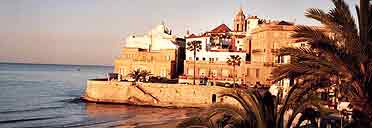
I decided to set up temporary home along with the illegal sardines and snappers last year when I spent three months writing in Sitges - a kind of Spanish Miami without the steroids. I lived in an apartment 30 metres from the Mediterranean with the most beautiful view I'll probably ever have in my life for a rent of £300 a month. I was quite happy renting. And then someone told me about this cheap flat she'd heard about. As well as being the Miami of Spain, Sitges - only 20 minutes from Barcelona by very modern train - is also its Beverly Hills. Values there over the past three years rose by 25 and 20 per cent respectively.
A purchase seemed to make sense. Now that the first rung of the London property ladder has disappeared well and truly into the clouds, the sunnier parts of Europe suddenly seem an interesting alternative. Aside from this, there is also the fact of the pound performing so strongly against the euro and the concept of buying then letting and thus having holiday makers pay off your mortgage (and maybe some of your London rent).
Meanwhile, the idea of buying abroad seemed the equivalent of an open relationship (but one that might actually work). It offers security without commitment - because you don't live there full time: ie you can be a property owner abroad and still appear a cool bohemian renter in England.
I was about to settle on Sitges when I met Martin in a bar. Martin, a gay 50-year-old retired civil servant, decided to sell up his two-bedroom semi in Sheffield seven years ago following a moment of enlightenment at the helm of his lawn mower: 'I suddenly stopped and thought, "What the bloody hell am I doing? I've got a front lawn and a back lawn and I don't want either."'
So he sold the house and with the proceeds he can now afford to spend the rest of his life living one line back from the Med, watching sunsets the colour of silver and pink and letting his skin tan to shades of warm caramel.
A few drinks later, Martin admitted that, actually, he wasn't a big one for sun and sea. Basically, he moved to Sitges because it provides him with what he calls, 'my winter warmers and my summer pick and mix'. When he was a closeted married man, he and his wife used to go to Switzerland for their summer holidays. 'It was all right,' he said with a shudder, 'but you've got to go where it suits, haven't you?'
Good point, Bob. I wasn't particularly looking for winter warmers so I decided that a drive up to Genoa would give me a feeling for the different vibes along different parts of the coast. The first thing you notice is the amazing light. It is an uncanny palette that changes the further east you go - ochre in Spain, turning to pink in the south of France and ending up as bluey green in Italy.
My first stop was Agde in France, which resembled a windswept set from a Sixties nouvelle vague film. Interesting architecture and you can buy a studio for 30 grand and a one-bedroom with terrace for less than 50. (Remember that, as in Spain and Italy, you must add on approximately 10 per cent to the advertised prices for notary and legal costs.) Still, back from the first line of the sea it looks a bit like a French version of Butlins (ie loads of cardboardy restaurants selling moules frites) which is fine when the sun comes out but can you imagine what you'd do if it rained?
Sète, 60 kilometres on, was also promising: long, duney beaches with an old-fashioned Tintin feel and similar prices to Agde. But I wasn't looking for Tintin. Next came Marseille, a French version of Barcelona or Sydney with the concomitant city-on-the-sea mellowness.
There is a selection of pri vate beaches in town, some set into cliffs to the west and long, white sand expanses to the east. New transport links with the TGV make access from Britain easy and the newly developed La Joliette region has some impressive, restored nineteenth-century warehouse lofts.
You're never going to get bored here with the Le Corbusier architecture, the incredible light and the stupendous fish market on the Vieux Port, but then, surely if you're based in a city already, the last thing you want is to come and live in another city?
On the other hand, if you don't want to bump into your butcher every time you go to the local disco then you might want to consider Toulon. This straddles the village/city divide. It's pretty much like any French town - the tabacs , the pretty terraces, the baguette shops - yet it's not too busy, its people are friendly and in the early evening light, a lot of the houses look like 1930s Hollywood hills villas. It's cheap too.
Basically, Perpignan to Toulon is the poor man's end of the Med (Le Var) and consequently prices are lower. Just round the corner at Hyères, the outrageous beauty of the Côte d'Azur begins, but Toulon is still on the wallflower side. Thierry Peisson from Toulon estate agents Top Immo says that his city is interesting in property investment terms. Property in the Alpes Maritimes (the posh bit of the Côte d'Azur - Cannes, Nice, Menton) is expensive, but prices are rising slower annually there than places in Le Var. 'In Toulon, apartments are cheap and rents are high,' says Thierry, 'because the town is filled with military people from the local naval bases.'
The bummer is that the naval people are there because Toulon is a great strategic point and consequently the beaches are nothing to write home about. Thirty kilometres down the road, in Hyères, the colours, crystal waters, cove beaches and the subtly sophisticated architecture are undoubtedly stunning. Hyères is where Queen Victoria would winter and has been popular with Brits ever since.
Then comes Saint Tropez. I remember it as expensive or snooty the last time I was here (aged 19, hitchhiking round the south of France trying to get a waitressing job wearing a frayed Dorothy Perkins skirt and Dolcis plastic shoes... I thought I looked posh.) It's still expensive and certainly snooty - but beach snooty as opposed to Paris snooty. Basically, it's hot and people don't wear many clothes so nobody's got the energy to be as ferocious as the northern French can be. (I ended up on a public beach in Ramatuelle with an atmosphere more like that of a relaxed Thai beach than Paris-on-Sea.)
Good points about St Tropez are: the architecture and light is exquisite, there is fantastic shopping potential, the bread and patisserie is fantastic, houses are no more expensive then they are in Sitges and given the location, you wouldn't have any trouble letting a property out for a few months in the summer. In fact, you can still get some bargains on the Côte d'Azur if you are prepared to be a little set back from the coast, say in the medieval towns of Vence, Èze and Mougins. According to Jacques Orain from Laforet Immobilier, the most frequent requests are for villas of about 200 square metres with a garden and a pool, costing between €700,000 and €900,000 (£427,000 to £550,000). But there are cheaper things to be had on the Côte d'Azur. On the east and west sides of Nice you can still get a one-bedroomed apartment of around 38 square metres in a new development for €90,000 to €99,000 (around £60,000).
Italy is great price-wise, people-wise, and looks-wise. The Italian Mediterranean coast is rockier than France, with smaller beaches enclosed by inlets. The Romans used to call the Ligurian coast the Bay of Whales because it became a favourite haunt of sperm whales, Clymene dolphins, Rissos dolphins, pilot whales and rough-toothed dolphins.
Genoa is a good place to look at. Ryanair offers very cheap flights there and the countryside looks like a laid-back version of the landscape around Florence. There are villas in the hills that you can buy for the price of a studio in Elephant and Castle.
Still, the trip decided me that Spain was where I felt at home and where I have friends. So I went back to Sitges and spent 66 grand on a one-bedroom flat with a large terrace and sun roof. The point of buying on the Med, as far as I am concerned, is not so much about owning bricks and mortar as owning a piece of the Med. Now I am five minutes from the beach and clubs and lying on a hammock while squinting between three water tanks I have a postage-stamp sized view of the great sea herself.
Meanwhile, I am having a great open relationship with my new property. I haven't seen it for a month now but it's good to know I can get both winter warmers and summer pick and mix at the drop of a cheap air ticket.
Factfile
Flights to Barcelona with EasyJet start at £40 return including taxes. Avis car rentals (0870 6060100) at Barcelona airport start at £147 for a week.
If you don't want to drive to Barcelona you can take the luxury ferry Viamare from Genoa port. The trip takes 17 hours. Prices for a two-person cabin start from £63 per head while car prices start from £57 per car.
Useful estate agents
Sitges: Sitges Property Services (00 34 93 811 0872); Key Star Real Estate (00 34 93 811 46 14)
Montpellier region: Agence Catherine Mamet (00 33 467 66 28 00); Top Immo, Toulon (00 33 494 622 886)
Marseille region: Check out the internet magazine on www.logic-immo.com; Agence Romand, Hyères (00 33 494 128 200); Laforê¿t Immobilier, St Tropez (00 33 498 126 062)
Genoa: Check out the English language property website at www.italy-riviera-realestate.com; Studio Immobiliare Possenti, Genoa (00 39 010 58 19 76)
