
Twenty-five years ago this April, the Falklands conflict put this windswept archipelago briefly on the map. Afterwards, as Britain and Argentina buried their dead and the taskforce sailed home, the islands faded from view again and, for most of Britain, stayed in the background.
There are 8,000 miles between the islands and the UK, which means an 18-hour journey via Ascension Island if you fly with one of the charter carriers subcontracted to the Ministry of Defence to provide the air bridge. The first 17 hours are little different from any other commercial flight, but the last hour as you approach the islands stays with you. It is about here, 200 miles out and 10,000ft up, that you notice the brace of RAF Tornado F3 fighter jets, one stationed off each wingtip. They attend every inbound and outbound flight, a reminder of the British forces stationed in this South Atlantic outpost.
Stepping off the aircraft on arrival, the first thing you notice is the light. It is startling in its clarity and brightness. The atmosphere is devoid of dust and pollutants, so your eyes have pure and perfect vision.
The clarity is down to the islands’ location, 400 miles from South America, 900 miles from Antarctica. A tiny population helps, too. In an area roughly the size of Wales, there are just 2,500 people. Slightly under 2,000 of them live in the capital, Stanley – a city comparable in size and population to a small British town.
The night skies are sparkling, unspoiled by light pollution. We don't get a night sky in many parts of Britain; we get to see the sodium glow of 1001 towns, instead. It is breathtaking when you look heavenwards south of the equator, the Milky Way a bright swathe across the night sky.
The Falkland Islands are not the end of the world, but they feel like it. Port Stanley, which can claim to be the most southerly capital city on the planet, also prides itself on being the safest. There has apparently never been a case of mugging or pickpocketing.
The town has changed a lot in the past 25 years, but there are countless reminders of its geographical isolation - I was told you could buy a Land Rover in any colour you like, but you might have to wait two weeks for a lightbulb. There are no fancy theatres or nightclubs, just an assortment of cosy pubs and restaurants and powder-white beaches meeting crystal-clear turquoise ocean.
The islands change dramatically once you leave Stanley. There are countless small settlements but most places of interest are connected with the conflict in 1982: the British cemetery at San Carlos, the Argentine cemetery at Goose Green; or the spot where Colonel Herbert ‘H’ Jones, VC, died.
Locals refer to anywhere outside the capital as "the camp", derived from the Spanish-speaking gauchos’ word “campo” (meaning countryside). It is one of the few reminders of the islands' proximity to South America.
Curious creatures
Aside from the war, the islands are famed for their flora, fauna and geology - unique rock formations, birdlife and sea mammals. Nowhere is this natural distinction more apparent than on Sea Lion Island, a short flight away. The lodge, the island’s only building, was airlifted over by helicopter. Visitors are kept to a minimum, which means that the 40-odd species of bird and five species of penguin are remarkably tame. A short walk from the lodge there are penguins, geese, ducks, gulls and moorland birds by the thousand. The beaches are home to hundreds of sea lions and huge elephant seals.
Rockhopper Point, on the southern coast of the island, is the site of a memorial to those who lost their lives on HMS Sheffield. It is a simple, touching affair facing out towards the South Atlantic.
From there, we drove to see the southern sea lions, just along the coast. Around 55 pups are born here each year to these rare creatures. Groups of five or six females, with one male, produce pups in December and January.
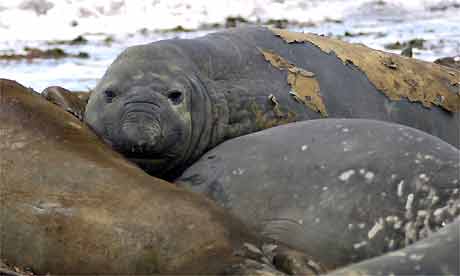
After lunch we walked down to the beach at Elephant Corner, which is chock full of elephant seals. These huge creatures reach up to six metres in length and weigh up to three-and-a-half tonnes. They lie in the sun, heave around to find a comfortable spot and flip sand over themselves to keep cool.
Nearby are the gentoo penguins - 2,800 breeding pairs, each situated on a peaty mound. Their curiosity leads them to approach and surround you. It is a real Gulliver moment, stepping among penguins for the first time. You feel you should keep your distance, but nobody has told the gentoos that. Elsewhere you will find yourself among cormorants, king penguins, rock hoppers, striated caracaras - all are wild creatures, but none treat you as a threat.
You have to recalibrate your senses when you visit the Falklands; everything seems familiar but somehow it is not. The vastness, the rugged beauty of the landscape, the scarcity of trees - it is a part of Britain, but not as we know it.
The islands are an overseas territory of the UK; there has been a British presence in the Falklands since 1833 and the islanders are fiercely patriotic. But for all that – and even though the landscape is reminiscent of home - you are never in any doubt that you are 8,000 miles away in the vastness of the South Atlantic.
There is a wonderful sense of esprit de corps among British military personnel on the islands, which washes over departing tourists as well as troops flying home, courtesy of the send-off each airliner gets. There cannot be many airports in the world where the terminal staff and check-in agents line up en masse and stand to attention as you walk out to your flight, the strains of “We gotta get outta this place” ringing out across the runway.
Getting there
Around 30 European tour operators offer tailor-made packages and escorted tours to the Falkland Islands. Some use MoD charter flights from the UK, others the weekly commercial service from South America.
The MoD flight flies to the Falklands six times a month from RAF Brize Norton, Oxfordshire. Bookings can be made via the travel coordinator, Falkland Islands Government Office, London (020 7222 2542)
LAN flies to the Falkland Islands from Santiago in Chile. Details from falklandstravel.com or falklandislandsholidays.com
Where to stay
Visitor numbers have increased steadily in recent years, from 49,000 in 2004/05 to a projected 56,000 in 2006/07. Most are cruise-ship passengers, but there has been a 10% rise in private travellers over the same period. Even so, don’t expect five-star hotels. Most accommodation is basic, although comfortable. The Falkland Islands tourist board website has lots of information on places to stay and things to do on the islands.
