
Sitting on a converted shrimping boat that's going to catch shrimp before a shrimp-and-salad supper gives you a chance to reflect on several things. Like how much people on the Gulf Coast like their shrimp, for one. Or how tame enjoying wilderness can feel, if that's the way you want it. Dolphins rise and fall in the wake of the boat while I sip my iced tea. And then choke because it's got about 900 sugars in it. Welcome to the Deep South.
A coastal wildlife tour wasn't what I imagined when I thought of Alabama - but in a quiet, wooded and sometimes wet corner of the US, the state (mainly landlocked) cautiously extends its toe out to touch the sea. Examine that toe more closely and peel back the layers, and you'll find it teeming with wildlife - offering not only a promising nature-tourism destination, but also a mangled metaphor that makes a very beautiful place sound like a dose of athlete's foot.
Many people zip through lower Alabama on their way between New Orleans and Florida, but there is good reason to stop - just ask the thousands of migratory birds who do it twice a year. The area presents a last rest before they take off again and head south; to Mexico, central America or further still. That process is reversed in spring, as all those different species of long-haul flappers head back over the Gulf of Mexico to their summer roosts. If their journey proves too arduous, you might even see what locals call the "fall out" - birds literally falling out of the sky as soon as they see land, because they are too weak to go any further. It's only now that twitchers are realising en mass the potential of the area, and flocking to it (get it?). But for more than 20 years Bob and Martha Sargant have been leading groups of volunteers in helping to tag the legs of the birds at Fort Morgan banding station. For two weeks, twice a year, they catch birds on their long journey and, after recording details about them and attaching coloured bands to their legs, release them to carry on their way.
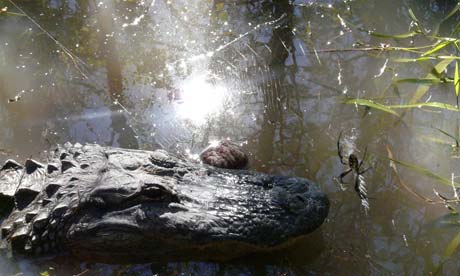
It's not just birds, either. There are growing opportunities to get in among the critters all over lower Alabama, in the huge claw-like landform that makes up the Mobile Bay area. Just outside the city of Mobile itself, the 5 Rivers Resource Center encourages people to engage with the wilderness. Soon, the miles and miles of kayaking trails already established in the upper Delta will be connected to the ones currently under construction in the lower bit, and people will be able to lose themselves in the bayou for days - sleeping at night on outdoor platforms, that are, we hear, 18in (46cm) above the water. That's important, apparently. At 12in (30cm) the alligators would tuck themselves in next to you for the night - 18 and they won't. Don't worry, though, they're more afraid of you than you are of them (although in my case I think that would probably be quite hard).
For - as scary as they look - it's reasonably rare that one turns bad. Sometimes they lose their natural fear of humans and, if they're considered a danger to the public, they're put down. Or they were until there was an alternative in the shape of Alligator Alley, where for the last four years Asbo-gators have been brought to anti-socialise in a safe environment. Now more than 150 float about happily while the public, safely out of range on walkways above, point and shudder without having to look over their shoulder. Alligators: majestic, amazing, just not something you want to pat on the head.
Unlike, perhaps, baby tigers. Once you're done with reptiles, there's a zoo that lets you play with cubs. It feels strange for a British visitor, but tigers being raised for magic shows in Las Vegas and private zoos need to lose their fear of human contact and thus, visitors can pay to spend some quality time with little cuddly tigers. This is all well and good, as long as you can remove from your mind that you are, really, essentially being attacked by a tiger. Yes, a tiger the size and strength of a boisterous puppy, but it's a tiger all the same. For people raised in a country where zoos preach the conservation message and try - wherever possible - not to meddle with the natural order of things, this is disconcerting. As is being told that "if she comes at you again with teeth, just bop her on the nose and say in a firm voice: No biting." It's. A. Tiger.
Alabama Gulf Coast Zoo is better known to American TV viewers as "The Little Zoo That Could", after a series that followed its evacuation and rebuilding process after various hurricanes. Indeed, every place you visit has a clause written into the story: "The bark on these trees is black because of the surge from the sea that happens during a..."; "All the animals were evacuated to the house of the zoo owners during a..."; "The planes in this hangar were damaged during a..."
Except those in the visitor trade don't say "hurricane". Somebody, somewhere, has decided that the word has negative connotations - so instead, you'll hear people mention the euphemistic "tropical occurrences" several times over before working out that they don't mean a coconut falling on someone's head.
Luckily, the wildlife comes in quieter forms. In the cultured gardens of Bellingrath, a large house belonging to a venerable Coca-Cola entrepreneur, butterflies wing their way around the flowers, stopping occasionally for a perfect picture opportunity. On the beaches that stretch along the bay, long-legged birds run in and out of the tide, eating whatever it is that long-legged tidal birds eat. Meanwhile, local people walk further up the beaches looking for sea turtles laying their eggs, which they'll report to the local nature reserve to keep an eye on. While there are of course other things to do - shopping malls, waterparks, all those kind of could-be-anywhere things - once you start looking for wildlife in lower Alabama, you find it easily, everywhere.
At the end of the day, of course, not everyone wants to cuddle a creature or snap butterflies or spend holiday hours peering through the business end of a binocular - naturally, there's more to do. Mobile's family-friendly Mardi Gras predates that of neighbouring New Orleans, and there's a fair amount of wild living to be done down on the city's French-quarter-esque Dolphin Street. And if you fancy a little taste of life in Alabama, remember that southerners love their food - particularly if a) it swims, b) it moos or c) you can fry it. It would take one hell of a tropical occurrence to stop the food coming here, and there's always a welcoming bar on hand to weather the storm.
After the shrimp supper and sunset over the bayou, our boat docked directly outside the Pirate's Cove, a kind of friendly biker's bar, (if bikes were boats) overlooking Arnica Bay. Local dogs pant around our salty feet. It's possibly a little exuberant to think of dogs as charming examples of the local wildlife, but a couple of bushwackers into the evening it was certainly possible: sitting on the veranda of a ramshackle bar, listening to slide guitar as the last edge of the sun dropped into the water like crab claws into a deep fat frier, it's possible to feel wild, and natural and quite, quite tamed, all at once.
Getting there
Anna's trip was organised by the Office of Travel & Tourism Industries, U.S. Department of Commerce
For further information on the region see: The Alabama Gulf Coast Convention & Visitors Bureau (+1-800-745-SAND (7263); info@gulfshores.com) and
Mobile Bay Convention & Visitors Bureau.
Anna stayed at The Battle House hotel. Rates vary according to season. +1-251-338-2000
Corsair Charters run chartered dinner cruises along the Alabama Gulf Coast
