
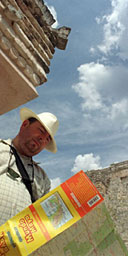
For years, every time one of the glossy little blue flyers fell out of the Sunday paper, I had thought, 'I want to go on a Swan Hellenic Discovery Cruise'. There was the promise of archaeological destinations, guest lecturers of real stature and evenings spent on deck drinking cocktails as the sun went down. A month ago I realised this ambition.
Such a trip is not a prospect to please backpackers, or one that many families with small children would be likely to take (I left mine at home, and I am still paying). Even so I was taken aback by the mature homogeneity of the Swans, with their blue and yellow baggage tags, waiting in the lounge for the Panama charter to take off from Heathrow. The average age I would have guessed to be in the late sixties, 98 per cent were white and most were in couples. Almost anybody not fitting this profile turned out to be a musician, a lecturer or a member of Swan Hellenic staff.
One thing the Heathrow lounge dispelled was my fantasy of a Poirot-sized paddle steamer, in which Angela Lansbury and a dozen others gather in evening dress to listen to a descendant of Sir Mortimer Wheeler discuss his latest excavations with the help of a slide show. Minerva II, the ship used by Swan Hellenic, can carry up to 650 passengers - and usually does. There would be a lot of us.
We eventually embarked (isn't that a wonderful word?), exhausted, at Colon after a very long flight, a dust-up with Panamanian customs and a humid coach journey across the isthmus from Panama City. As we got off the coach and checked in on the quay, the Minerva II towered above us, and I thought she was one of the most beautiful things I had ever seen. Smaller than most cruise ships, more modern, and full of Oriental people in white uniforms, who - in almost colonial style - insisted on carrying bags, showing us to lifts and serving drinks.
The cabin was a very good size for one person, though might have been a little claustrophobic for two. There was a double bed, a small sofa, a decent-sized writing table, a TV, small fridge, a little bit of free booze, a dinky bathroom with a shower (no bath) and a pleasant balcony. And a couple of really neat touches: a pair of binoculars which could be taken on excursions, and three volumes of short stories beside the bed. On the pillow was a folded A4 copy of the Daily Programme, detailing what time everything was open and what time the trips would be leaving the next morning.
Setting out to explore the ship, I discovered the lounge, principal venue for lectures and concerts, and, next to it, the Mortimer Wheeler bar, sporting a large portrait of the Terry-Thomas lookalike legend who helped found the company in the Fifties, who was its earliest lecturer and (some say) its greatest Lothario. And, sitting at the bar was a theatrical knight with a Wheeleresque reputation, whose presence on board gave everyone something to talk about for a fortnight. One day I saw him greeting a crew member on the stairs. 'Good morning!' he thundered. It was 4pm.
A cruise ship is a gigantic hotel that follows you about. You travel to a thousand places and never have to unpack. This ship had a very good gym, where I used to work out while watching Honduran dockers at work 50 feet below me, an internet cafe, a library (complete with busts of Aristotle sculpted by members of the crew), several bars, a collection of paperbacks donated by past passengers which contained five copies of Wuthering Heights and four of Hard Times, and, of course, several restaurants.
The most unsettling aspect of cruising for a Briton is being forced to share your meals with strangers. For the first week you are simply shown to the next table with spaces, and you (and they) take social pot luck. I think this is a good thing, and I met several very pleasant and much-travelled people this way. I particularly liked the chap with a cravat who, with the help of the salt cellar and the sugar bowl illustrated an encounter with three elephants that had nearly been disastrous, before the animals decided to lumber 'orf' into the butter dish. The best anecdote was about a lady who, on a previous cruise, was unhappy with her cabin, and of whom it was said, 'she needed a suite. She was a big woman, she had hip problems and she was on her fourth husband'. All of which requires space. Least successful conversation was with a very old man who had been cruising with his wife for a month, and, in response to a question, turned to her and asked: 'Help me out here dear, where have we just been?'
The printed list of guests (which discreetly omitted the famous thespian) revealed a different truth: every fifth person was a doctor. Apparently Swan cruises attract a hugely disproportionate number of retired GPs. Which is just as well because, with an age profile like this one, death or illness are never very far away. Though the company claims to lose very few passengers, the laws of averages combine to make final things happen.
The age thing may also explain two other phenomena. The first was the positioning around the ship of jigsaws, which were replaced when completed. I had never seen that before. The second was that the cocktail bar was deserted by everybody, save the most dissolute, by just after 11 each evening.
One reason for this was the early departure of the excursions. A Swan trip is all about excursions. Every day in port the local buses with their guides would draw up on the quay and - over a couple of hours - virtually every passenger aboard would disembark (I love that word, too) and depart for a Mayan ruin, a nature ramble or an afternoon snorkelling. You'd be swiped out, using your special card, and, on return, be swiped in again. Compulsory ID cards hold no terror for the Swan passenger.
My voyage was along the Caribbean coast of Central America, where the main themes were the civilisation of the Maya, and the ecologies of the rainforest and the reefs. In Colon, Archie, the camp Panamanian guide, admitted that the town was 'kind of trashy, and I apologise', before pointing out the purple jacaranda, frangipani and yellow acacia trees, commenting on the years of General Noriega and delivering himself of some choice quotes on the subject of Panama's relationship with the US.
In the forest of Costa Rica, Gloriana told our enraptured bus: 'I live in a place where I open the door and a cloud walks in.' That day we took a tram ride through the canopy of trees and spotted an ornate hawk-eagle. Driving through Belize City our guide told us that we were looking at, 'one of the three sets of traffic lights in Belize', adding: 'It used to be four.' Then he took us on a river trip where we saw kingfishers, kingbirds, alligators, straw-haired Mennonites in wide-brimmed hats or bonnets, and a wonderful wader with red legs, called a grey-necked woodrail. Then we alighted at a Mayan city in the jungle, with howler monkeys. At Uxmal, in Mexico, we scrambled for two hours over temples and ball-courts, watched by huge iguanas.
Some of the trips consisted of long drives and short visits and were a little disappointing. And there's cruise syndrome, in which you always arrive on site too late or too early to see many animals or birds. Nevertheless the good excursions were thrilling. In Guatemala we started off with a speed-boat ride along the coast that was wet, fast and exhilarating. Then we arrived at the extraordinary town of Livingston, on the mouth of the Rio Dulce, where Africans had been ship-wrecked in the 1700s on their way to slavery. The result is the Garifuna culture which exists only in this one place. Backpackers love it.
The nearest anyone came to death on one of these journeys (apart from one or two scares involving irregular heartbeats) was when someone's walking stick fell off the luggage rack on a bend. But I admired the indomitability of my shipmates. To see an 80-year-old insist, in 90 per cent humidity, on climbing the sheer face of a Mayan temple, is an inspiring thing. One of the Swan Hellenic representatives was apparently approached, near the end of the cruise by three old ladies. 'We were booked onto the full-day trip tomorrow,' explained one, 'but my sister broke her arm this morning, so we'd like to change to the half-day trip.'
Oddly, this indefatigability seems not to extend to the very obvious fact that cruises take place on ships. I was struck by how many people got sick even when the boat moved around very little. And complained about it, too. This was despite the reassuring aural presence of the captain, whose clipped tones and odd, extended phrasing punctuated the trip. There'd be a bing bong followed by something like: 'This is the kepten spikkin. We have turned 120 degrees to port and.........now have the sea abaft our beam, and will shortly be mekkin for Perto Cortiz...........' These very long broadcasts became famous on the boat, but it was also known that the kepten was a first-class seaman. In the Falklands, apparently, when a fuel barge tried to come alongside in a heavy swell, he... Well, another time, maybe.
One thing I ought to stress to people who have been on cruises, is that a Swan cruise is different. No one-armed bandits, no karaoke, no bingo. We had a young classical wind ensemble, the actors Anton Rodgers and Elizabeth Garvie did three splendidly high-class Radio 4 turns, and there was a Filipino night where the crew did Morris dancing with coconut shells.
But the real point of difference was the lectures. Every sea day there'd be up to three 45-minute talks by professors, lady canons or geographers dealing with different aspects of what we were about to see. It was a treat to see 300 lay people, some taking notes, being told that a particular Mayan architecture was 'not straight pook, but a derivative of pook'. We discovered how the god Quetzalcoatl angered Lord Smoking Mirror and how Mayan kings used to offer up their own blood by making incisions in their manly parts.
All the lectures, I thought, were good, and some were better than good. The excursion guides, however, must have hated them. Instead of a coach load of ignoramuses they were faced off with a party of questing amateur archaeologists or naturalists. Some, like poor Miguel in Yucatan, barely survived.
These lectures, by the way, illustrating Swan's eye for detail, were all repeated on the ship's TV, and could be watched for up to three days after they'd been delivered. Rather a good touch, I'd say.
And now some tips, if you haven't cruised before. First, you know all that stuff about the dress code in restaurants? The bastards mean it. I shall not easily forget having the one word 'JACKET!!' hurled at me when attempting to enter the Grill improperly attired.
Second, choose a cruise that visits small ports. You get better, less touristy guides, more imaginative excursions and the locals are actually pleased to see you. We were the first cruise ship to use the Honduran port of La Ceiba, and the news was in the local newspaper.
Third, rainforests are so called because it rains.
Fourth, choose journeys that have as few days at sea as possible. A day at sea is a bit like visiting a gym where all the members suddenly turn up. The crew don't enjoy it, the deck chairs are taken and some truly alarming sun-bathing takes place. One lady, who should have known better, occupied a lounger half-naked, a towel over her head and her legs horribly akimbo.
Fifth, you don't have to eat the food. Swans reckon that the average cruiser puts on a stone during the voyage. This is unnecessary, given that there is a very good gym and that the food is not that special.
Sixth (and this may get me into trouble), I did not come across a single person who had paid the full brochure fare. Discounts are universal and seem to start at 40 per cent. This means that cruising is far cheaper than it looks.
As it happens I went free, and one lady, on being told this, accused me of being 'in the pocket' of Swan Hellenic. I tell you this because I loved this trip. I loved practically everything about it. I made some good friends on board, saw fabulous places, slept and ate well and was never bored (excepting the man who couldn't recall where he'd been). And I thought the ship was magnificent. Had I paid, it would have been worth every penny.
One last experience indicates what the others thought. With a day to go it turned out that the charter company suddenly wasn't able to fly us all home. Some of us would have to wait another 24 hours. A bing bong announced that Swan would give the volunteers a free night in the Bahamas plus £200. I was standing by the desk when the announcement was made, and heard a sound like thunder. The deaf could hear, the lame threw away their crutches and the crippled ran to book their places. Everyone wanted to stay.
Factfile
David Aaronovitch travelled with Swan Hellenic (084 5355 5111; www.swanhellenic.com) on the 'Mysteries of the Maya' cruise. The 15-day itinerary departs from Panama and calls at Costa Rica, Honduras, Guatemala, Belize, Mexico, USA (for Key West) and the Bahamas. He stayed in a deluxe cabin with private balcony which costs £4,438 pp based on two sharing. Fares start at £2,786 pp for a standard inside cabin. Price includes all meals, return flights from London to Panama, transfers and excursions. The next tours will be in 2006, but fares and itinerary should be similar.
If you liked the sound of that, try these...
Hebridean Spirit (01756 704704; www.hebridean.co.uk) has a one-week Scandinavian cruise that makes stops in Norway, Sweden and Denmark. The cruise departs from Bergen, Norway, where you'll see the Renaissance Rose Garden, take tea and waffles in Baadehuset, and visit the Norwegian Viking Ship museum. Then you'll glide past the wild southern fjords towards Oslo to see the modernist Vigeland sculptures in Frogner Park, then on to the fairy-tale castles of Frederiksburg, Denmark, before flying home from Helsingborg. The cost of £3,460 per person (sharing a double) includes meals, flights, shore visits, use of the gym and steam room, and drinks. Departs 14 July.
For a twist on the typical Caribbean cruise, sail aboard a fully restored clipper. It has huge billlowing sails and an intimate private yacht feel though it has 114 rooms, an Edwardian-style library, piano bar and spa. The two-week 'Windwards Cruise' with Kuoni (01306 742222; www.kuoni.co.uk) starts and ends in Barbados. You spend two days there at the beginning and five days at the end at the Accra Beach Hotel and Resort. In between it sails to St Lucia, the tiny volcanic islands of Iles des Saintes, the white beaches of Antigua, old colonial mansions of St. Kitts, waterfalls and jungles in Dominica and cosmopolitan Martinique. Prices from £2,175pp in January, including Heathrow flights and all meals aboard the ship but not in the hotel.
Classes on the history and archaeology of the Eastern Mediterranean, the Roman Empire and religions and crusades are among those given on a cruise next March with Swan Hellenic (0845 355 5111; www.swanhellenic.com) from £3,024 pp for two weeks. From Aqaba, Jordan, you visit Sharm el Sheik and Alexandria in Egypt, Benghazi and Tripoli in Libya, and Sousse and Tunis in Tunisia.
Shipmates aboard the small Black Prince can enjoy a jazz music cruise that grooves its way round the Shetland Islands and several ports in Norway, beginning and ending in Greenock for £995 for 12 nights, departing 8 June; or take a wine-themed cruise, from £549 for 8 nights, departing 10 March 2005 from Liverpool, calling at La Rochelle, Bilbao, La Coruña and Oporto. Both Fred Olsen trips are bookable with Cruise Traders (08000 960060; www.cruisetraders.com).
