Images of James Bond whipping his Aston Martin around like a spinning top on frozen Icelandic lakes were quickly dispelled from my mind as I ran through the first exercise at the Bridgestone Winter Driving School in Colorado's Steamboat Springs.
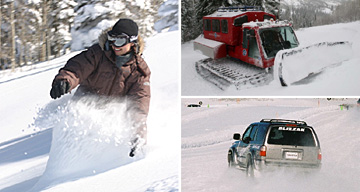
Sitting behind the wheel of a new 4WD Toyota FourRunner all I had to do was take it up to 25mph and stamp on the brakes, at which point the ABS system took over and kept the vehicle in a straight line, give or take a few inches.
This was still pretty impressive given the eel-like slipperiness of the Bridgestone course, the only facility of its kind in North America. In a part of the world that regularly sees 40 feet of snow in an average winter, this course is a necessity for truck drivers, the emergency services and those who just want to keep their car out of the ditch when the snow starts falling; among the people on my course were three county sheriffs.
Though the intended purpose of this trip had been this crash course in ice driving, I soon discovered that, in between sliding around the winter driving track, it was hard to avoid the occasional glance across the tantalisingly glistening snows of the Yampa Valley to 3,894-metre (or 12,777-foot) Buffalo Mountain.
Detour into backcountry
The following day I was actually standing atop the mountain having been carried there by the good folks at Steamboat Powdercats. A "cat" is essentially the same vehicle that's used to groom ski runs, but with a cab attached to the rear for transporting skiers to backcountry powder stashes.
But why pay well over $200 a day to ski within a couple of miles of the excellent resort of Steamboat Springs? Well, the cat skiing operation has access to 10,000 acres (4,047ha) of beautiful glades, bowls, trees and steeps that on any given day are being ridden by less than 40 skiers in total; your guides will know exactly where the best conditions are to be found; and since this winter has up to now been even snowier than usual - and "usual" is 500-plus inches per year of some of the driest snow in the world - we were pretty much guaranteed some excellent skiing.
The thought of skiing powder often causes consternation amongst skiers, even those with plenty of experience, but with modern "fat" skis the whole process is easier than ever, and our guides were more than happy to pass on tips, the fundamental ones being: keep your weight over both skis, and enjoy yourself.
The former may take a run or two to get to grips with; the latter you'll pick up after your first couple of turns. With bluebird skies and talc-dry, shin-deep powder on every run, broad grins spread across the faces of all 12 skiers right from the initial run and remained fixed there for the rest of the day - well, almost. Two of the skiers with us were plainly out of their depth and struggled to cope, and I was astounded to find that one of them had only three days' experience. Introducing powder skiing to the masses is all very well, but when two skiers with an over-inflated sense of their abilities flounder around on every run and hold up the rest of the group, it's not the best show of etiquette.
Even so, slicing through high alpine glades with Colorado powder cascading over your shins and threading lines between firs and aspens to the swish of "champagne powder" (a term trademarked by the nearby Steamboat Springs Resort; only in America ...), it's hard to stay irritated at anyone or anything for long.
Despite being only a spit away from the eponymous resort when you're riding with the "cats", it's a world away from the hum of ski lifts and "packed powder" that is resort skiing. It's the kind of day that any serious skier should include in their ski holiday, at least once, for whilst it's not cheap, how else could you get in 10,000 feet or so of powder skiing in a day - and with a free lunch thrown in?
Back to the program
But back to the real purpose of this journey: did I stand up to the biggest challenge? Would I be able to match my ice driving skills with those of 007?
Our driving instructor, Kurt, had us follow him around the course before starting the exercises, and with a mix of snow and ice-plastered corners, reverse cambers, long straights and a large skid pad there was plenty of opportunity to get our vehicles totally out of control on the 1.5-mile track.
So, to prevent that, we spent the morning learning how to use the brakes with and without the help of ABS and how to deal with skids, with Kurt providing instruction via radio from his own vehicle and also demonstrating how to do the various tasks properly from time to time.
Using your brakes without ABS is tricky - it involves "cadencing", where you apply pressure to the brake pedal until the vehicle starts to skid then lift off the brake briefly, reapply pressure until skidding and so on until you come to a halt, ideally in a straight line. And this is about the only chance you get to use the brakes all day.
Indeed, everything you've ever learnt about "normal" driving is tossed out the window. Kurt emphasised that while driving on snow and ice, you use your brakes rarely as they'll invariably get you into a skid, and once you're in a skid, they can be your worst enemy.
We learnt to deal with under-steer and over-steer on the skid pad. The former is easiest to control and comes pretty naturally - it's the spectacular kind of turn you see rally drivers performing all the time and in an ideal world simply requires you to turn "into" the skid to pull the back end around in the right direction. Overdo it, however, and your rear end will swing out the opposite way. Hit the brake pedal and you'll only make things worse.
Far more difficult to cope with was over-steer in which the car insists on going in a straight line towards the lamppost you so desperately want to avoid. Again, foot off the brake and rather than wrenching the wheel around in the direction you want to go, use small turns of the wheel and you should steer out of the skid.
We had the chance to put all this into action in the afternoon, when Kurt had us perform a series of manoeuvres threading though cones, before he let us loose once again on the track, first in a clockwise direction then, to make things difficult, anticlockwise.
Even so, where previously we'd been skidding out of control and into snow banks, mistakes were relatively few and far between. It made me feel far more comfortable on snow and ice than I've ever been before, and as I write I'm about to take a trip through the snow-plastered mountains of British Columbia feeling far more confident in my ability to deal with the snow that's forecast.
Way to go
Crystal (0870 160 6040; www.crystalski.co.uk) charter flights from Gatwick to Denver run every Wednesday and Saturday until April 5, priced at £419 return including taxes. Transfers to Steamboat cost an additional £55, full return.
Bridgestone Winter Driving School: (www.WinterDriving.com) a full-day 'Second Gear' course as described costs $445 per person including classroom and track instruction, use of brand new Toyota vehicles and lunch.
Steamboat Powdercats: (www.steamboatpowdercats.com) offers cat skiing for intermediate, advanced and expert-level skiers (be honest about your ability!) which includes 10 to 18 runs a day. Breakfast, lunch and powder skis or boards are provided. From $259 pp per day.
