
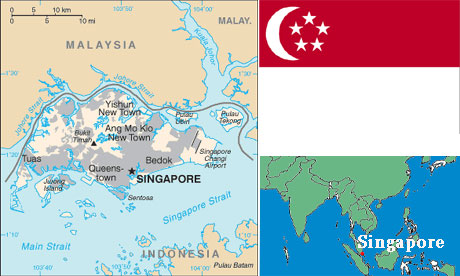
Singapore was wrenched from historical obscurity by Sir Stamford Raffles in 1819, when he recognised the potential of this quiet, but strategically located, South East Asian backwater. Since then, it has become a beacon for Capitalist endeavour, and famous for its draconian laws which forbid the chewing of gum or smoking in public.
The Republic of Singapore, comprising the main city state and some further 64 islets, is joined to the Malay Peninsula by a road and rail carrying causeway. It became a British Crown Colony in 1867, but was invaded by the Japanese in 1942, who occupied it until the end of the war, after which the British returned, but not for long. In 1959 Lee Kuan Yew was elected Prime Minister, and for the next 31 years led a vigorously conservative regime. He resigned in 1990, and was replaced by the more liberal Goh Chok Tong.
The city is beautifully pristine, if overly sterile - you could eat your dinner off the floors of the immaculate subway system - but an excellent place to shop and enjoy the most fabulous cross-section of Asian foods that you're likely to find anywhere in the world. With such an ethnically mixed population - nearly 4 million - of largely Chinese, Malay and Indians, the cultural flavours beneath the squeaky surface are amazing, especially if you head for China Town, Little India or Arab Street.
Language
English, Malay, Mandarin and Tamil.
Climate
Hot and humid throughout the year, there are no distinct wet/dry seasons. Most rain falls during the north-east monsoon (November to January) and showers are usually sudden and heavy.
Health
No vaccinations required.
Food
A gastronomic feast of Asian, European and fusion delicacies. By far the best and most economical way to enjoy it is either from an open-air street stall or in one of the buzzing food markets. You can get Chinese, Indian, Malay, Indonesian and Western foods as well as variations like Nonya, a cuisine combining Chinese and Malay food, using Chinese ingredients and local spices such as lemongrass and coconut cream.
Make the most of an incredible variety of tropical fruits, including some very unusual ones like rambutan, mangosteen, durian, jackfruit, pomelo, starfruit, zirzat, buah duku, chiku and jeruk.
What to buy
Orchard Road, the main shopping street, is a shopper's paradise. It is jammed end to end with immaculate air-conditioned multi-storey shopping complexes. If you want your consumerism to be a little less in your face (admittedly hard to come by in Singapore) head for Arab Street or Little India, where you can haggle for antiques, batiks and carpets.
Other good buys are electronic and camera equipment, as well as tailored clothing, jewellery, silks, perfumes and silverware. If you're into reptile and snake skins, you can purchase an impressive array of shoes, briefcases, handbags and wallets. Wigs are another favourite.
Events
January/February: Chinese New Year, with dragon dances, parades and fireworks;Hari Raya Puasa marks the end of Ramadan with three days of high-spirited celebrations.
April/May: Vesak is a day celebrating Buddha's birth, enlightenment and death, when caged birds are symbolically released into the air.
May/June: The Dragon Boat Festival with boat races across Marina Bay, commemorating the death of a Chinese saint.
September: The Festival of the Hungry Ghosts, when the trapped souls of the dead are released for merry-making on earth - Chinese operas are performed for them and food offerings are made.
October: (based on lunar calendar, so variable) Thaipusam, a dramatic Hindu festival with spectacular acts of body-piercing - not for the squeamish.
November/December: During Ramadan, food stalls are set up in the evening in the Arab St district, near the Sultan Mosque.
Embassies and visas
UK: High Commission for the Republic of Singapore, 9 Wilton Crescent, London SW1X 8SP
Tel: (020) 7235 8315. Tel/Fax: (020) 7235 9850 (consular section). Website: singapore.embassyhomepage.com
E-mail: info@singaporehc.org.uk. Mon-Fri 1000-1200 and 1400-1600.
Singapore: British High Commission, Tanglin Road, Singapore 247919, Tel: (6) 473 9333 or (6) 424 4244. Fax: (6) 475 9706 or (6) 424 4356. Website: www.britain.org.sg
Visa requirements: Not required for a social stay of up to 90 days, if at all. A 30-day permit is issued on arrival, but extensions are difficult to obtain.
Currency
£1 buys approx. 3 Singapore Dollar (S$)
Timezone
GMT +8
Getting there
Singapore is well served by most major international airlines. Flights direct from London are offered by British Airways, Singapore Airlines and Quantas. Flight time from London is 13hrs. There are also direct flights to all capital cities in South-East Asia. Singapore's international port serves an increasing number of cruise liners - one of the fastest growing tourist development areas in Singapore.
If you want to enter or exit Singapore overland, you can do so either by rail or road. Trains run to Kuala Lumpur and Johor Bahru in Malaysia on a route that extends to Bangkok. Alternatively there are bus and coach services which operate to Johor Bahru and beyond.
Related literature
CM Turnball, A History of Singapore
Jack Owen, The Fall of Singapore: a historical account of the fall of Britain's "impregnable citadel" in 1942.
John McEwen, Out of the Depths of Hell: an account of his experiences in 1942.
Suchen Christine Lim, Fistful of Colours (winner of Singapore Literature Prize): documents the strain between modern and traditional ethnic communities in Singapore.
Joseph Conrad, Lord Jim
Paul Theroux, Saint Jack
