
An old man with a leathery face leads a herd of wide-horned bullocks home after a long day in the fields. A horse-drawn cart stacked high with hay and bundles of firewood meanders down the road.
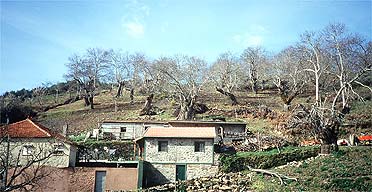
These are scenes from everyday life in the heart of Tras-os-Montes (meaning "Beyond the Mountains"), a neglected rural backwater in Portugal's far north. A wild and rugged place, it is one of Europe's most remote regions, with many of the buildings being former monasteries. The people there are a tough breed, and many have faces as hard as the granite terrain that surrounds them. But their toughness masks a warmth and hospitality.
Tras-os-Montes is Europe at its most rustic. Surrounded by three high mountain ranges, it was cut off for centuries. The region is so remote, even Napoleon Bonaparte regarded it as too hard to conquer and passed it by. Most visitors to Portugal do likewise, heading instead straight for Porto or the fertile, terraced valleys of the Douro River, or flying direct to the beaches and golf courses of the Algarve.
It's their loss. A strong community spirit still thrives in Tras-os-Montes, as does a quality of life that has long been lost in the urban sprawl elsewhere in Portugal. Wooden-wheeled ox carts are in daily use, and farmers still work the undulating land with simple wooden hand-tools. It is often hard to believe you are actually in Europe, let alone in the same country as the Algarve. Only the occasional TV aerial reminds you that you haven't travelled back in time to the middle ages.
The Portuguese government has largely ignored the region, and you get the impression that's just how the locals like it. Their strong traditions have been barely touched by outside influences. Some villagers still consult medicine men about the important things in life, like death, illness and football. City-dwellers may see them as primitive and backwards, but they are independent - if they are sometimes the butt of jokes to the rest of the Portuguese, it's unlikely they give a damn.
With the help of a guide, we were to trek across part of this beautiful and rugged region. Many villages in this area are isolated and can still only be reached by mule or on foot. The tiny village of Ribeirinha has traditional houses with slate walls held together with a mixture of mud and goodwill. Here, we saw village women washing pig entrails in the river. No part of any animal is wasted, so the intestines and lungs are cleaned and later smoked in wine and garlic, before being mixed with meat to make chorizo sausage.
Our picnic lunches were local specialities but fortunately free of intestines. Trekking always creates a huge appetite and, like hungry wolves, we devoured hunks of grilled pork and "bola de carne", a meat cake made from ham, chicken and walnuts. Dessert was a slice of local cheese topped with some heavy-duty marmalade, washed down with some vinho verde and thimble-sized measures of the local liquor called aguardente, a kind of grappa.
Tras-os-Montes is a harsh, unforgiving landscape with bitterly cold winters and scorching summers; in July and August, even mad dogs stay in the shade. When the sun shines in this remote region, it shines hard. But when it doesn't, it can get very cold. We walked through the boulder-strewn granite landscape of the Alvao National Park, the smallest national park in Portugal. And at 1,000 metres, it was certainly cold.
The smell of wood fires greeted us in Lamas de Olo, a medieval village of granite-block and thatch-covered ancient houses. We spotted many "espinheiros", the region's traditional stone granaries. Some were topped with stone crosses, but all were too narrow to have been former monasteries. In the village we passed oxen being led by bent old ladies clothed in long black shawls and headscarves. The women were of an indeterminable age and had wonderful faces the texture of elephant skin.
As we were still cold, we retreated to a small cafe for a large, reviving coffee and a game of table football. Nearby, a group of old boys played a noisy game of cards. Already competitive, the game threatened to get heated. And what were they quarrelling over? It turned out to be a prized bounty of "bacalau" or dried salted cod, which awaited the victor behind the bar. Codfish was a highly prized commodity in the middle ages - but in Tras-os-Montes, its appeal still hasn't worn thin.
On the way back we met a goatherd with a healthy, mahogany complexion who invited us to have a drink in his home. But with his 100 or so sheep and two dogs we didn't like to cramp his style. Back at out the 18th-century traditional farmhouse we huddled, knackered, around the open fireplace to get warm again. We'd rather smoke ourselves to death than let any of the heat escape. Only when the logs started to crackle did I feel the blood flowing around to my system. It was fortunate we had digested the "aguardente", otherwise we would surely have been blown into orbit. The farmhouse was situated in a tiny village called Pontido, 6km from the small town of Vila Pouca de Aguilar, north of Vila Real. Like many other farmhouses in the region, it is part of an excellent tourism arrangement where local people open their ancestral manor houses to paying guests. The village only had a population of about 50 people, and on an early morning stroll you could easily meet half of them.
Our hosts were Dona Maria and her son, Alberto. She was one of those exceptionally strong and kind Portuguese ladies who wields the real power in their family. Even though her arm was in a sling after a recent fall, she was still up half the night baking cakes for us. The farmhouse may not have been a former monastery, but it did have its very own chapel.
Ways to go
· Sunvil Discovery offer tailor-made holidays, farmhouses and characterful accommodation in northern Portugal and many in towns in the Tras-os-Montes region, including Vidago, Pinhao, Guimaraes and Braganca.
· Starting price for April, May and October 2003 at the Vidago Palace Hotel is £460 pp (7 nights) based on two sharing, B&B accommodation, car hire and flights with TAP (Air Portugal) from London Heathrow/Gatwick to Porto.
· For the Vintage House Hotel in Pinhao, starting price is £614 pp (7 nights) based on two sharing, B&B accommodation, car hire and flights with TAP (Air Portugal) from London Heathrow/Gatwick to Porto.
· For the Paco de Sao Cipriano, near Guimaraes, the starting price of £534 pp (7 nights) is based on two sharing, B&B accommodation, car hire and flights with TAP (Air Portugal) from London Heathrow/Gatwick to Porto.
· Sunvil also offer some new and competitively priced fly-drive itineraries to Portugal. Visitors can stay in a combination of selected Historical (restored buildings of national importance and generally deluxe accommodation) and Regional (more standard accommodation - three- to four-star) Pousadas, a network of state-run hotels throughout the country, located either in areas of exceptional natural beauty or of particular historic interest.
· For more details, telephone 020 8758 4722 or visit Sunvil Discovery.
