
At sunset I found myself sailing out of Qingdao harbour, China disappearing slowly over the horizon under a blanket of pollution as the stars came out above the Yellow Sea. I would have stood on the deck admiring all of this if it hadn't been so bitterly cold.
With fourteen hours ahead of me I decided to find out what the ferry had to offer. Five minutes later I'd heard the same musak song twice and located the standard ferry offerings of over-priced "restaurant", fruit machines and duty free, plus the more unusual additions of the Korean sauna and the karaoke room. It was clearly going to be a long voyage.
I sat on my bunk in the dormitory. Twenty-five of us had been allocated less space than the restaurant's deep fat fryer. I suddenly regretted throwing away my copy of War & Peace; beyond the Trans-Siberian, I'd decided I'd had enough of carrying it. Come back Prince Bolkonsky, all is forgiven!
The passenger on the next bunk was a Korean trader named Che. His fixed grin, glassy eyes and the unmistakable smell of soju (the industrial solvent sometimes passed off as an alcoholic drink) told me I was in for trouble. The chain-smoking Che started up a one-sided conversation entirely in slurred Korean. I think he was telling me a hard-luck story about a failed business deal in China. I accepted the revolting fish flavoured biscuits he offered me and tried to look sympathetic.
The rest of the dormitory was tucking into gimchi, Korea's national dish. Gimchi is a dish that the uninitiated should approach cautiously in a well-ventilated area. I'm actually a big fan of the spicy fermented cabbage but it can be a bit of a shock to the system, especially for breakfast. It's western equivalent would be the forgotten two-month-old tub of coleslaw at the back of the fridge.
By morning the air in the dormitory was positively explosive. I was glad I'd secured the lower bunk and read the emergency evacuation instructions. Fortunately Che was too hungover to light up another cigarette or we'd have been blown to smithereens.
Outside, in the fresh air, the ferry was sailing among tiny islands with sandy beaches whose almost tropical appearance seemed at odds with the ice that had formed on the deck during the night. We fought our way through a fleet of container ships into the bustling harbour of Incheon where, back in 1950 during the Korean War, General MacArthur led a US invasion that proved a turning point in the conflict. MacArthur's motto was 'Have a plan. Execute it violently. Do it today.' Unfortunately MacArthur wasn't the first foreign invader with violent plans to turn up in the Korean peninsula. The Koreans have become quite used to them.
The Koreans are very much a good kid growing up in a rough neighbourhood. The War Museum in the capital Seoul covers about half the city and you really need a car to look round all of it. Despite the Koreans' national pride and their ingenious forms of defence, such as multiple arrow launchers and armoured turtle ships, the Japanese, Chinese, Mongolians, Russians and Americans take turns invading. The agreed practice appears to be to start at one end of the country and work your way to the other destroying everything along the way. The Koreans do their best to get out of the way and then pick up the pieces.
It's not surprising that the Koreans have so many construction firms as everything gets rebuilt at least once every 70 years. Even the beautiful and ancient looking palaces and temples are often recent but very impressive reconstructions. The Koreans are keen to point out who's responsible at every opportunity and it's normally the Japanese. Perhaps that's why pride of place is given to the statue of Admiral Yi Sun-shin, who achieved a crushing naval victory against Japan in 1592 (with those clever turtle ships).
Even now the Koreans still live with the threat of war. My hotel in Seoul was within easy artillery range of North Korea. A few years ago they would have pumped a few hundred thousand shells into downtown Seoul within a couple of hours of war breaking out. Now, of course, they only need the one nuke and even the shoppers in the underground malls are unlikely to survive that one.
I decided I'd like to get a closer look at the North Koreans and travelled the 30 miles north to the Demilitarized Zone. The US army tour rejects scruffy looking people on the grounds that the North may use their photos for propaganda purposes. Luckily the Korean tour wasn't quite so picky and let me on the minibus. I'm probably a celebrity in Pyongyang by now. The barbed wire starts long before the DMZ on the outskirts of Seoul in an attempt to stop the infiltration of spies. It didn't stop me or the other tourists blasting away with my camera despite the restrictions.
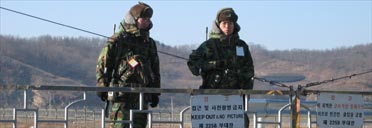
By the time our minibus got to Freedom Bridge the landscape was covered with bunkers, observation posts and heavily armed soldiers as far as the eye could see. On the hills, huge spotlights beam messages to the North Koreans, perhaps saying "Our gimchi's better than your gimchi." The North Koreans do the same, so these gimchi debates can continue across the last frontier of the cold war throughout the night.
We followed the road as it weaved its way through the minefields up to the Dora Observation Station. In front of us, across a lethal landscape of tank traps, machinegun nests and fermenting gimchi pits, stretched the 4000m wide DMZ. Through a pair of high-powered binoculars it was just possible to make out some real live North Koreans staring back at real live tourists. Disappointingly none of them seemed interested in taking my photo. I knew wearing that clean jumper was a mistake. The whole situation was bizarre, almost comic, and yet there was a sense of genuine tension in the air.
The propaganda battle was is full swing. Our guide told us that the village in the north was called 'Propaganda Village' whilst the one in the south was called 'Freedom Village'. If I'd asked a North Korean I'd probably find that I was standing on Evil Yankee Imperialist Hill opposite the Glorious People's Revolutionary Gimchi Peak.
Without a hint of irony the guide told us that the population of 'Freedom Village' had got too large so if you have more than two children you're forced to move out of the DMZ. On the North Korean side the hills were almost completely stripped of trees. "The North Koreans are starving and eat the bark," said the guide. We were then treated to a video on the superiority of South Korean flora and fauna.
Back in Seoul it was hard to link the busy streets and people going to work or out shopping with the scenes at the DMZ only a few miles away. A snow shower sent the Singaporeans in the hotel who'd never seen the wretched stuff into a frenzy of excitement. I'm sick of snow.
I paid a visit to the beautiful and extremely unlucky Gyeonbokgung Palace (destroyed by the Japanese in 1592 and 1910 and the Chinese in 1950), taking advantage of one of the few moments in history when it isn't a pile of rubble. Later I headed south, through wooded rolling hills, towards the port city of Busan, stopping en route at the tranquil Bulguksa Temple (demolished by the Japanese in 1593) and Beomeosa Temple (destroyed by you-know-who in 1592). After all the destruction that the peninsula has suffered I can only admire the pride and resilience of the Korean people and the care and patience with which they preserve their unique and fascinating culture. I just hope they don't have to rebuild anything anytime soon. I'm catching another ferry across the Sea of Japan to visit the temple-demolishing neighbours. Frankly the Koreans and I think they've got some explaining to do.
