
Having recently convinced myself that I am suffering from SAD, but more likely just exhausted by the unrelenting greyness of another British winter, I jumped at the chance to travel to Tunisia in late January to catch a few rays. The remit was to indulge myself in the respective luxuries of three of the country's newly opened boutique hotels.
I am reliably informed by those in the know that, having long lagged behind neighbouring Morocco when it comes to stylish places to stay, Tunisia may yet become the Noughties' hippest winter holiday destination. I can see why when I arrive in the picturesque coastal village of Sidi Bou Said.
Having fled the airport in a torrent of recrimination from the half-dozen irate taxi drivers I didn't choose, and then somehow been expertly relieved of roughly twice the cab fare previously quoted, I enter the Hotel Dar Said with my preternaturally calm partner, Lynette, in a somewhat frazzled state of mind. As soon as I step over the threshold, though, peace descends.
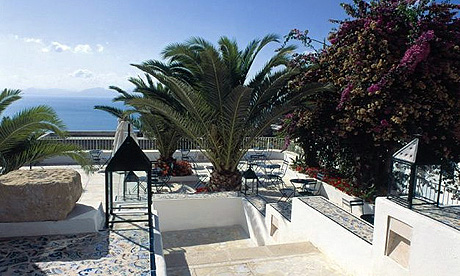
From the outside, Hotel Dar Said looks like another beautiful white building in a village consisting solely of beautiful white buildings, all arranged in higgledy-piggledy fashion around a hill-top mosque overlooking the Bay of Tunis. Inside, it is a different matter. Built as a grand family residence in the mid-nineteenth century, it has been impeccably restored. Bougainvillea tendrils snake around a small central courtyard which is open to the sky. Each room is decorated in different colours and designs, with high ceilings and the signature trelliswork and ornate wall tiles that make Tunisian interiors so dazzling and yet somehow restful.
We have barely checked into our airy and tastefully spartan room on the corner of the courtyard when we are directed by the attentive concierge towards the nearby Au Bon Vieux Temps, the only place that serves dinner this late.
Outside, though it is not yet 10 o'clock, there is not a soul about. The night sky is starry, the silence uninterrupted save for the soft rustle of fragrant eucalyptus leaves. You feel, as is often the case in Africa, that you have travelled back in time, though the ambience here is altogether more Mediterranean.
Like the hotel, the restaurant is both spacious and intimate, with a terrace overlooking the rooftops of the town and the bay far below. The night air is chilly, though, and we take a table at the back of the main room. While a few stragglers sip on their espressos, we tuck into grilled sea bream washed down with a bottle of earthy Tunisian red.
I sleep soundly until woken in the early hours by strangely spooky nocturnal noises, perhaps a bird or small beast trapped in one of the air vents. Lynette wakes to find me poking at the grille with a rolled-up newspaper. It works. Briefly. The next morning I wake way too early to the animated to-ing and fro-ing of the hotel staff, and realise that a room on a courtyard has its drawbacks.
After continental breakfast delivered to the room, we take a tour of the hotel in the company of the concierge. We discover, among other delights, a hammam at the rear, and a small swimming pool to the side. The water is cold but the late January sun is hot. We postpone exploring the village until late afternoon, and laze over a book and a beer until lunchtime, with the promise of a steam in the hammam at the end of the day.
Sidi Bou Said is the perfect weekend destination, only three-and-a-half hours from London, small enough to explore over two days, and just big enough not to grow bored in. The narrow streets that snake down from the hotel to the marina below are relatively empty in January and February, unlike spring and summer when they fill with day-trippers. Around the corner from the hotel, on the street of the same name, is the magical Cafe Sidi Chabanna, its layered white terraces, dotted with sky-blue tables, carved into a cliff overlooking the long semicircle of the bay.
It's the perfect spot for a restorative mint tea before we wander down to nearby Rue Habib Thameur, where the shopkeepers selling trinkets, leather goods and sandals seem stoical-going-on-desultory about the lack of custom. There is little of the frantic hassle of Tunis's famed but fading medina, where we head the following morning.
We leave the Dar Said reluctantly. You can see why, for all its understated charm, it has - according to my Lonely Planet guidebook - been rated among the 50 best hotels in the world. Even though the hammam steadfastly refused to exude steam, and those spooky nocturnal noises persisted, I could happily have lazed here all week.
Another taxi drops us in Place de la Kasbah in the centre of Tunis, from where we enter the bustling medina on foot through the stillness of the Place du Gouvernement, where armed policemen stand sentinel at every ministerial gate. In search of Rue Sidi ben Arous, we pass through the souks that ring the great mosque, housing quiet fez-makers and noisy silversmiths, and then turn left into a dusty, rundown-looking backstreet.
Not, you might think, the most promising location for a boutique hotel. But you'd be wrong. Rue Sidi ben Arous is, as it turns out, a street of many hidden delights, not the least of which is the Hotel Dar El Medina, discreetly situated just past a tiny silversmiths and a barber's shop. Like the riads of Morocco, the Dar El Medina sits behind a huge wooden door, which reveals a hidden world of colours, shapes and textures.
A narrow stairway, with black and white brickwork, leads to the two floors of rooms above and the roof terrace, where you can arrange for mint tea and cakes to be served in an alcove that overlooks the medina. The sense of intimacy is such that you feel you are sharing someone's expansive and tastefully decorated home.
Our room is a small, split-level affair, with the bed taking up the entire raised section, tucked underneath a small shuttered window. As boutique hotels go, the Dar El Medina tends towards the spartan; and at this price, I'd prefer not to have to negotiate a hand-held shower first thing in the morning.
The breakfast, though, which is served until lunchtime in a mustard-coloured room below, almost makes up for it. Croissants, cakes and breads fill the table, alongside fresh fruit, freshly squeezed orange juice and a pot of strong coffee. It's the perfect preparation for a morning battling your way through the heart of the medina and out into the open colonial spaces of the Ville Nouvelle, where the clothes shops stock a fascinating range of retro styles. It's a long time since I've seen a grey, Bri-Nylon school shirt.
Though not as exotic or as lively as its Marrakesh equivalent, the medina is huge and labyrinthine and can be a daunting experience. As always, it is best to keep calm and surrender to the chaotic energy of the place by smiling noncommittally through gritted teeth at every approaching shopkeeper who greets you with a barrage of welcomes in French, German, Dutch and English, while tugging you by the arm towards yet another stall stuffed with rugs, sandals, bags, brassware, plates, silverware and leather goods.
I much preferred the more restrained atmosphere of the ancient souks that fringe the medina. Here, fans of the late Tommy Cooper might well find the attraction of a relatively cheap, handmade fez irresistible. I did, although, for some reason, I have yet to wear it into work.
The Dar El Medina is a few doors away from the wonderful Dar Hamouda Pacha, a candlelit courtyard restaurant in an ornate mansion set back off the street, where you can wine and dine on good traditional fare to the quietly mesmerising sound of traditional Sufi musicians. A block away is the more expensive and elaborately decorated Dar El Jeld, the best traditional Tunisian restaurant in the capital. It is worth the price for the magnificently ornate surroundings alone.
We end the week in historic Carthage, which is back out on the highway towards Sidi Bou Said and, despite being chocker with ancient Roman sites, oddly resembles suburban Los Angeles in its endless sprawl of white, single-storied Spanish-style villas that provide weekend retreats for the rich of the nearby capital.
Carthage is a mind-blowing place even if, like me, you soon tire of ruins, statues and frescoes, however elaborate and well preserved. Its latest attraction, although situated on the side of the huge Roman site at Byrsa Hill, is an utterly modernist block, the stark white Villa Didon. Imagine the Bauhaus on steroids and you're halfway there.
This is the concept of a boutique hotel but conceived on the grandest scale, so big that it is not really boutique at all. It's an imposing white concrete block wherein everything has been constructed to the nth degree of designer functionalism.
Every door is push button, every surface matt grey concrete or buffed steel or glass. You could easily picture Daniel Craig's version of 007 hanging out here in his Gucci suit and white Commes shirt. In fact, one of the barmen is a dead ringer for him. Even in my newly pressed Agnes B suit, I feel criminally underdressed, and half-expect the style police to abseil down the side of the building and arrest me for not wearing the right shoes. It's that sort of place - not a Bri-Nylon shirt in sight - and seems oddly incongruous among the Roman ruins.
Nevertheless, I grit my teeth and give it my best shot. The Jacuzzi in the room helps, of course, as does the huge balcony with stunning view across to the mountains on the far side of the bay, and all the way down to the capital. It occurs to me that, in my nomadic youth, I had stayed in rooms that were roughly the same size as the wardrobe in this one.
Feeling oddly guilty, I press the push-button control on my room door, glide earthwards in the glass lift, and go to sample the delights of the dining room, which overlooks the Bay of Tunis.
The exquisitely presented food, it has to be said, redefines the term 'to die for'. You have not experienced culinary nirvana until you taste freshly caught, lightly seared sea bream on a bed of something way too delicious to be a mere root vegetable.
An after-dinner cognac for my self-indulgent girlfriend costs nearly a tenner but even that does not dent my all-too-rare feeling of utter satisfaction. Almost, but not quite. I retire to my bedroom a happy man, driven to bed early by the dread strains of ambient techno drifting from the DJ decks in the bar.
The following day, I wander the ruins in the footsteps of Dido and Aeneas, lunch in the best local restaurant, the Neptune on the seafront, and indulge myself further with a visit to the Villa Didon's designer hammam, where I have several layers of supposedly dead skin scrubbed off by a giggling woman armed with a designer scouring pad.
Tunisia may have belatedly cottoned on to the glamourous spell that the words 'boutique hotel' cast on a certain type of mildly adventurous, but pampered, European traveller, but, with Villa Didon, they have certainly upped the designer ante. The ancient Romans, who once settled this same hill in grand style, would undoubtedly have approved.
Essentials
Sean O'Hagan travelled to Tunisa with i-escape.com. Double rooms at Hotel Dar El Medina from £37 pp; Hotel Dar Said from £66 pp, including breakfast; Villa Didon Hotel and Spa, Carthage, from £73 pp, based on two sharing. Flights to Tunis from £129 return from Gatwick with GB Airways (0870 850 9850)
