
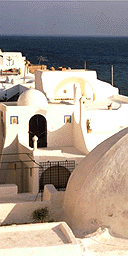
What is it with Brits and islands? From Devon's Burgh Island to Zanzibar, we only feel truly content when literally cut off. Wandering idly in the sunny harbour of Sfax, Tunisia's second largest city, I had found myself caught in the hubbub of a ticket-waving crowd and propelled on to a boat to Kerkennah, unable to resist the lure of a small group of islands that I knew virtually nothing about.
The beauty of many small islands lies in their compact identity, and Kerkennah does not disappoint. So flat and palm-filled that its trees appear to grow out of the sea, the islands are a relaxed disjunction from the intense, self-assured mainland. Having spilled off the ferry into a mess of cattle dung, fishing boats and too many forms of transport for a one-horse island, we muddled on to the correct bus and stared out as an unchanging view of battered date palms went by. The occasional scythe-wielding farmer got on or off.
Kerkennah consists of two inhabited islands, Chergui and Gharbi (or Melita), which have been yoked together since the Romans built a causeway. In the clear waters that don't lap above waist level even 100 metres offshore, there float several additional chip-sized islands, along with wrecks of German and Italian ships sunk by British forces during the war. Fishermen can be persuaded to row you out to an uninhabited island called Gremdi for a small fee - and will even collect you if you offer enough.
The islands were originally called "Cercina" because the witch-goddess Circe is supposed to have imprisoned Odysseus here, believing him too handsome to let go. She set a trend: Kerkennah has been a place of exile for centuries, but prisoners can hardly have cried when told that their fate was to be shipped over a shallow sea to the insular equivalent of the Elysian fields.
Rebellious Romans and adulterous Muslim wives were deported here, while the Carthaginian general Hannibal took refuge on the islands after he had been banished from Carthage. In AD15 a chap called Caius Sempronius Gracchus was executed in paradise for having seduced the emperor's daughter. And, if you make it by bus to the islands' most northerly village, El Attaia, and trek by foot or bike a little further north, you'll stumble across Habib Bourguiba's traditional sailing boat and a house he sheltered in for three days. The independence leader who became Tunisia's first president escaped to Kerkennah from French custody in 1945, grabbed his boat, set sail for Libya and walked to Alexandria, only to be charged with illegal entry.
The Kerkennah Islands are home to flat, sandy earth, some rare flowers like the purple fagonia, a few sheep and fish and year-round sunshine. Sponges, aloe vera and dates do not a vibrant economy make, so many of the hospitable locals have had to move to Sfax to find work, hoping to return in retirement. For visitors, however, the place is a refuge from northern Tunisia's tourist ghettos like Sousse and Hammamet, and just a few hours away by train or bus. Foreign aficionados post gushing letters on Kerkennah's web bulletin suggesting, "don't go there unless you want to fall in love", but do so, and return year after year. Encircled by Circe's magic, this place can be hard to leave, and visitors who arrive for days can often stay for weeks.
Touristic development on Kerkennah has been erratic, to say the least. The islands sometimes get Tippexed off the Tunisian map, and the government has been mysteriously unwilling to divert resources. Locals were irate when a recent dictionary of Sfaxian language and traditions omitted all Kerkennian dialect words and customs: the Spanish dumped 400 men here in the 16th century and words like " zapatos " (shoes) and " la galleta " (hard, cracker-like bread that local fishermen take on trips) have survived.
The ominously named Society for the Exploitation of the Islands of Kerkennah was established in 1961, but the thin strip of unassuming hotels that resulted is easy to miss. For instance, setting out at night to explore the main "resort" (Sidi Frej) from the shabby 30s splendour of the Cercina Hotel (purportedly in the heart of the town), we stumbled only on a disgruntled camel after my companion decided to relieve himself under the stars. A dog barked as a car went past: in winter and spring, the only tourists likely to join you will be gooey-eyed Tunisians.
Since the point of the islands is to do nothing - and there is very little to do apart from walk, hire bikes to explore and relax - it is sensible to spend the evenings watching the sunset turn the sea bright red before hitting your al fresco hotel bar and restaurant.
This being Tunisia, there will only ever be men in the bar, but here they don't balk at seeing a woman in their midst. I made friends with a retired grandfather who had worked as a bureaucrat for the French. He had eight kids and 30 grandchildren, all alive " grce à dieu ", and a couple of teeth. With shaking hands he offered me choice tapas from the bar: dried chunks of octopus - the Kerkennian equivalent of pork scratchings - fava beans doused in cumin, olives and segments of blood orange.
The prawns cooked with garlic and tomatoes in Hotel Cercina's restaurant were delicious, and the food here is meant to be the best on the islands. On the Sidi Frej pier, you can watch the fishermen setting sail for the night just after sunset. Kerkennians use an unusual fishing method building traps made of palm fronds arranged in V-shapes around the shores. When the fishermen return in the morning, the fishy smell of their on-board barbecue envelops the beach, and, after a long night together, they affectionately pick bits of fish grit out of one another's hair.
With at least six ferries per day, it didn't prove hard to get back to Sfax, but island life had dimmed the mind. Having forgotten the Barclaycard number and left the passports behind, we had an insufficient £2 to make it to Sousse, and the banks were closing for the night. A gaggle of bank clerks shouted " c'est impossible! " but the manager eventually took pity and lent us a fiver to get back. Just like at home.
Way to go
Panorama (08707 595595, panoramaholidays.co.uk) offers seven nights' half-board at the two-star Grand Hotel in Sidi Frej (including flights and transfers) from £339. The Grand is the only hotel that operates with a tour operator. A regular ferry goes from Sfax to the Kerkennah Islands (one hour 15 minutes). Other hotels: the two-star Cercina Hotel in Sidi Frej (04/259453, fax: 281262) offers inexpensive bungalows or hotel accommodation and the best food on the island. Small rooms cost 30 dinars for two in the low season and deluxe rooms 50 dinars for two
Further information: Tunisian National Tourist Office (020-7224 5598, tourismtunisia.com). Kerkennah's official website is at kerkennah.com. Time difference: +1hr. Flight time London-Tunis: 2hr. £1 = 1.98 dinars.
