
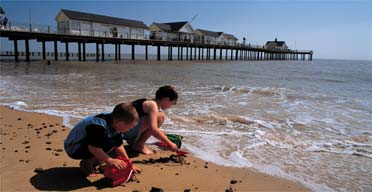
In the manicured public garden adjacent to St Edmund's church in Southwold, Suffolk, I was enjoying a crab sandwich among the "Keep off the Grass" signs when I saw a kid in a baseball cap pull a flower out of the ground. He was about nine years old. I, and half a dozen other adults, looked on appalled. "Did you just pull up that flower?" asked an elderly man in clothes that looked suitable for crown green bowling. "No," said the boy. "But I saw you do it," interjected another man, who was wearing a Panama hat. "No you didn't," said the kid.
Then the elegant woman who was with Panama hat tried a more subtle tack: "If you ever do see anyone do that, will you tell them it's very naughty?". The kid made a noise that grudgingly suggested he might do and cycled off.
In turning to thuggery in Southwold this youth is ploughing a very lonely furrow. Actually, it's almost heroic when you consider that I have never heard a single drunken shout in the town, or seen a pane of cracked glass or any hint of graffiti.
Southwold - known as "Hampstead on sea" - is the most middle-class holiday destination in England. Any noticeboard in the town soon gives the game away. A leaflet promoting an exhibition by the Southwold Quilters ... A flyer for the current play at the Summer Theatre, which is run by Jill Freud, wife of Clement ... Their son-in-law, screenwriter Richard Curtis (the noticeboard reveals) is opening a fete in aid of Niger, while at nearby Blythburgh church a blessing is to be held on Sunday morning for parishioners' pets or livestock ... All of which makes me feel guilty about admitting that Southwold is one of my two favourite resorts, and that I have holidayed there every summer for the past 10 years.
A series of historical accidents have conspired to make it the polar opposite of my other favourite, Blackpool, beginning with the fire of 1659, after which a series of greens were built throughout the town. Designed as firebreaks, their incidental effect was to make Southwold look more like a village - one comprising houses that are either Georgian and grand or amusingly buckled and quaint and likely to house old sea dogs - for which, in 2005, read merchant bankers.
The fishing industry faded in the late 18th century, owing to the silting up of the harbour, leaving behind just enough fishing boats to be picturesque. Another genteel by-product is the Fisherman's Reading Room on Long Island Cliff, where you can sit and read newspapers amid model ships and black-and-white photographs of stroppy looking, but safely dead, Southwold fishermen. The harbour also survives, the silting-up having left sufficient clearance for the merchant bankers' yachts. Some boat building still goes on, and a man who sits in a rowing boat with a dog will ferry you over to equally picturesque Walberswick. But the main activity in the harbour is crab fishing, carried on by children who tend to call their fathers "daddy".
The narrow gauge railway connecting Southwold to London, was closed in 1929, just as the populist era of seaside holidays was really getting underway. So the town became that haunt of aesthetic middle-class motorists from London, a situation that the council seems determined should endure.
The only thing allowed to make a noise after 11pm in Southwold is the sea. The parish magazine is full of lists of cautious, tasteful planning applications, invariably followed by the word "refused". Neon is not allowed, so that the most assertive sign is the grand, wrought-iron swan that hangs outside the 17th-century Swan Hotel and creaks atmospherically in a sea gale. The operators of the town's Electric Picture Palace have joked that only "two candles and a bicycle mudguard reflector" are allowed, although they have been permitted a modest electric sign for their cinema, which is like a 20s Rialto in miniature. A film is shown every night in summer with an interval, during which an organist, complete with organ, rises through a trapdoor on the stage in front of the screen. Space does not permit the storage of wine glasses, so instead sherry is served, or, of course, tea, poured from a pot by the cashier.
The brightest light comes from the lighthouse, which is the maritime equivalent of the cinema in that it is small and perfect to the point of parody. It looks as though it was designed only yesterday, by a stylist, and whether it has saved the lives of many sailors I don't know, but it has performed heroic service in increasing the marketability of Southwold. Unfortunately, its light is about to be dimmed forever but this is balanced by the revival, over the last couple of years, of Southwold's storm-buffeted, frequently truncated pier.
The newly extended structure makes a virtue of white paint and bare wood, worthy of any Crouch End kitchen designer. There are about eight fruit machines of the traditional, raucous sort on the pier. More typical of Southwold are the witty, interactive amusements by the Heath Robinson of Suffolk, Tim Hunkin.
The reconstruction of the pier is pushing up house prices in the north of the town, which is slightly less salubrious than the south. A moderately picturesque three-bedroom house in Southwold will cost at least £400,000. A man who owns one of the better properties told me that prices per square foot in Southwold are higher than those in Notting Hill, and he should know because that's where his first home is located. The second homes often feature a model sailing yacht in the window, or some other Swallows and Amazons sort of artifact proclaiming both "We love the sea" and "We're absolutely loaded, thank you very much".
The yuppies of parvenu Whitstable are forever boasting that beach huts in the town can fetch £30,000, but in Southwold the pastel-shaded huts (photographed, I would say, approximately once a day throughout summer by someone from a colour supplement) have reached £60,000. Given that they lack running water, and that you are not allowed to sleep in them, it could be argued that this is slightly too much, but consider: it could add a £100 a week to the holiday let chargeable on the associated house.
Yes, the colonisation of the town by wealthy Londoners has caused resentment. This summer, I spoke to a female Southwold native who bemoaned the passing of an ordinary dress shop on the high street ("it sold crimplene separates, and that type of thing") and its replacement by a designer dress shop. But, as of this year, second homeowners in the town have had to pay 90% of council tax, which has quelled some of the anti-banker talk.
Southwold is entirely dependent on its wealthy visitors, the only other industry being Adnams brewery, which with its dray horse local deliveries, is a tourist attraction in itself. Its beer is served in each of the town's five mellow pubs, and my Southwold days tend to end in my particular favourite, the Lord Nelson on East Street. There I'll sit, red-nosed after a day on the festive, yet uncluttered beach, feeling relaxed even after childcare (because Southwold is the one place where I'll let my nine- and 11-year-old sons roam free). Alongside me, most likely, will be a banker, receiving a debriefing from his gardener on the state of the rose beds. This troubles my conscience, but the fact is I'd buy a house in Southwold tomorrow if only I had a spare half million.
Way to go
Southwold, Suffolk is approximately two hours north east of central London, off the A12. The nearest railway station is Darsham, nine miles away. Overseas visitors can fly to Norwich International Airport, or Stansted.
· Andrew Martin's novel, The Blackpool Highflyer is published in paperback by Faber and Faber on September 1.
