
Whether it's historic churches, out of the way bistros or good, old-fashioned sun, sea and sand, most holidays are all about the pursuit of pleasure. Pain, discomfort and exhaustion don't normally feature high on our happy-holiday must-have list. Unless you choose to spend your vacation running a marathon, which is what my friend Alan, his brother Robert and I chose to do with our early Easter break.
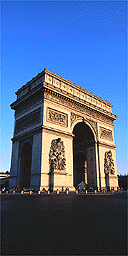
A fortnight ago, the twenty-fifth Paris marathon got under way on a cold and drizzly Sunday morning. Miserable weather for most holidaymakers, but we and our 27,000 fellow runners couldn't have hoped for better conditions for our tortuous tour of Paris. Unlike the London marathon, which shamefacedly unwinds itself around mean little suburban roads, the Paris race is a celebration of the French capital. Starting down the Champs Elysées towards the Place de la Concorde, the Obelisk and the millennium wheel, the route follows the city's broad boulevards to the Bois de Vincennes, meanders back along the Seine, through the shadows of Notre Dame and past the Eiffel Tower before finishing in a glorious burst up Avenue Foch to the Arc de Triomphe.
We arrived the day before the race - having narrowly avoided missing our connection from Waterloo when the train flouted rolling-stock convention and left early, not late. Needless to say, it still managed to arrive behind schedule. We bookedin to a hotel near the Gare du Nord, where the manager was very excited about our participation in ' la grande course'. In French that even we could understand, he urged us to ' Courez vite'.
Having unpacked (our luggage seemed to be made up almost entirely of breathable undergarments, elastic knee supports, plasters and various lubricants), we headed off to find an Italian restaurant where we could load up on pasta - all marathon runners 'carb up' before a big race as the event consumes carbohydrates quicker than seven-year-olds eat Smarties. It was a 'dry' meal as runners have to avoid the dehydrating effects of alcohol and caffeine. This put us in the possibly unique position of being three lads on holiday in a foreign capital, strolling around the streets looking for entertainment... completely sober. I told you marathon running was fun.
We soon headed back to our room to do what all runners do before a race: compare treads on trainers, discuss whether we should run in vests or T-shirts (hilariously, I had written 'Keep up, Alan' on the back of mine) and make puerile jokes about Vaseline. Robert then showed off the talking photobox his wife and kids had given him which shouted 'Go Robert Go!' when you pushed a button, and Alan put the good-luck card his family had made for him on the mantelpiece. I saw my wife's handwriting on a folded note in the bottom of my bag. Discovering it was just an old shopping list, I had to make do with the hotel cleaner's cry of ' Bonne chance' as we left.
Standing beneath the Arc de Triomphe waiting for the starter's pistol, we anxiously ate as many bananas and Jelly Babies as we could stomach. (Alan assured us the glycogen content of the sweets makes them the ideal athletic snack, though none of us could recall seeing Linford Christie downing any before his races.) We soaked up the glorious multicultural camaraderie that every marathon conjures up and tried to ignore the smell of several thousand digestive systems nervously working overtime. Robert told us that we should try to imagine we were fully loaded Jumbos sitting on the runway and that as we flew round the course we'd get lighter and lighter. Alan and I weren't quite sure what he was getting at, and decided to try and mentally visualise ourselves successfully finishing the race instead. We soon stopped when we realised that even imagining a marathon was gruelling.
The first Paris marathon took place in 1896 and was won by an Englishman, Len Hurst, who stopped a few miles before the finish to down a glass of champagne and then crossed the line six minutes ahead of his nearest rival. Who knows, maybe this would be our year. Either way, we felt confident we'd do better than the seven runners who from some misplaced sense of history had chosen to run barefoot.
At 9am, we get under way and all along the route crowds gather to cheer us on. Our ears ring with cries of ' Allez, allez, allez'. We have our names written on our T-shirts and people step out to shout ' Bon courage, Martin ' and ' Bonne chance, Alan'. We feel both heroic and glamorous, something none of us has ever felt before. Bands play, an all-male cheerleading troupe lifts our spirits and a lone piper almost makes me burst into tears. At one point I discard an empty water bottle into the path of a fellow runner. ' Pardon, monsieur,' trips off my tongue. 'That's all right mate,' comes the reply. With six miles to go, we pass a feeding station where they are handing out glasses of red wine. Not sharing the same joie de vivre as our Gallic competitors, we wimp out and go for sickly energy boosters instead.
With only a couple of miles to go, I feel I can't take another step, but a comradely hand on the shoulder and grip on my elbow from a nameless fellow runner keeps me plodding on and somehow seems to sum up the genuine bonhomie that binds all the competitors.
The race's winner is the Kenyan Simon Biwott, who pipped me at the line by a mere 83 minutes. I'd finished in a personal best of 3 hours 32 minutes. Having collected our medals and rewarded ourselves with the first beer in a week, we make our way back to the Gare du Nord and the train home. The race may have lasted only a few hours, but the memories of our marathon weekend will stay with me for a lifetime.
Leaders of the pack... 10 of the most unusual big races on the planet
The oldest: In its 106th year, the Boston Marathon is the father of city races. You must be able to run a 3hr 10 min race to enter.
The most dangerous: You could bump into rhinos, cheetahs and leopards on the Safari Marathon in Kenya. Runners are protected by game wardens patrolling the route.
The easiest: You don't get much flatter than the Dutch city of Rotterdam, but it's not a complete walk-over. Last year running times were marred by a force four wind.
The biggest: About 30,000 runners are taking part in today's 21st London Marathon.
The most scenic: Some 3,700 steps have to be climbed during the The Great Wall Marathon. Part of the run is on the wall itself.
The hardest: Participants in the Marathon des Sables have to cross 150 miles of the Sahara in Morocco, carrying all their food and gear. It takes a week.
The highest: Four of the world's five highest mountains can be seen during the five-day 100-mile Himalayan Stage Race.
The most northerly: The Midnight Sun Marathon is run at night in Tromso, Norway, where the sun doesn't set from May to July.
The newest: The reggae beat might help you pace yourself during the Reggae Marathon, which debuts in Jamaica this December.
The lowest: Runners descend 1,300 metres to the lowest point on earth during the Dead Sea Marathon in Jordan.
Holidays on the run
Travel companies have responded to the increasing popularity of marathon running by organising race packages. Here are some sample deals from Leisure Pursuits, which specialises in marathon, cycling and triathlon packages (0800 018 6101):
Prague Marathon (20 May) includes race entry, flights, one-way transfer, three nights at city centre hotel, with breakfast, from £445 per person, twin share
Chicago Marathon (7 Oct) package includes three nights' accommodation in four-star hotel, flights with Virgin Atlantic, airport transfers and guaranteed race entries, from £884 twin-share
Reggae Marathon, Jamaica (8 Dec): from £1,032 for seven nights twin-share, flights, transfers and race.
